



A New Signal of Mazda’s EV Commitment
A recently spotted development vehicle in Southern California suggests that Mazda is finally accelerating its long-delayed push into the U.S. electric vehicle market. The prototype, photographed near the company’s R&D center in Irvine and first reported by Automotive News, represents Mazda’s first EV engineered specifically for American buyers. If it reaches production on schedule, the new model could fill a major gap in Mazda’s lineup, which currently lacks any fully electric offerings in the United States.

What the Prototype Reveals
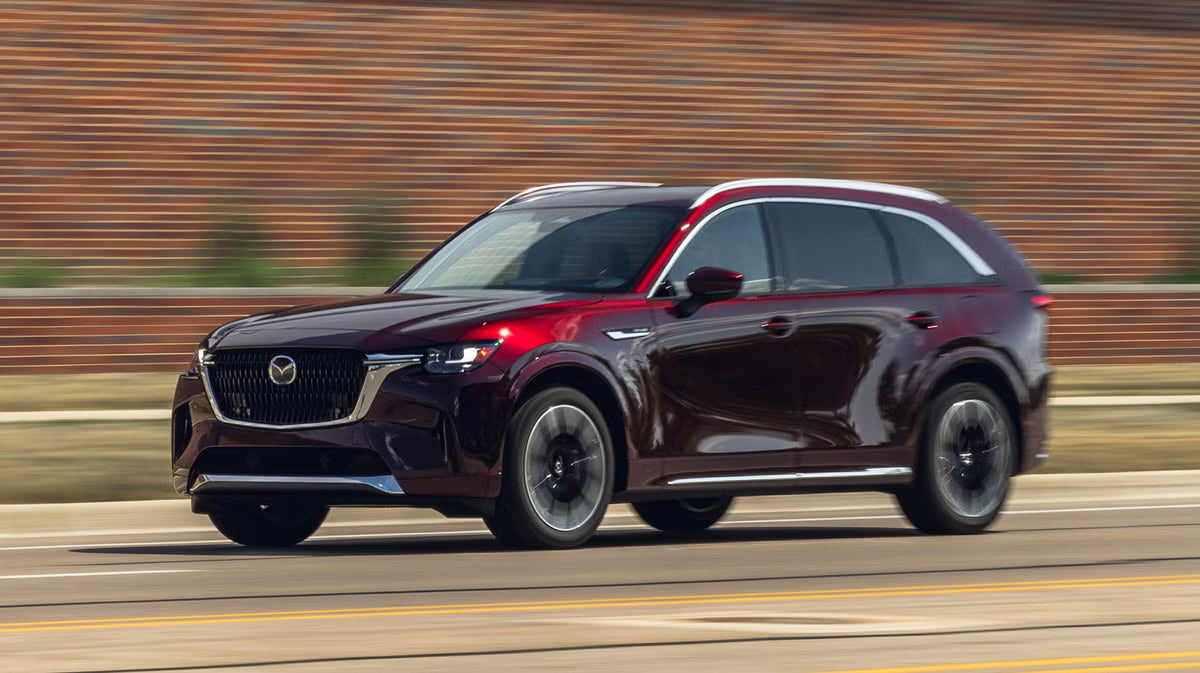
The test mule wears a heavily altered Mazda CX-90 body, though the rear section appears borrowed from the smaller CX-60. Its unusual proportions—including narrow wheel placement and inconsistent body lengths—indicate this is an early-stage engineering mule rather than a near-production vehicle. These types of prototypes often disguise new platforms under mismatched bodies as engineers evaluate packaging, cooling, and chassis behavior.
One clear indicator that the model is electric is the closed-off upper grille, which mimics the CX-90’s design but blocks airflow entirely. Only a small lower opening remains for necessary cooling. Such grille designs are typical of EVs that do not require extensive front-end ventilation.
Mazda’s Next-Generation EV Platform
Beneath the temporary bodywork is likely Mazda’s upcoming dedicated EV architecture, known as Skyactiv EV Scalable Architecture. This platform is designed to support a wide range of vehicle shapes and sizes, from compact crossovers to taller SUVs. Mazda has emphasized affordability as a key development goal, which suggests the platform may rely on a more conventional 400-volt electrical system rather than a costlier 800-volt design.
While Mazda declined to comment on the prototype’s details, the company has confirmed that the first production vehicle built on this architecture will be an SUV or crossover manufactured at a new factory currently under construction in Japan. That model is expected to debut around 2027. Given the timing and the mule’s location in the U.S., this prototype may be the early foundation of a separate EV intended specifically for the American market.
Mazda’s Quiet EV Strategy So Far
Mazda has kept its long-term EV plans relatively secretive. Officials have shared only that future models built on the dedicated platform will offer “advanced design, superior convenience, and extended driving ranges.” This silence reflects Mazda’s cautious approach: the brand has historically been slower than competitors in committing to widespread electrification.
The company’s first U.S. EV, the MX-30, launched with limited range and struggled to attract buyers. After only two years on the market, Mazda ended its U.S. sales, leaving the brand with no all-electric presence in America.

Lessons From Overseas Partnerships
Mazda’s partnership with China’s Changan has produced more competitive results. The jointly developed 6e (sold in some markets as the EZ-6) has earned positive feedback for its driving dynamics and design quality—outperforming the MX-30 in both areas. A crossover version, the EZ-60, is also on the way and is expected to adopt a different name for Europe. These models offer clues as to what Mazda’s future global EV lineup could look like and may indirectly influence its U.S.-specific designs.
Looking Toward a More Electric Future
Mazda aims to electrify a significant portion of its lineup by the end of the decade, with a target of EVs accounting for roughly 25% of global sales by 2030. The newly spotted American-market prototype signals that Mazda is now taking concrete steps toward that goal. While production is still years away, the development activity suggests a shift from hesitation to genuine commitment—an important move as the U.S. EV market grows increasingly competitive.
Recommend Reading: Mazda Patent Sparks Fears of Electric MX-5 Replacing Iconic Roadster


Partager:
Sodium-Ion Batteries Reach U.S. Grid Storage, But Big Challenges Remain
New Pricing Confirms Rivian-Backed Also’s TM-B E-Bike Starts at $3,500