



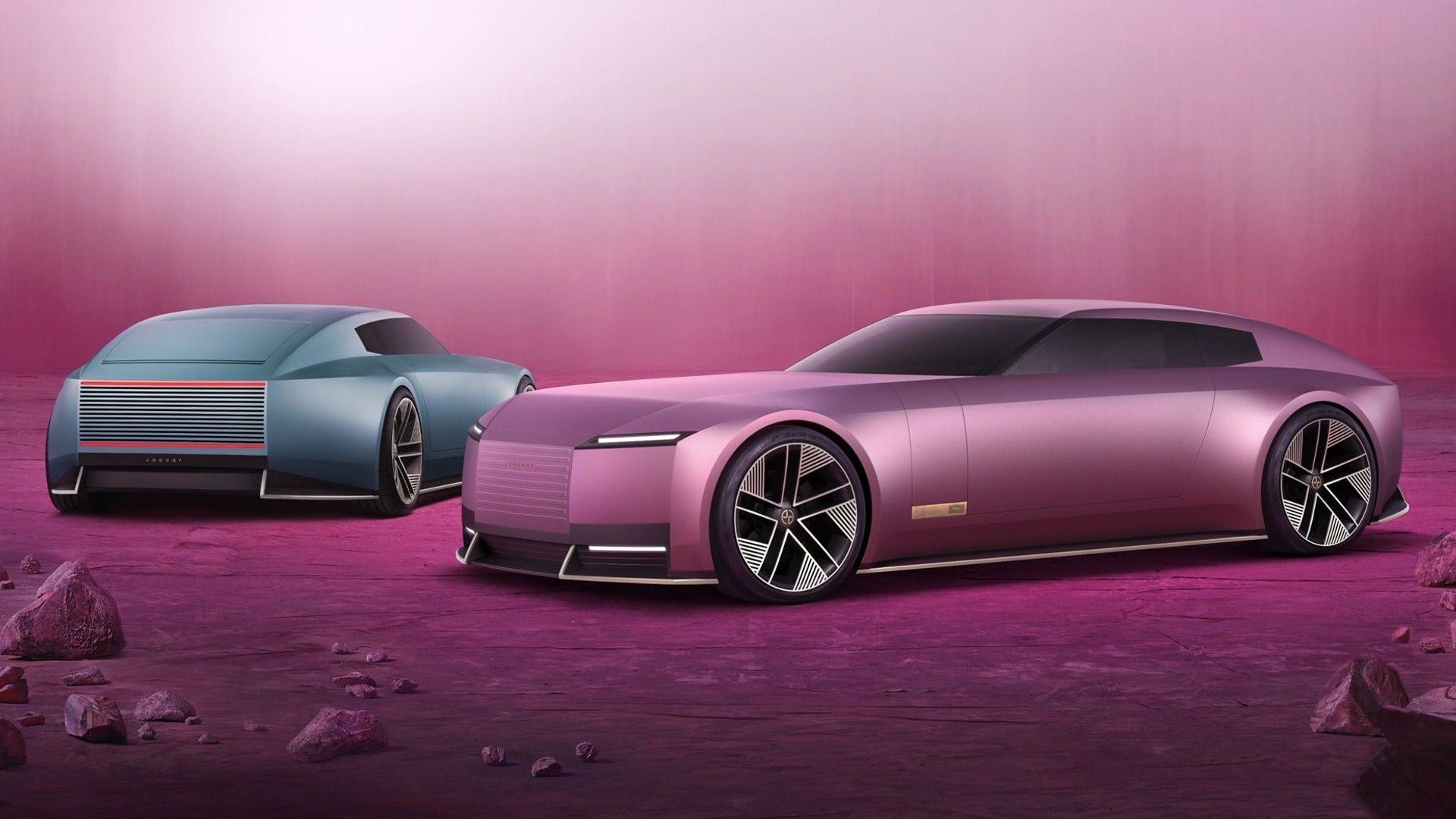
Jaguar is fully aware that its latest reinvention has startled longtime fans, industry analysts, and investors alike. Yet despite criticism, leadership changes, and a cooling global appetite for premium EVs, the British marque is pressing ahead with its plan to relaunch as an all-electric luxury brand—and it has no intention of reversing course.
For Jaguar, this transformation is not a tentative experiment. It is a decisive bet on design, desirability, and long-term relevance in a market that is still finding its footing.

A Brand Reset That Left No Middle Ground
Jaguar’s current position is the result of a deliberate and dramatic reset. After years of declining sales and an unsuccessful attempt to compete directly with German luxury brands on volume and model variety, the company chose to abandon that strategy entirely.
All existing Jaguar models were canceled, and the brand committed to returning as a smaller, more exclusive manufacturer focused solely on premium electric vehicles. This was not a gradual evolution, but a clean break—one that left Jaguar with no fallback portfolio of gasoline or hybrid models.
The move coincided with turbulence inside the company, including high-profile leadership departures, cybersecurity disruptions that halted operations for weeks, and public backlash over its new design language and brand identity. Together, these challenges amplified scrutiny of Jaguar’s electric-only ambitions.
Why Jaguar Refuses to Keep Gasoline as a Safety Net
At a time when many automakers are quietly extending the lifespan of internal combustion engines, Jaguar is choosing the opposite path. According to managing director Rawdon Glover, maintaining gasoline or hybrid options would undermine the company’s core objective.
Jaguar does not want a strategy dependent on regulation or bans, but one based on customers actively choosing its products. From the company’s perspective, a long-term vehicle architecture must be designed around where the market will be—not where it happens to be today.
Jaguar’s next-generation platform is expected to debut in 2027 and remain in production for roughly eight years. That timeline extends well into the 2030s, a period when infrastructure, charging access, and consumer attitudes toward EVs are likely to look very different from today.

A Calculated Risk With No Easy Exit
Unlike rivals that can hedge their bets across multiple powertrains, Jaguar has already committed billions of dollars to its electric transformation. Reversing course now would be technically possible—but financially and operationally prohibitive.
The company’s past attempts at reinvention offer little comfort. In the 2010s, Jaguar launched a broad lineup of sedans, crossovers, and sports cars designed to boost volume, yet profitability largely rested with Land Rover. Even a heavily funded electric XJ program was abandoned late in development, leaving Jaguar without a modern flagship.
As a result, this electric reboot represents Jaguar’s last major strategic roll of the dice. There is no parallel combustion lineup to lean on if demand fails to materialize.
Introducing Jaguar’s New Electric Flagship
The first model built on Jaguar’s new electric platform will not chase mainstream trends. Internally known as the X900, the vehicle is positioned as a halo product rather than a volume seller.
Planned specifications include approximately 1,000 horsepower, a targeted range of around 400 miles, and a long-wheelbase grand touring sedan profile. With an expected starting price near $120,000, it is designed to sit firmly in the upper tier of the luxury market.
This choice reflects a strategic belief that Jaguar must rebuild its identity from the top down, emphasizing emotion, craftsmanship, and distinction rather than practicality or mass appeal.

Design as the Core Differentiator
Jaguar’s leadership believes that many modern electric vehicles suffer from visual sameness. Cab-forward proportions, tall ride heights, and efficiency-driven shapes may optimize packaging, but they rarely inspire passion.
Jaguar wants its next-generation EVs to provoke an emotional response first, with electrification serving as a supporting technology rather than the main selling point. The company aims to reintroduce drama into EV design through bold proportions, distinctive surfaces, and interiors that emphasize calm, luxury, and individuality.
From Jaguar’s perspective, desire—not drivetrain—is what ultimately convinces buyers in the premium segment.
What Buyers Really Care About, According to Jaguar
Internal research and third-party studies cited by Jaguar suggest that exterior design and emotional appeal account for more than half of a customer’s purchase decision. Interior atmosphere, materials, and comfort rank close behind.
Powertrain choice, by comparison, plays a much smaller role for most buyers. Jaguar interprets this as validation that its EV strategy should focus on aesthetics and experience first, with battery technology enabling those qualities rather than defining them.
In this framework, electrification is not the headline—it is the foundation.
Development Progress and Timeline
Jaguar states that the design of its first electric sedan is fully locked. More than 150 prototypes have already been built and are undergoing durability and validation testing across a range of climates and conditions.
The company expects to begin accepting customer deposits in the summer of 2027, with initial deliveries targeted for the end of that year. However, leadership has emphasized that timing will ultimately depend on quality benchmarks rather than fixed deadlines.
The car will launch only when Jaguar is confident it meets its standards, even if that means delaying production.

Leading the Market, Not Waiting for It
While some competitors are slowing EV rollouts in response to political and economic uncertainty, Jaguar believes waiting for perfect conditions is a mistake. Instead, the brand intends to shape demand by offering a product that stands apart from existing luxury EVs.
Jaguar’s goal is not to convince every buyer—but to reestablish itself as a maker of cars people want on an emotional level. Whether that approach translates into commercial success remains uncertain, but the company is betting that clarity of vision matters more than flexibility.
As Jaguar approaches its 100th anniversary, this electric transformation may define its future—or bring its long, storied history to a close.
Recommend Reading: Mercedes Introduces Long-Range CLA EV With Competitive U.S. Pricing


Partager:
Ford Scales Back EV Ambitions at a Cost of Nearly $20 Billion
Jaguar’s New Electric Flagship Drives Better Than Expected
2 commentaires
Jags still have electrical problems! I used to own an XJ6 for ten years back in 1990s and it had major electrical problems. Lucas electronics that was used in the car was nicknamed the “prince of darkness” and when Ford bought the company it fixed a lot electrical problems. Jaguar has not figured out that making a reliable car is key to any long term survival. Jaguar needs to run by an engineer rather than a bunch of looser con-artist business folk.
I have a Jaguar, an F-Type. It’s a nice car when it runs. What is wrong with it. Not the Engine, not the ZF8 transmission. Not mechanical stuff.
But every electrical part is unreliable. It has at least 8 different ECU processors. And when; not if; they go out. They have to be connected to the Jaguar cloud “TOPIX” to get recoded. NOT Cheap. The ignition system is know for failed and frozen fuel injectors. A few minor design changes would have fixed most of this. Jaguar should be the last company to depend electronics. And it is obvious now in 2025 that electric cars are not that great.