



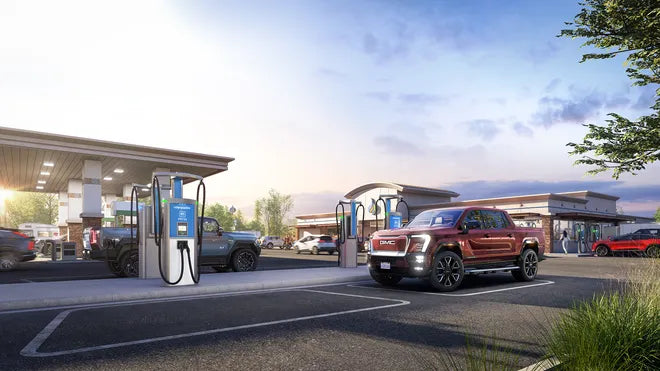
China Leads the Charge in Ultra-Fast EV Charging
China continues to dominate the global EV landscape, and that includes charging infrastructure. Several Chinese automakers now sell vehicles capable of 1-megawatt (1,000 kW) charging speeds. Combined with compatible public stations, drivers can recharge in as little as five minutes—roughly the same time it takes to fill up a gas tank.
Europe isn’t far behind. Many European charging networks already offer 350–420 kW chargers, though only a few cars can reach those speeds. Now, the United States is set to join the ultra-fast race, but the move might be ahead of its time.

600 kW Chargers Arrive in the U.S. Next Year
According to USA Today, ChargePoint will roll out 600 kW DC fast chargers in America beginning in 2026, partnering with electronics giant Eaton to launch the next generation of high-power charging.
The new hardware promises some impressive upgrades:
-
30% lower installation costs
-
30% smaller footprint
-
30% lower operating expenses
On paper, these chargers could top up an EV battery in about 10 minutes. The only problem? No EV currently on sale in the U.S. can handle that much power.
No EVs Yet Capable of 600 kW Charging
At present, the most powerful U.S. chargers—like those from Gravity—peak at 500 kW. Only a handful of EVs can even exceed 350 kW charging speeds. The Lucid Gravity leads with 400 kW capability, soon to be joined by the BMW iX3 and Porsche Cayenne EV.
But 600 kW compatibility remains years away. Neither American nor European automakers have announced plans for models that can accept that level of charging power. Unless tariffs on Chinese EVs are lifted, opening the door for faster-charging imports, these new chargers will likely be underused for now.
Why Voltage Matters More Than Power
Charging speed isn’t just about kilowatts—it’s about voltage architecture.
Most U.S. EVs, including Teslas and the Volvo EX90, use 400-volt systems, which max out around 250 kW. Higher-speed charging requires 800 volts or more, which allows the same energy transfer with less current.
Cars like the Porsche Macan EV, Hyundai Ioniq 6, and Kia EV6 use 800-volt setups, but even they top out at about 240–270 kW in real-world conditions. The Lucid Gravity’s 926-volt system offers more headroom for future upgrades, potentially enabling it to use 600 kW chargers later—but not today.
So while 600 kW infrastructure is technically “future-proof,” the vehicles to take advantage of it simply don’t exist yet.
Overkill or Smart Investment?
There’s a case to be made for installing more powerful chargers than current EVs require. Doing so ensures stations remain relevant as technology improves. However, at present, the jump from 350 kW to 600 kW offers little practical benefit for most drivers.
Even the fastest-charging U.S. EVs—like the Lucid Gravity and BMW iX3—take 20 to 25 minutes to charge from 10% to 80%. That’s already quick enough for long-distance travel, especially with growing fast-charging coverage nationwide.
As one analyst put it, “You can build a megawatt charger today, but without megawatt cars, it’s just an expensive power box.”

The Bottom Line
Ultra-fast 600 kW chargers are coming, but most EVs can’t use their full potential yet. The rollout reflects the industry’s push to prepare for next-generation vehicles, even if the hardware seems a bit ahead of the curve.
In short, the technology is impressive—but for now, 10-minute EV charging in America might be more hype than necessity.
Recommend Reading: Tesla’s 500 kW V4 Superchargers Could Redefine EV Charging in America

Partager:
GM’s Record EV Sales Come With a $1.6 Billion Cost
Americans Grow More Receptive to Chinese Cars