


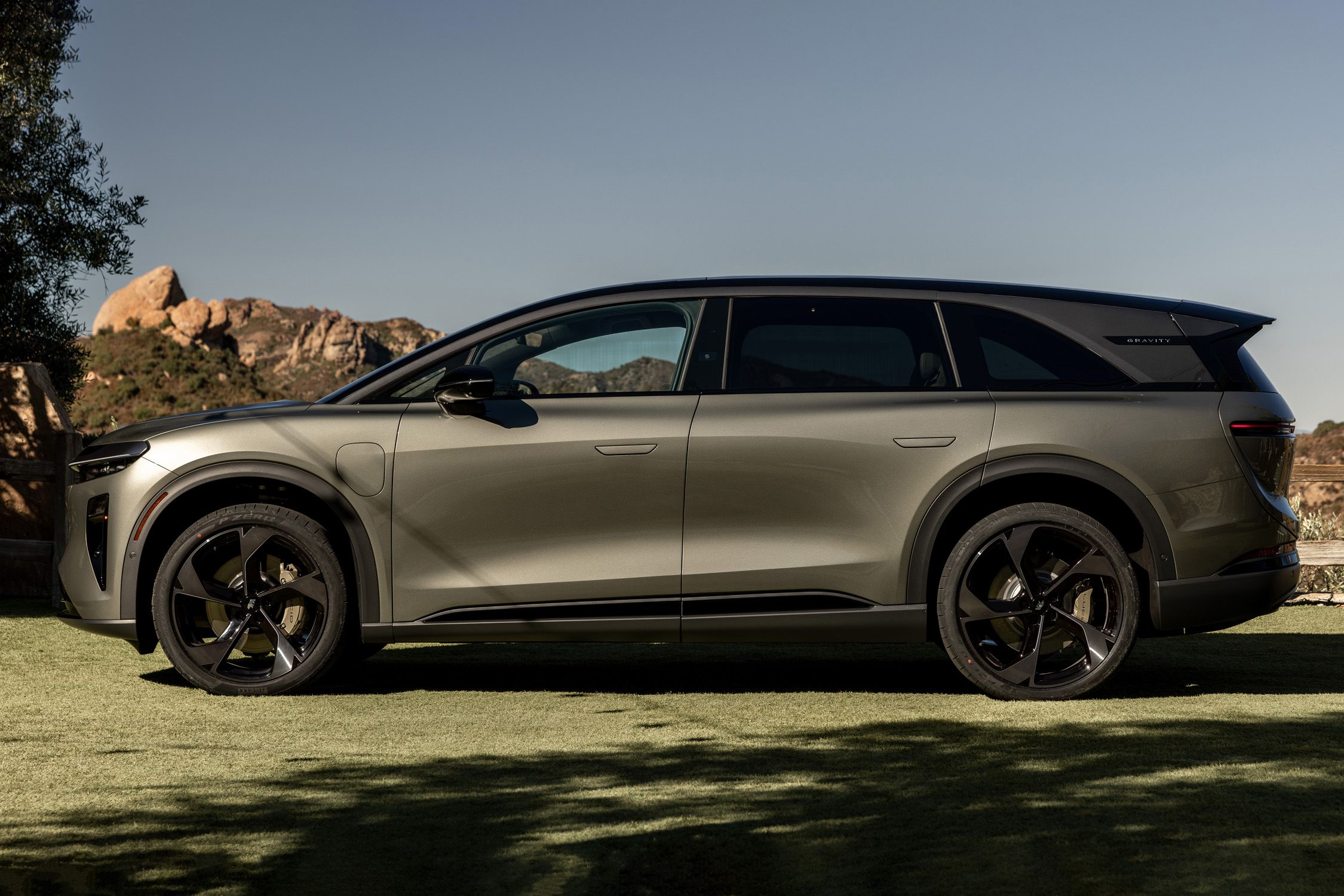
Lucid built its reputation on delivering electric vehicles with exceptional efficiency, long-distance capability, and advanced in-house engineering. Its first model, the Air, set new benchmarks for range in the EV market. Naturally, expectations for its second vehicle—the Gravity SUV—were sky-high. While early real-world tests left many observers puzzled, a recent retest has offered a much clearer picture of what the Gravity can truly deliver.

Lucid Gravity SUV


Gravity’s Range Promise and Early Disappointment

Lucid positioned the Gravity Grand Touring as a long-range electric SUV capable of up to 450 miles, according to EPA estimates. That figure comes from an aerodynamic body, Lucid’s proprietary electric motors, and a massive 123-kWh battery pack. Priced at just over $96,000, the Gravity aims for the upper tier of the premium EV segment.

Yet early independent testing didn’t go as planned. In an initial highway test conducted at a steady 70 mph, reviewer Tom Moloughney recorded just 345 miles—well below both the EPA rating and Lucid’s typical real-world performance. The efficiency number, 3.0 mi/kWh, was roughly 20% lower than the SUV’s EPA cycle results. Since EPA testing blends city and highway driving, some discrepancy is normal, but this drop was significant enough to raise eyebrows.

Lucid shared those concerns. After evaluating the test vehicle, the company discovered a mechanical issue in the rear drive unit, prompting a full motor replacement. With the SUV repaired, Moloughney agreed to conduct a fair, controlled retest.


A Dramatic Turnaround in the Second Test

Under similar conditions—but with a properly functioning drive unit—the Gravity delivered a dramatically different outcome. In the second test, Moloughney achieved 401.3 miles on a full battery, using 99.8% of its charge. That marked a 16% improvement over the first attempt and brought efficiency up to 3.43 mi/kWh, much closer to the 3.6 mi/kWh seen on the EPA cycle.

This result falls in line with expectations for a highway-only test, where EVs typically perform at their worst compared to blended city/highway cycles. While still shy of its 450-mile EPA rating, a 400-mile highway range is a strong result for a family-sized electric SUV.

Another observation from the retest stood out: the Gravity appeared unusually sensitive to temperature changes. Even a 20–30°F shift during the day in Arizona resulted in a 6% gain in efficiency. The first test, conducted in colder New Jersey conditions, suggests that ambient temperature may influence the Gravity more than many competing EVs.


Comparisons With Other Independent Tests

Moloughney’s highway drive was not the only recent range test of the Gravity. Another independent test reported 358 miles, aligning more closely with typical real-world highway expectations and hinting that the SUV’s actual range may sit in the 360–400-mile band, depending on driver behavior and conditions.

These variations underline the complexity of EV testing. Terrain, temperature, and driving style can all create significant swings in final results. Still, the consistency of results above 350 miles indicates that the Gravity has substantial long-distance capability.

Uber Turns to Lucid Gravity for Its Next Wave of Autonomous Ride Services


What the New Results Mean for Lucid

Lucid designed the Gravity to serve as a luxury, long-range alternative in the rapidly expanding electric SUV category. While the first test raised concerns about whether the SUV could meet its ambitious claims, the retest shows the vehicle is far closer to expectations when operating as intended.

Delivering over 400 miles at highway speeds places the Gravity among the most capable long-range EV SUVs on the market today. It still trails Lucid’s Air Grand Touring, which remains the king of ultra-long-range EVs, but the Gravity’s performance is more than adequate for long trips, daily commuting, and real-world family use.

The retest also highlights the importance of correct calibration and mechanical condition in evaluating EV performance. With its engineering foundations validated, the Gravity appears far better positioned to meet the expectations set by its EPA rating and Lucid’s reputation for efficiency.

Recommend Reading: Uber Turns to Lucid Gravity for Its Next Wave of Autonomous Ride Services

Laissez un commentaire

Veuillez noter que les commentaires doivent être approuvés avant d'être publiés.

Ce site est protégé par hCaptcha, et la Politique de confidentialité et les Conditions de service de hCaptcha s’appliquent.

FAQ

Quelle est l'autonomie réelle du Lucid Air ?

La Lucid Air offre la meilleure autonomie de sa catégorie, estimée par l'EPA, jusqu'à 830 km selon le modèle. La version Grand Touring est la plus performante, idéale pour les longs trajets en véhicule électrique.

Combien de temps faut-il pour charger un Lucid Air ?

Grâce à un chargeur rapide CC, la Lucid Air peut parcourir jusqu'à 320 km d'autonomie en 15 minutes environ. Une charge complète à domicile de niveau 2 prend généralement de 9 à 12 heures, selon l'ampérage.

Le Lucid Air prend-il en charge les superchargeurs Tesla ?

Actuellement, les véhicules Lucid utilisent la norme de recharge CCS et ne sont pas nativement compatibles avec les Superchargeurs Tesla, sauf si un adaptateur est fourni. Cependant, l'adoption de la norme NACS pourrait changer la donne.

Quel est le prix d'un Lucid Air ?

En 2025, le prix de la Lucid Air démarre à environ 69 900 $ pour l'Air Pure et peut dépasser 139 000 $ pour les versions Grand Touring ou Sapphire. Les prix varient selon la finition, la capacité de la batterie et les options.

Lucid Motors est-elle une marque fiable ?

Lucid Motors s'est positionnée comme une marque de véhicules électriques haut de gamme, offrant des performances exceptionnelles, des matériaux de luxe et une technologie de pointe. Bien qu'encore relativement récente, la marque a reçu des retours clients globalement positifs, même si l'offre de services continue de s'élargir.

Où sont fabriqués les véhicules Lucid ?

Lucid Motors fabrique ses véhicules à Casa Grande, en Arizona, dans son usine ultramoderne AMP-1, la première usine de véhicules électriques entièrement nouvelle construite en Amérique du Nord.

Lucid propose-t-il un plan de location ou de financement ?

Oui, Lucid Financial Services, exploité en partenariat avec Bank of America, propose des options de location et de financement. Cependant, certains clients ont exprimé des inquiétudes concernant les frais de fin de bail ; il est donc important de bien examiner les conditions du contrat.

Quelles sont les principales différences entre Lucid Air Pure, Touring et Grand Touring ?
  • Air Pure : Entrée de gamme avec RWD ou AWD, et luxe minimaliste
  • Air Touring : Des performances de milieu de gamme avec plus de fonctionnalités et une transmission intégrale de série
  • Air Grand Touring : autonomie premium, puissance et fonctionnalités de luxe avec plus de 500 miles d'autonomie
Comment DreamDrive de Lucid se compare-t-il au pilote automatique Tesla ?

Le DreamDrive de Lucid offre des fonctions avancées d'aide à la conduite, notamment le régulateur de vitesse adaptatif, le maintien dans la voie et l'assistance sur autoroute. Bien qu'il ne soit pas entièrement autonome, il rivalise fortement avec l'Autopilot de Tesla et le Super Cruise de GM.

Existe-t-il une application Lucid pour contrôler la voiture à distance ?

Oui, Lucid propose une application mobile pour iOS et Android qui permet la surveillance à distance du véhicule, le contrôle de la charge, le préconditionnement et le suivi de localisation en temps réel.

Vous n'avez pas trouvé votre réponse ?

N'hésitez pas à nous contacter

Actualités sur les véhicules électriques

Tout afficher

Volkswagen Issues ID.4 Battery Recall as Fire Risk Prompts New Charging Guidance

Volkswagen Issues ID.4 Battery Recall as Fire Risk Prompts New Charging Guidance

Volkswagen has issued multiple recalls for ID.4 electric SUVs over battery overheating risks. While only a small group faces parking and charging limits, over 45,000 vehicles are affected by inspections and software fixes.

Plus

Volvo CEO Says the U.S. Is Built for EVs—and the Logic Is Hard to Ignore

Volvo CEO Says the U.S. Is Built for EVs—and the Logic Is Hard to Ignore

Volvo’s CEO argues the U.S. is uniquely suited for EV adoption thanks to widespread home charging access, suburban living, and consumer-driven demand—if automakers better address education and equipment barriers.

Plus

Most Scout Buyers Prefer Range-Extended Power Over Fully Electric Trucks

Most Scout Buyers Prefer Range-Extended Power Over Fully Electric Trucks

Scout Motors reports that 85% of reservations for its Terra pickup and Traveler SUV favor extended-range electric powertrains, as buyers prioritize long range and flexibility over fully electric options.

Plus