





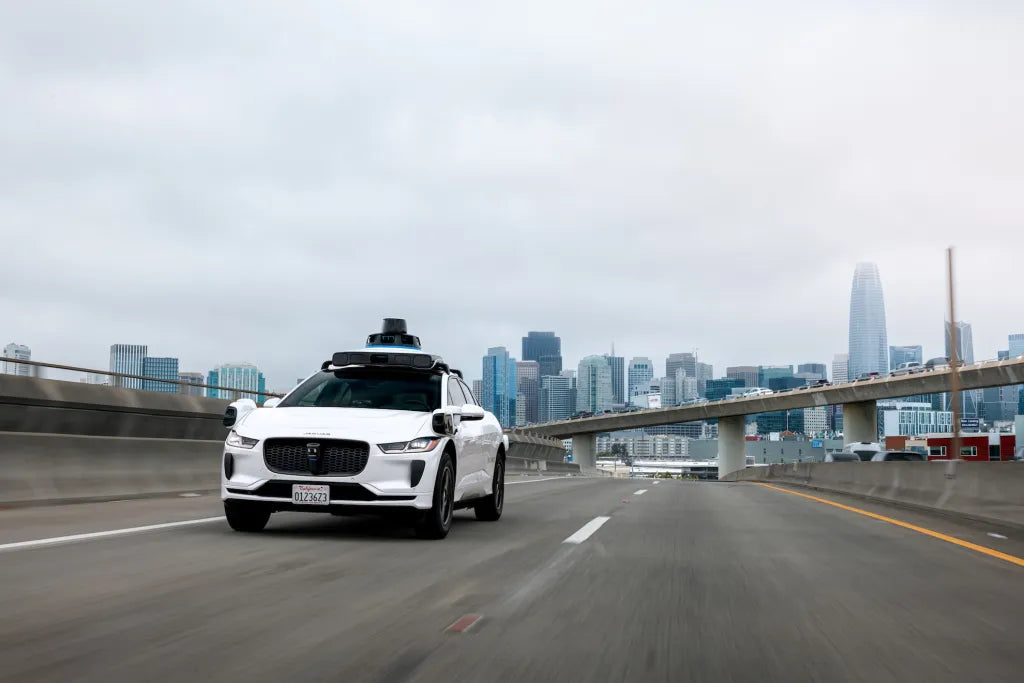
A New Phase for Waymo’s Self-Driving System
Waymo has introduced the sixth generation of its autonomous driving platform, marking a major shift in how the company plans to deploy driverless vehicles at scale. Unlike earlier iterations that were limited primarily to the Jaguar I-Pace, the updated system is designed to be more affordable, easier to manufacture in large volumes, and adaptable across multiple vehicle models.
The first production vehicle to carry the new setup will be an electric minivan built by Zeekr, known internally as the Ojai. Employee-only rides in Los Angeles and San Francisco are scheduled to begin soon, with broader public access expected to follow. In parallel, Waymo is preparing to integrate the same hardware into the Hyundai Ioniq 5, expanding its multi-vehicle strategy.

Built for Scale and Cost Efficiency
A central goal of the redesign was to support high-volume output. Waymo says the new hardware was engineered from the start for mass production, allowing the system to be installed in different vehicle platforms without extensive reengineering.
To support this expansion, the company is enlarging its manufacturing operations in the Metro Phoenix area. The facility is being prepared to assemble tens of thousands of hardware kits annually. As production increases, per-unit costs are expected to decline, strengthening Waymo’s position in the increasingly competitive robotaxi sector.
The company currently operates roughly 1,500 autonomous vehicles, but plans to expand that number to about 3,500 this year, with a long-term ambition of deploying tens of thousands across multiple cities. It also intends to launch service in 20 additional urban areas within the year.
A Multi-Sensor Strategy
Waymo continues to rely on a layered sensor configuration rather than a camera-only system. The sixth-generation platform integrates high-resolution cameras, lidar units, radar modules, and external audio sensors, creating full situational awareness around the vehicle.
This approach contrasts with companies that emphasize vision-only solutions. By combining complementary sensing technologies, Waymo aims to provide redundancy and maintain functionality under varied road and weather conditions.
Importantly, many of the components were developed internally. The company states that the hardware has been optimized for durability and reliability, including improved performance during rain, snow, and low-visibility scenarios.
Cameras: Fewer Units, Higher Performance
The latest system uses 16 cameras, each rated at 17 megapixels, replacing the previous setup that relied on 29 cameras. Although the total number of units has been reduced, Waymo reports significant improvements in image quality and dynamic range.
Enhanced low-light capability allows the system to interpret nighttime scenes more effectively. According to the company, the cameras collect vast quantities of visual information, enabling detailed environmental modeling.
To prevent weather-related interference, most optical sensors are equipped with cleaning mechanisms designed to remove snow or debris automatically. This addition is intended to ensure consistent performance in colder climates.
Lidar, Radar, and Audio Detection
Short-range lidar modules are included to help detect pedestrians, cyclists, and other vulnerable road users with centimeter-level precision. These sensors contribute detailed spatial mapping that complements the camera data.
Radar units, selected in part for cost efficiency, provide additional object detection and distance measurement. Radar is particularly useful in poor visibility, where optical systems may struggle.
Another notable component is an upgraded external audio recognition system. These sensors can identify approaching emergency vehicles or trains by analyzing sound patterns, allowing the vehicle to respond appropriately even before visual confirmation.

Transitioning From Testing to Commercial Deployment
Until now, Waymo has operated Zeekr and Hyundai test vehicles on public streets with safety drivers present. The move toward employee-only fully autonomous service signals a transition from testing to commercial readiness.
With broader public access planned and vehicle diversity increasing, Waymo is positioning itself to maintain leadership in the U.S. robotaxi market. By focusing on cost reduction, scalable manufacturing, and sensor redundancy, the company is attempting to balance safety with rapid growth.
As competition intensifies, the success of this sixth-generation platform may determine how quickly autonomous ride-hailing becomes commonplace in major cities.
Recommend Reading: Waymo Introduces the Ojai Robotaxi as Fleet Expansion Accelerates









Partager:
Rivian Plans 20,000–25,000 R2 Deliveries in 2026
Will China Restrict Yoke Steering Wheels by 2027?