



Draft Rule Signals Shift in Interior Safety Policy
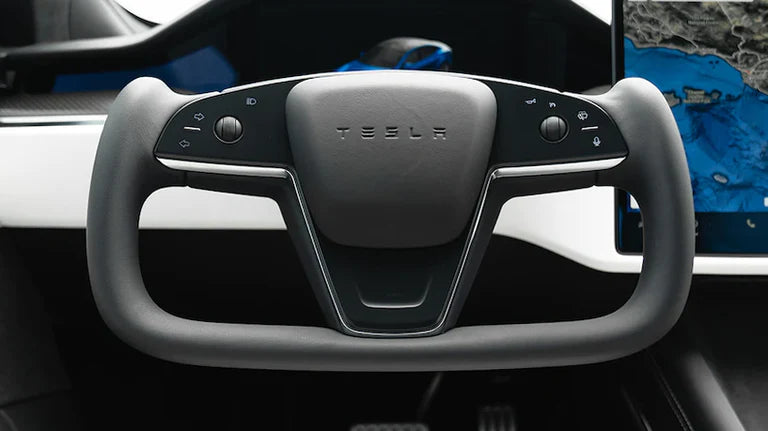
China’s auto regulator has issued a proposed safety requirement that could make yoke-style steering controls difficult to approve for passenger vehicles. The draft, released by the Ministry of Industry and Information Technology (MIIT), introduces new testing criteria that assume a traditional circular steering wheel design.
Under the proposal, impact forces must be evaluated at both the upper and lower sections of the steering rim during certification. Because a yoke eliminates the top portion of the wheel, it would struggle to meet those validation conditions. If adopted as written, the standard would take effect in 2027, potentially reshaping cockpit design across the market.

Airbag Performance at the Center of the Debate
Regulators argue that a continuous steering rim better supports occupant protection when the driver airbag deploys. In a conventional layout, the airbag expands outward from the center hub and is guided by the surrounding wheel structure.
By contrast, a yoke leaves an open gap at the top. According to material referenced in the regulatory filing, this configuration could allow the inflating airbag to shift downward rather than cushioning the driver’s head and upper torso as intended. In severe collisions, that misalignment might increase the risk of contact with the steering column or dashboard.
Another concern cited involves the airbag cover. Authorities highlighted the possibility of uneven breakage during deployment, which could create loose fragments. Simulation images accompanying the draft reportedly compare head-impact outcomes between round wheels and flattened designs, with the former demonstrating more stable protection.
MIIT’s internal data suggests that 46% of driver injuries in crashes are linked to the steering wheel and column assembly. That statistic appears to have played a role in prompting tighter evaluation standards.
Certification Challenges for Yoke Designs
Although the draft does not explicitly ban yokes, it effectively raises the bar for approval. Automakers would need to prove compliance with testing procedures tailored to a full circular rim. Meeting those benchmarks could require significant redesign or additional engineering work.
China has become one of the most active markets experimenting with unconventional cabin layouts. Several domestic electric vehicle brands have adopted flattened or aircraft-inspired steering controls as part of a futuristic aesthetic. The proposed rule suggests regulators are now scrutinizing those styling choices more closely.
This approach aligns with a broader regulatory pattern. Authorities have recently moved to curb features considered visually distinctive but potentially problematic in emergencies, such as flush-mounted door handles that may hinder rapid access after a crash.
Real-World Usability Questions
Beyond crash performance, yoke steering has sparked debate over everyday handling. Without a complete rim, drivers cannot easily perform traditional hand-over-hand movements during tight maneuvers. Parking or navigating sharp turns may require larger steering inputs, which some motorists find awkward.
The issue is particularly noticeable in vehicles that rely on conventional mechanical steering systems. Tesla’s Model S and Model X, which introduced a yoke option without fully eliminating steering ratios that require multiple turns, received mixed feedback from customers who reported difficulty during low-speed maneuvers.
Manufacturers that combine yoke designs with steer-by-wire technology have attempted to address this limitation. By electronically adjusting steering response, such systems can reduce the amount of rotation needed from lock to lock. Lexus, for example, pairs its yoke-style control with steer-by-wire in the RZ, aiming to deliver smoother operation. The company has stated that the compact shape enhances forward visibility and frees up legroom, potentially improving cabin comfort.
A Broader Push for Risk Reduction
China’s regulatory environment has grown more cautious as advanced vehicle technologies proliferate. The scrutiny of steering controls coincides with parallel efforts to manage other emerging risks, particularly those associated with electric vehicles.
Battery fire mitigation remains a key area of focus. Authorities and manufacturers are exploring a range of solutions, from improved thermal management systems to more experimental containment strategies. The overarching objective is to reduce injury and property damage as EV adoption accelerates.
Within that context, steering wheel design may seem minor. However, because the steering assembly is directly between the driver and the airbag module, regulators appear unwilling to tolerate ambiguity in safety validation.

Industry Implications Ahead of 2027
If the proposal becomes law in its current form, automakers operating in China may need to reconsider yoke-style offerings. Companies that have invested in distinctive cockpit layouts could face additional development costs or choose to revert to traditional designs for regulatory simplicity.
Given China’s scale as the world’s largest automotive market, such a shift could influence global product planning. Even brands based outside China may adjust their design strategies to maintain compliance in one of their most important regions.
For now, the draft remains under review. Yet its direction signals that when styling trends intersect with occupant protection, regulators are prepared to prioritize standardized safety benchmarks over design experimentation.
Recommend Reading: China Moves to Ban Flush Door Handles Over Safety Concerns

Partager:
How Waymo’s New Robotaxi Hardware Powers Zeekr and Hyundai EVs