


Grocery Stores Become a New Charging Destination
Kroger is taking a significant step into the electric mobility ecosystem by expanding EV fast charging across its U.S. grocery locations. Through a long-term partnership with charging network operator EVgo, the supermarket giant plans to deploy thousands of DC fast-charging stalls over the next decade, transforming everyday shopping trips into convenient charging opportunities for EV drivers.
The initiative reflects a broader trend in the EV infrastructure space: placing chargers where people already spend time. Grocery stores, with predictable dwell times and nationwide footprints, are increasingly seen as ideal locations for public fast charging.

First Sites Already Online, More States Next
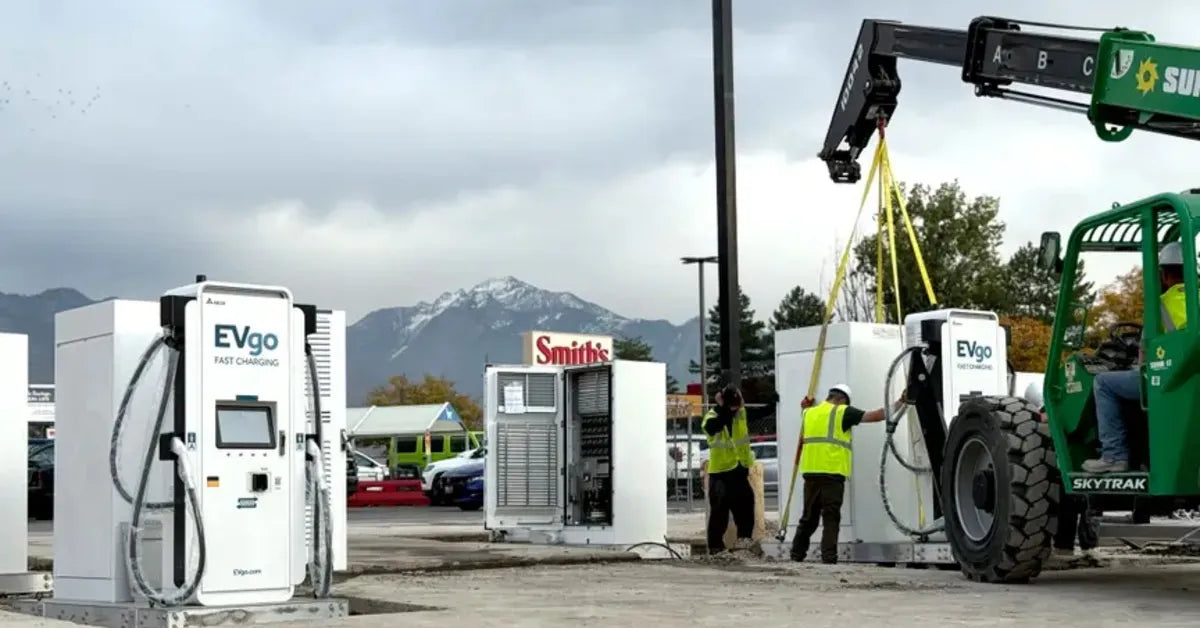
The first charging site from the Kroger–EVgo partnership is already operational at a Smith’s Food and Drug location in Salt Lake City, Utah. Additional locations are scheduled to launch soon across Arizona, California, Florida, Georgia, Texas, and Washington, with further states expected to follow.
According to the companies, many of these locations will feature chargers capable of replenishing significant battery range in as little as 15 minutes, depending on vehicle capability and battery state. This positions Kroger stores as practical stops not only for daily errands, but also for short, high-speed charging sessions.
Scope of the Deployment Through 2035
EVgo has committed to installing at least 150 DC fast-charging stalls per year at Kroger-owned locations through 2035. The rollout will span multiple Kroger banners, including Kroger, Fred Meyer, Fry’s Food Stores, Harris Teeter, King Soopers, Foods Co., and Smith’s.
Each site may host up to 16 high-power charging stalls, making some locations comparable in scale to highway charging hubs rather than traditional retail chargers. While EVgo has not disclosed power ratings for every future installation, early deployments suggest a focus on ultra-fast charging.
High-Power Charging as the Standard
The Salt Lake City site offers a glimpse into what drivers can expect from the partnership. That location features 12 chargers rated at up to 350 kilowatts, supporting simultaneous charging for up to 24 vehicles. Currently, the site uses CCS1 connectors, though EVgo also operates chargers equipped with NACS connectors and is expected to expand connector options as the market evolves.
This emphasis on high-power charging aligns with EVgo’s broader strategy of catering to long-range EVs and minimizing dwell times, especially in urban and suburban environments where space efficiency matters.
Convenience as a Key Adoption Driver
EVgo CEO Badar Khan framed the partnership as a way to integrate charging into daily routines rather than treating it as a separate task. By placing fast chargers at grocery stores, the companies aim to reduce friction for EV adoption and normalize public charging as part of everyday life.
As Khan noted, Kroger already serves millions of Americans weekly. Adding fast charging to those locations effectively turns routine shopping stops into opportunities to recharge vehicles without requiring additional trips or planning.
EVgo’s Rapid Network Growth
The Kroger rollout is just one piece of EVgo’s aggressive expansion strategy. According to data from the Alternative Fuels Data Center, EVgo currently operates around 4,800 DC fast-charging stalls in the United States. By the end of 2029, the company expects that number to exceed 15,000 stalls nationwide.
To accelerate deployment, EVgo has formed partnerships with companies such as GM Energy and Pilot Company. GM Energy alone already supports more than 2,000 co-branded charging stalls, with additional sites under development.
Faster Installation Through Modular Design
EVgo is also streamlining construction by using prefabricated charging slabs, which can be installed more quickly than traditional custom-built systems. This approach reduces on-site construction time and allows new charging locations to come online faster, a critical advantage as demand for fast charging continues to grow.
Combined with large retail partners like Kroger, this strategy positions EVgo to scale its network rapidly while maintaining consistency across locations.

A Growing Role for Retail-Based Charging
Kroger’s move underscores a shift in how charging infrastructure is being planned in the U.S. Rather than relying solely on highway corridors, charging providers are increasingly targeting retail and lifestyle destinations where drivers already park for 20 to 45 minutes.
If successful, the Kroger–EVgo partnership could serve as a template for other national retailers looking to participate in the EV transition while enhancing the customer experience.
Recommend Reading: Public Charging Memberships Worth the Money in 2025


Partager:
GM Faces a Hard Reality About Plug-In Hybrids in the U.S.
Tesla to End One-Time Purchase Option for Full Self-Driving Software