


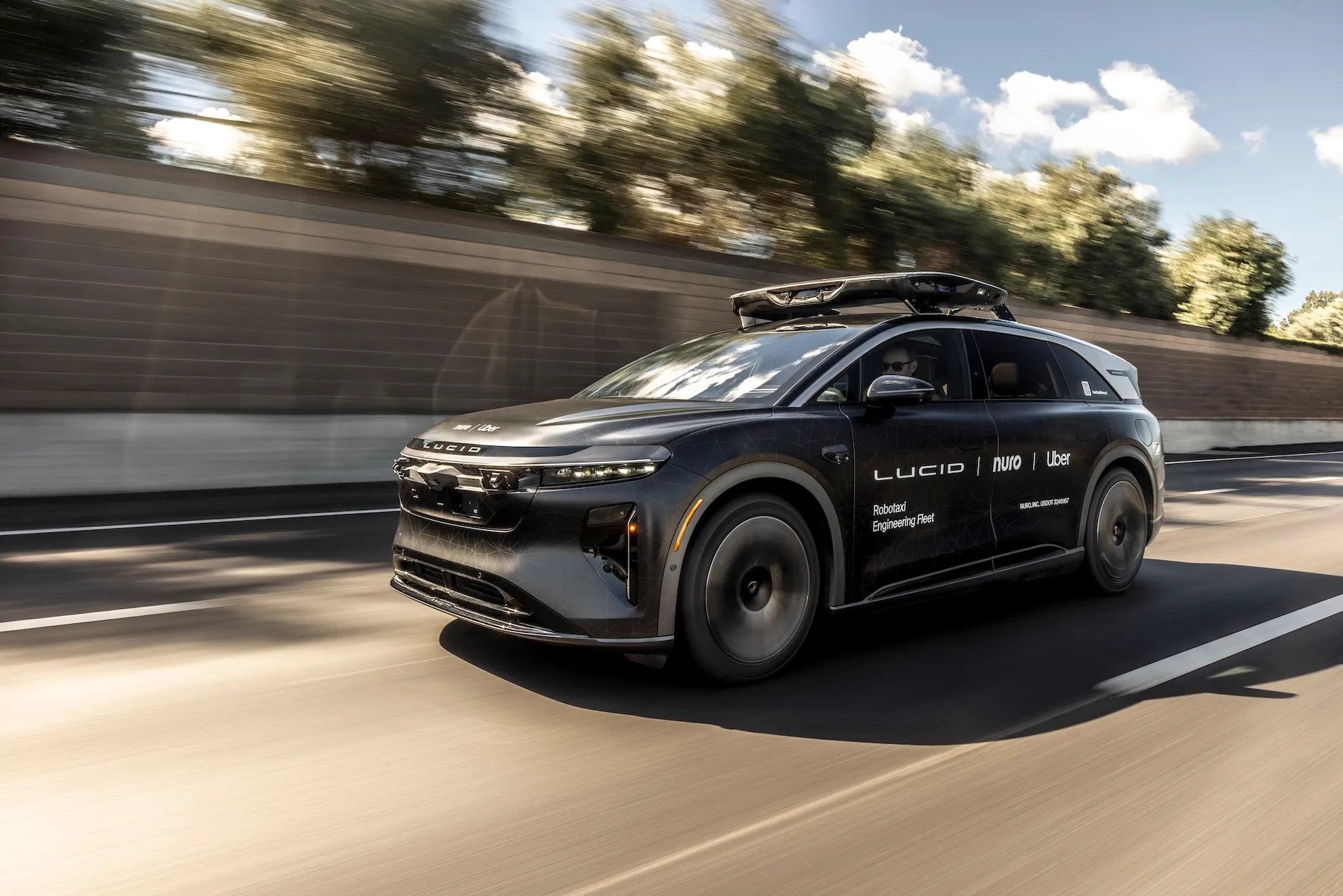
Uber is accelerating its push into autonomous mobility, forming broad alliances across the industry as it prepares for large-scale driverless operations. One of its most notable moves is a three-way agreement with Lucid Motors and self-driving specialist Nuro, which will bring autonomous technology to thousands of electric SUVs starting next year. The decision to use the Lucid Gravity, a premium electric SUV, raised questions—but Lucid’s leadership says the choice was based on engineering readiness rather than price.

Why Uber Selected the Gravity
Uber’s plan involves equipping more than 20,000 Lucid Gravity SUVs with Nuro’s robotics hardware beginning in the coming year. As part of the partnership, Uber will also invest $300 million in Lucid.
At the UBS Global Industrials and Transportation Conference, Lucid CFO Taoufiq Boussaid outlined the rationale behind the selection. According to him, the Gravity was “fit for purpose,” offering a redundant electrical and control architecture that aligns with the safety requirements for autonomous fleets.
This built-in redundancy—multiple steering paths, backup braking systems, and duplicate control modules—reduces the need for costly structural modifications. Many vehicles require extensive reengineering before they can support driverless systems; the Gravity avoids that issue.
The Role of Redundant Systems in Autonomous Fleets
Safety-critical redundancy is one of the largest barriers to scaling robotaxi services. Autonomous vehicles must run on systems far more robust than typical consumer cars, and retrofitting those systems can be expensive and time-consuming.
Lucid previously highlighted that the Gravity already includes redundant electrical and controls architectures, giving it an advantage over models that need additional engineering or structural reinforcement. Boussaid noted that this directly enables faster deployment for Uber’s robotaxi operations.
By reducing the need for deep vehicle modifications, Uber and Lucid can shorten development timelines and lower operational costs—two major hurdles in commercial autonomy.
How Nuro’s Technology Fits In
The Gravity currently supports Lucid’s Level 2 suite, DreamDrive Pro, but robotaxi operations require full driverless capability. Under the partnership, Lucid will integrate Nuro’s complete sensor and compute stack: lidar, radar, cameras, and onboard processing hardware.
These vehicles will roll off the production line already configured for autonomy. Uber will purchase them directly and list them exclusively through the Uber app once deployment begins.
Addressing the Gravity’s Price Tag
Despite its engineering strengths, the Gravity’s price—expected to exceed $80,000—makes it an unusual robotaxi candidate. Boussaid acknowledged this, noting that the long-term strategy likely revolves around Lucid’s upcoming midsize EV platform.
This future model, expected to cost about $50,000, will incorporate Nvidia’s next-generation autonomous driving technology. According to Lucid, the platform will eventually support eyes-off self-driving, positioning it as a more scalable option for large fleet deployments.

A Crowded Partner List and an Uncertain Road Ahead
Uber has lined up more than a dozen autonomy partners, including Waymo, Avride, May Mobility, and Momenta. The company is placing broad bets on different technologies and deployment strategies, rather than committing to a single solution.
The bigger unknown is how many of these collaborations will progress beyond pilot programs and press announcements. Scaling driverless fleets remains expensive and complex, and only a handful of companies have demonstrated the ability to deploy at meaningful volume.
Yet Uber’s partnership with Lucid and Nuro indicates that it is preparing for a future where electric, purpose-built autonomous vehicles form the backbone of its mobility network.
Recommend Reading: Waymo’s New Zeekr-Built Robotaxi Emerges Ahead of Wider U.S. Expansion
Partager:
Heat Pumps Prove Crucial for Maintaining EV Range in Winter
Tesla Pushes Aggressive Year-End Deals to Boost Model Y Sales