



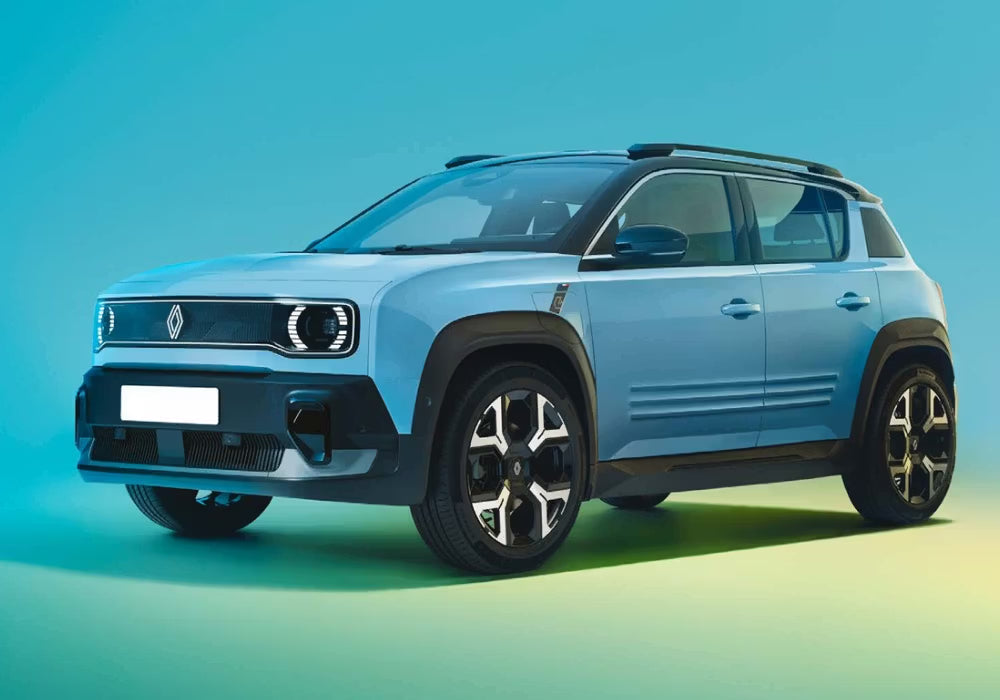
Renault’s Retro Strategy Is Paying Off
Few automakers have leaned into heritage as effectively as Renault has over the past year. After a long period of cautious design and conservative EV offerings, the French brand has found renewed momentum by reinterpreting its most recognizable nameplates for the electric era. The approach began with the Renault 5, continued with Alpine’s performance-focused A290, and now expands with the all-new Renault 4 E-Tech Electric.
Rather than relying on nostalgia alone, Renault has paired familiar shapes with modern EV platforms, competitive efficiency, and accessible pricing. The result is a lineup that feels emotionally engaging without sacrificing usability. The Renault 4, in particular, aims to channel the spirit of the original people’s car into a compact electric crossover designed for everyday urban life.

A Modern Take on a Practical Icon
The original Renault 4 was never about performance or luxury. Introduced in the early 1960s, it was affordable, durable, and endlessly practical—a vehicle designed to blend seamlessly into daily life. The 2025 Renault 4 E-Tech respects that philosophy while translating it into a fully electric format.
Built on the same AmpR Small platform that underpins the Renault 5, the new 4 is larger, taller, and more versatile than its predecessor. Its design borrows key visual cues from the classic model, including a boxy silhouette and distinctive lighting, but the execution is unmistakably modern. The proportions are carefully balanced to accommodate battery packaging, safety requirements, and real-world usability, making it feel contemporary without losing its charm.
Powertrain, Range, and Charging
Renault has deliberately kept the powertrain lineup simple. In the UK and most European markets, the Renault 4 E-Tech is offered with a 52 kWh battery paired to a 150-horsepower front-mounted electric motor producing 181 lb-ft of torque.
Performance is modest but appropriate for the car’s mission. Acceleration from 0–62 mph takes approximately 8.2 seconds, with a top speed limited to 93 mph. The focus here is not speed, but smooth, predictable delivery suited to urban and suburban driving.
Under the WLTP cycle, the Renault 4 delivers up to 247 miles of range. Renault has taken an unusually transparent approach by offering an online range estimator that accounts for temperature, driving conditions, and drive modes, helping buyers set realistic expectations. DC fast charging peaks at 100 kW, allowing a 15–80% recharge in roughly 30 minutes—adequate for short trips and routine stops rather than long-distance touring.

Interior Design and Everyday Practicality
Inside, the Renault 4 emphasizes clarity and usability over minimalism. The cabin layout is straightforward, with physical controls retained for key climate functions and a centrally mounted 10.3-inch touchscreen handling infotainment duties. The interface is responsive and intuitive, with Apple CarPlay available for those who prefer familiar ecosystems.
Storage and practicality are highlights. The rear cargo area offers 14.8 cubic feet with the seats up, expanding to nearly 50 cubic feet when folded, making the car surprisingly capable for grocery runs, small family duties, and weekend errands. Thoughtful cubbies and cupholders reinforce the Renault 4’s role as a functional daily companion rather than a design statement.
Driving Character in the City and Beyond
On the road, the Renault 4 immediately feels approachable. Steering is light, controls are intuitive, and the car responds smoothly to throttle inputs in Comfort mode. Eco mode softens responses to extend range, while a customizable “Perso” mode allows drivers to fine-tune the experience.
In city traffic, the Renault 4 excels. Its upright seating position improves visibility, while compact dimensions make parking and tight maneuvers stress-free. One-pedal driving is available and adjustable via steering-wheel paddles, allowing drivers to choose between coasting and stronger regenerative braking.
At highway speeds, the Renault 4 remains composed. Wind noise is present but controlled, and overtaking performance is sufficient for everyday scenarios. While not designed for spirited driving, the car remains pleasantly engaging on winding roads, where its modest power output encourages smooth, momentum-based driving rather than aggressive inputs.

Technology and Safety Systems
As with all modern European vehicles, the Renault 4 comes equipped with a comprehensive suite of driver-assistance systems, including lane keeping aids, speed alerts, and collision warnings. These systems are effective but, as expected, generate frequent alerts. Renault has at least made it relatively easy to deactivate certain features through programmable controls.
The digital instrument cluster prioritizes readability, displaying speed, range, and drive mode information in large, clear fonts. While the reversing camera fulfills its purpose, image quality is average and falls short of best-in-class systems.
Efficiency and Real-World Use
In mixed driving conditions, the Renault 4 demonstrates commendable efficiency. Real-world consumption of approximately 3.6 miles per kWh suggests a usable range closer to 185–190 miles, depending on conditions. Importantly, cold-weather performance appears more stable than earlier Renault EVs, reinforcing its suitability for year-round use.
Pricing and Market Position
In the UK, the Renault 4 E-Tech starts at £27,195, rising to £31,195 in higher trims. This places it above the entry-level Renault 5 but still within reach for buyers seeking a compact electric vehicle with personality. While not the cheapest option in its segment, it competes on design, comfort, and ease of use rather than raw specifications.

Final Verdict
The 2025 Renault 4 E-Tech is not a car designed to impress on paper. Instead, it succeeds by being pleasant, intuitive, and emotionally appealing in daily use. Its moderate range, sensible charging speeds, and thoughtful interior make it a strong candidate for urban drivers and small families looking to transition to electric mobility without stress.
For the right buyer, the Renault 4 delivers exactly what the original did decades ago: a simple, friendly car that quietly improves everyday life.
Recommend Reading: Renault Revives the Twingo as a Budget EV to Rival Low-Cost Chinese Cars
Partager:
New Generation of EVs Set to Reshape Global Competition in 2026
Ford’s EV Retreat Signals Opportunity for Chinese Automakers