



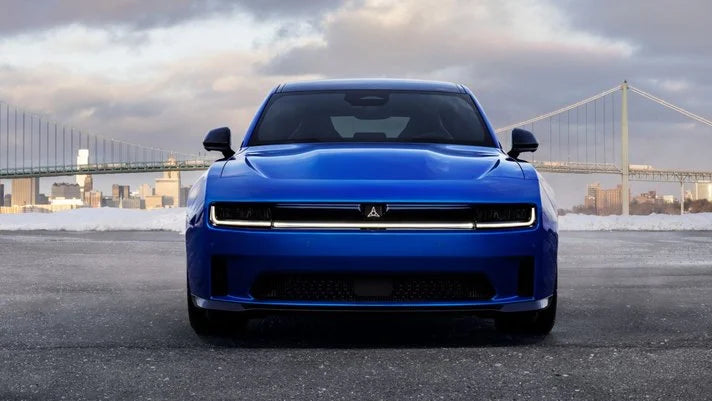
The 2027 Dodge Charger Daytona Scat Pack EV arrives with a meaningful hardware update that reflects a broader industry shift. For the first time, Stellantis is offering a factory-installed Tesla North American Charging Standard (NACS) port, giving Dodge’s electric muscle car direct access to Tesla’s Supercharger network across North America.
While the Charger EV continues to face challenges in the market, this update improves everyday usability and lowers the barrier to public fast charging—an area where earlier models struggled to compete.

Built-In NACS Port Expands Charging Access
The most notable change for 2027 is the addition of a factory-installed NACS charging port, making the Charger Daytona EV Stellantis’ first electric vehicle to adopt Tesla’s connector natively.
With this upgrade, owners can access more than 25,000 Tesla Superchargers in North America without using an adapter, a major advantage over previous CCS-only models. Dodge says the car will ship standard with a J1772-to-NACS adapter for AC charging, while a CCS1-to-NACS adapter will be offered separately for drivers who want access to Electrify America or EVgo stations.
This move aligns Dodge with other automakers transitioning toward NACS as the dominant charging standard in the U.S.
Pricing Drops Slightly for 2027
Alongside the charging update, Dodge has made a modest pricing adjustment. The 2027 Charger Daytona Scat Pack now starts at $74,490, including destination charges. That represents a $1,490 reduction compared to the previous model year.
The four-door variant remains available and continues to carry a $500 premium over the two-door version. While the price cut is relatively small, it signals an effort by Dodge to make the electric Charger more competitive in a segment facing increased pressure from both legacy brands and newer EV manufacturers.
Performance Remains Unchanged
Mechanically, the Charger Daytona Scat Pack carries over its existing powertrain. The dual-motor all-wheel-drive setup produces 630 horsepower, with an additional 40-hp boost available for up to 10 seconds via Dodge’s PowerShot feature.
Standard equipment continues to include the Fratzonic Chambered Exhaust, which generates a synthetic V-8-style sound, as well as multiple performance-focused drive modes such as Drift Mode and Donut Mode. These features reinforce Dodge’s effort to maintain muscle-car theatrics in an electric format.
Battery, Range, and Charging Performance
Power comes from a 94-kWh battery pack operating at roughly 400 volts, unchanged from earlier versions. Dodge estimates a 267-mile driving range, matching the outgoing model.
Although the automaker has not released updated charging figures for the NACS-equipped version, previous Charger EVs could charge from 20% to 80% in approximately 24 minutes on a compatible 400V DC fast charger. Since most Tesla Superchargers also operate at 400 volts, real-world charging times are expected to remain similar.
A Model Still Searching for Its Audience
Despite its bold design and headline power numbers, the electric Dodge Charger has faced a rocky launch. Build quality concerns, software issues, and mixed reactions to its EV-only identity have contributed to weak early sales and owner frustration.
Stellantis attempted to broaden appeal by introducing a six-cylinder gasoline variant this year, though its impact on overall Charger sales remains unclear. Even with strong lease incentives, some owners report extended delays before being able to fully use their vehicles.
The 2027 update improves practicality, but it may not fully address deeper concerns around reliability and execution.

Verdict: A Necessary Step, Not a Complete Reset
Adding a native NACS port is an important and overdue upgrade for the Dodge Charger EV, significantly improving charging convenience and aligning the car with the direction of the U.S. EV market. Combined with a small price cut, it makes the Charger easier to live with day to day.
However, the underlying challenges remain. Until Dodge resolves quality issues and strengthens customer confidence, the Charger EV’s long-term success will depend on more than just charging compatibility.
Recommend Reading: Jeep and Dodge EVs to Gain Tesla Supercharger Access Starting in 2026


Partager:
2026 Kia EV4 Focuses on Comfort and Efficiency Over Performance
How the Ford F-150 Lightning Became an Emergency Power Lifeline