



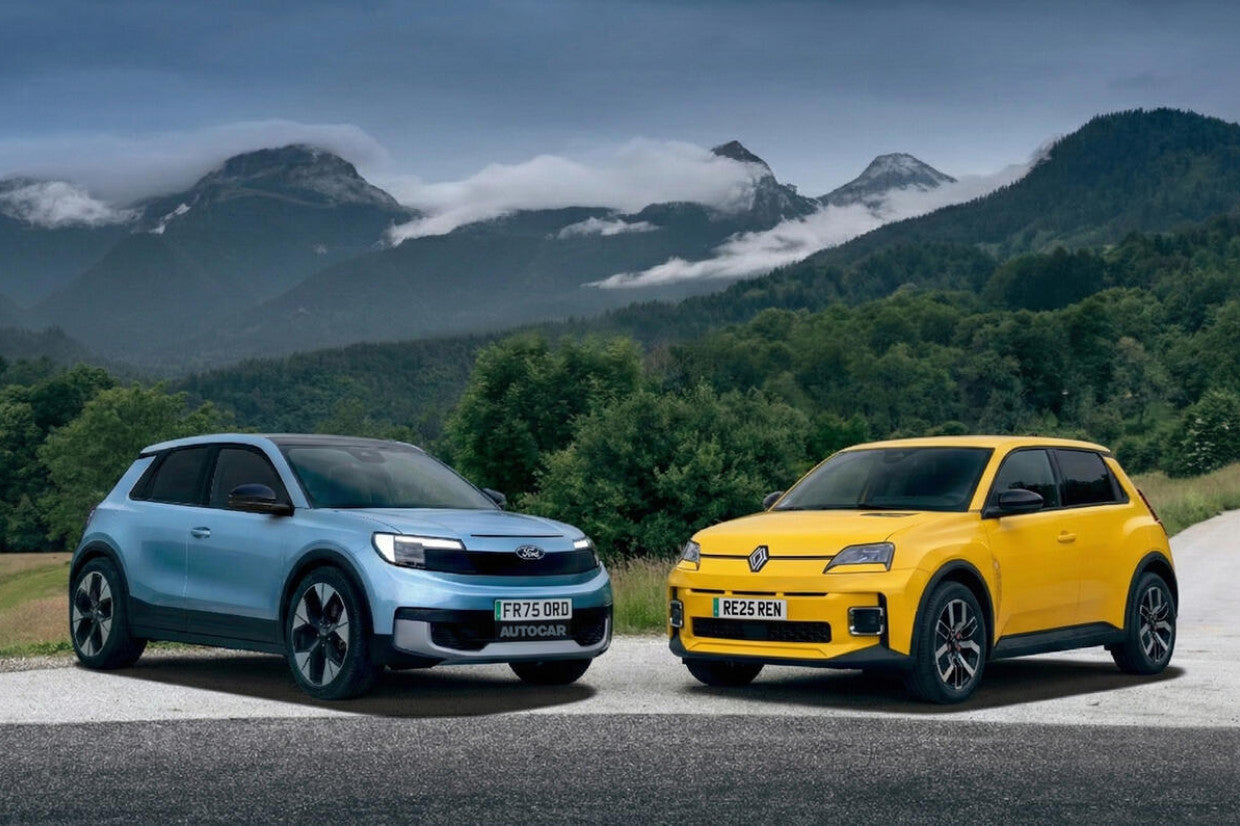
A New Alliance for Affordable Electric Models
Ford is accelerating its push into Europe’s budget EV segment through a newly announced partnership with Renault. Under a formal agreement, Ford will use Renault’s Ampere electric platforms to build two new battery-electric models, both scheduled to launch in early 2028. As part of the arrangement, Renault will also manufacture these vehicles at its specialized EV facilities in France, echoing Ford’s earlier platform-sharing collaboration with Volkswagen on the Explorer and Capri sold in Europe.

Platform Options and Early Clues on Vehicle Segments
While the companies did not specify which version of the Ampere platform Ford will adopt, the two likely candidates are AmpR Small (formerly CMF-B EV) and AmpR Medium (previously CMF-EV). This opens the door for one B-segment subcompact and one C-segment compact EV, enabling Ford to cover two major volume categories in Europe.
Industry observers suggest the pair could instead be two city-focused models, similar to Renault’s upcoming 5 and 4 E-Tech. If so, Ford may be preparing to revive the Fiesta nameplate as a fully electric hatchback. That would make Ford the fifth brand using this platform after Renault, Nissan, and Dacia.
Despite relying on Renault architecture, Ford CEO Jim Farley emphasized that the finished products will still feel like Fords, stating they will bring together “Renault Group’s industrial scale and EV assets with Ford’s iconic design and driving dynamics.”
Potential Performance: An Electric Fiesta ST?
Ford’s use of Ampere technology may enable the brand to reintroduce a performance-oriented Fiesta ST powered entirely by electricity. The small Alpine A290 uses the same underlying platform and delivers 220 horsepower and 221 lb-ft (300 Nm) of torque, launching from 0–62 mph (0–100 km/h) in 6.4 seconds. A Ford version with similar output would give the brand a credible hot-hatch entry in the EV era.
Battery Options and Expected Range
The battery configurations for the Ford-badged models are expected to align closely with the Renault 5 and 4 E-Tech. This means:
-
40 kWh standard battery
-
52 kWh long-range pack
The Renault 5 achieves up to 255 miles (410 km WLTP) on the larger pack, offering a strong indication of what Ford’s variants will deliver. The range positioning places these EVs squarely in the “affordable, practical” category—an area where Ford needs to regain ground.
Production in France and Ford’s European Strategy
Both new EVs will be built at Renault’s Douai EV hub, a major center for Ampere production. Ford described the models as “the first step in a comprehensive new product offensive for Ford in Europe.” Alongside the Renault-based vehicles, Ford is still developing its own EVs, including a future model expected to revive the Focus name. However, unlike the classic hatchback, the new Focus is likely to take the form of a compact crossover positioned between the Puma and Explorer, with affordability as a core priority.

Why Ford Needs This Partnership
The Ford-Renault agreement highlights Ford’s urgent need to remain competitive as lower-priced Chinese EVs gain traction across Europe. Developing a ground-up electric platform is expensive and time-consuming, and Ford has openly stated it must cut costs to survive in the new EV landscape.
CEO Jim Farley has been candid about the pressure facing legacy automakers, saying “we are in a fight for our lives in our industry.” As a result, outsourcing development and manufacturing appears to be Ford’s most viable path to keeping its brand present in key volume segments while minimizing financial risk.
Recommend Reading: Ford’s $30K Electric Truck Bets on Smarter Design


Partager:
Silicon Anode Advances Signal Major Step Forward for Next-Gen EV Batteries
Fiat Plans U.S. Launch of Its Mini Electric Topolino