Ford’s Shift Toward Cost-Efficient EVs

Ford was among the earliest legacy automakers to take electric vehicles seriously. The Mustang Mach-E and F-150 Lightning arrived with strong reviews and healthy early demand. Yet despite their visibility, both models fell far short of Ford’s internal sales expectations. The reason was simple: Ford built them like conventional vehicles and then added expensive battery packs, resulting in losses on nearly every unit sold.

At the same time, Ford has grown increasingly wary of rapidly advancing Chinese EV manufacturers, whose vertically integrated supply chains and aggressive production methods enable them to build competitive EVs at significantly lower prices. Ford’s leadership, including CEO Jim Farley, has been blunt: unless the company learns to build EVs with the same efficiency, its long-term outlook is at risk.

Ford universal EV platform.


The New Universal EV Platform

To close that gap, Ford has created the Universal EV Production System, a ground-up rethinking of how electric vehicles are designed and assembled in the United States. The first product riding on this platform will be a $30,000 electric pickup arriving in 2027.

We don’t yet know the truck’s final appearance, but Ford has already made one thing clear: it will not follow the classic, boxy profile of today’s pickups. Instead, its form will be shaped entirely by cost efficiency and aerodynamics.


Inside Ford’s Skunkworks Approach

In interviews with Wired, CEO Jim Farley and chief EV, digital, and design officer Doug Field explained how Ford’s Southern California “skunkworks” team rebuilt the entire EV development process. Their objective was to reduce manufacturing steps, shorten engineering timelines, and minimize material use.

Field’s team became fixated on one particular lever: drag reduction. According to Field, cutting just 0.01 Cd of aerodynamic drag equates to $25 in battery savings. Since batteries are the single most expensive EV component, this relationship fundamentally alters how Ford designs future models. Farley even suggested that Ford’s next-generation EVs could use far smaller battery packs than their competitors, relying on improved efficiency instead of raw kilowatt-hours.


Borrowing Lessons From Tesla and China

Doug Field’s background plays a major role here. Before joining Ford, he helped engineer the Tesla Model 3, a vehicle whose cost-efficient design was essential to Tesla’s early profitability. Chinese automakers have since built on that playbook, combining Tesla-style engineering with ultra-efficient factories and lower labor costs. The result: EVs under $20,000 that still deliver strong range and performance.

Ford’s traditional assembly methods simply cannot compete with that. That is why the company is adopting a new “assembly tree” system that uses three sub-lines feeding into a shorter final line, dramatically reducing complexity, parts count, and labor requirements.


Why Aerodynamics Will Define the 2027 Truck

A key outcome of Ford’s new process is the emphasis on aerodynamic shape. While American buyers love rugged, upright trucks and SUVs, that profile is disastrous for EV range. A larger battery could compensate, but that would undermine Ford’s entire cost-reduction strategy.

By designing a more aerodynamic truck, Ford can deliver the same range with a smaller battery pack—achieving both lower prices and lower manufacturing costs. The Tesla Cybertruck, with its surprisingly low 0.34 drag coefficient, proves that aerodynamic trucks are possible. Ford’s pickup will aim for even better efficiency, though its exact Cd remains undisclosed.

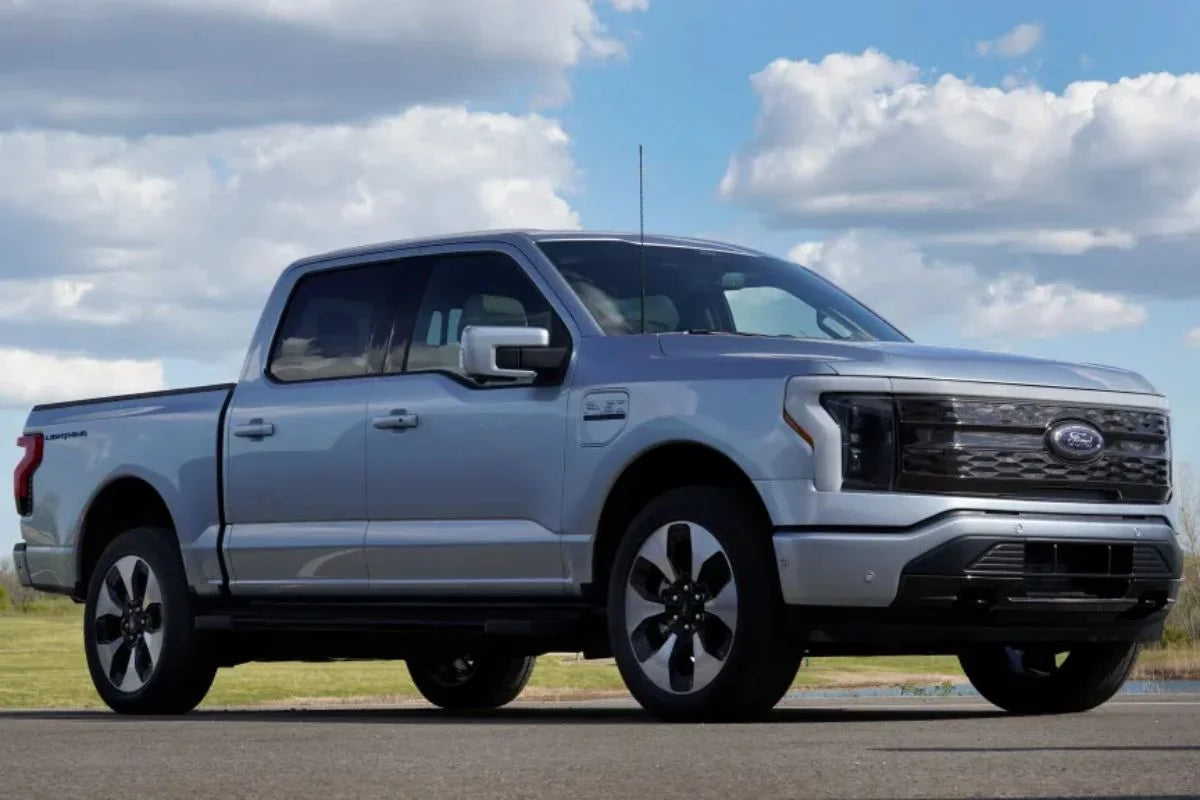
Ford electric truck being showcased nearby the dealer.


Will Buyers Accept the New Look?

The biggest wild card is consumer preference. If Ford’s efficient design deviates too far from the classic pickup silhouette, buyers may hesitate. However, Ford believes the long-term EV race will be won not by tradition but by engineering discipline, manufacturing efficiency, and intelligent energy use. Competing head-to-head with BYD and other global manufacturers requires nothing less.

Recommend Reading: Ford May End F-150 Lightning Production as EV Sales Slow

FAQs - Chinese Electric Vehicles for U.S. EV Users

What is Ford BlueCruise and how does it work?

Ford BlueCruise is Ford’s hands-free driving technology, available on select highways in North America known as Blue Zones. It uses a combination of adaptive cruise control, lane centering, GPS mapping, and driver-facing cameras to allow hands-free driving while ensuring the driver stays attentive.

Which Ford and Lincoln vehicles come with BlueCruise?

As of 2025, BlueCruise is available on popular models such as the Ford Mustang Mach-E, F-150 Lightning, F-150, Expedition, and Lincoln Navigator, Aviator, and Corsair. Ford plans to expand BlueCruise availability across more EVs and traditional vehicles in the coming years.

How much does Ford BlueCruise cost?

BlueCruise typically comes with a trial period (90 days to 3 years depending on the model) and requires a subscription afterward. Pricing starts around $800 per year or $75 per month, though packages vary by vehicle and dealer promotions.

What are Ford BlueCruise Blue Zones?

Blue Zones are pre-mapped divided highways where BlueCruise has been validated for hands-free driving. As of 2025, Blue Zones cover over 200,000 miles of highways in the U.S. and Canada, with Ford expanding coverage via over-the-air updates.

Is Ford BlueCruise the same as Tesla Autopilot or GM Super Cruise?

No. While all are advanced driver-assistance systems (ADAS), each works differently. Tesla Autopilot relies on camera-based vision AI, GM Super Cruise uses LiDAR-based HD maps, and Ford BlueCruise combines adaptive cruise control, lane centering, and driver monitoring. BlueCruise is designed for practical, safe highway driving rather than full autonomy.

Does Ford BlueCruise work in bad weather or heavy traffic?

BlueCruise can operate in rain, fog, and stop-and-go traffic, but performance may be limited in severe weather conditions such as snowstorms or when lane markings are not visible. The system always requires the driver to remain attentive and ready to take over.

Can Ford BlueCruise be updated with new features?

Yes. BlueCruise is designed with over-the-air (OTA) update capability, meaning Ford can release new features, expand Blue Zones, and improve system performance without requiring a dealership visit. This makes BlueCruise future-proof compared to traditional ADAS systems.

Does Ford BlueCruise make a vehicle fully self-driving?

No. Ford BlueCruise is classified as a Level 2 autonomous driving system under SAE standards. This means it offers hands-free capability under specific conditions, but the driver must remain alert and keep eyes on the road at all times.

What are the safety features of Ford BlueCruise?

BlueCruise uses infrared driver-facing cameras to ensure the driver’s eyes remain on the road. If the driver looks away too long, the system issues warnings and will gradually slow down the vehicle if no response is detected. This makes it safer than systems that allow driver inattention.

What is the future of Ford BlueCruise technology?

Ford plans to continue expanding BlueCruise with more mapped roads, improved lane-change automation, and integration with EV platforms such as the Mustang Mach-E and F-150 Lightning. By 2030, Ford aims to make BlueCruise a cornerstone of its connected vehicle ecosystem, competing directly with Tesla FSD and GM Super Cruise.

EV News

View all

GM Records $7.1 Billion Charge as EV Strategy Shifts

GM Records $7.1 Billion Charge as EV Strategy Shifts

General Motors took a $7.1 billion charge after cutting back EV capacity in North America. Policy changes, slower demand, and factory realignments are reshaping GM’s electrification strategy without ending it.

Read more

Kia EV2 Debuts as a New Entry-Level Electric Crossover for Europe

Kia EV2 Debuts as a New Entry-Level Electric Crossover for Europe

Kia’s new EV2 targets Europe’s growing demand for affordable electric crossovers. With up to 278 miles of range, fast charging, and urban-friendly design, it aims to bring EV ownership within reach of more buyers.

Read more

California Plans $200 Million EV Incentive Program

California Plans $200 Million EV Incentive Program

California is proposing a $200 million incentive program to support EV buyers after the federal tax credit ended. The plan could offer upfront discounts and help sustain EV adoption in the nation’s largest electric vehicle market.

Read more