


New Mid-Size Electric Pickup Planned for 2027

Ford has revealed plans for an affordable all-electric pickup, expected to start at around $30,000 with production beginning in 2027. The truck will be built at Ford’s Louisville Assembly Plant in Kentucky, which will adopt new manufacturing techniques.

Although Ford calls it mid-sized, representatives compared its footprint to the Ford Maverick but with more interior space. The truck will not replace the Maverick—Ford believes there is room for both models. It will offer BlueCruise hands-free driving capability and target Toyota RAV4-level passenger volume with additional storage in a frunk and truck bed.


Performance and Battery Details

The pickup will use a 400-volt architecture and be powered by a lithium-iron phosphate (LFP) battery produced at Ford’s BlueOval Battery Park in Michigan. Ford is aiming for a 0–60 mph time of around 4.5 seconds, similar to an EcoBoost Mustang.

The truck will be a software-defined vehicle with over-the-air updates for continuous improvements. Its interior is forecasted to exceed the passenger space of a current Toyota RAV4, and design hints suggest a possible cargo pass-through system for longer items such as surfboards.

Ford electric truck being showcased in public.

Universal EV Platform and Production System

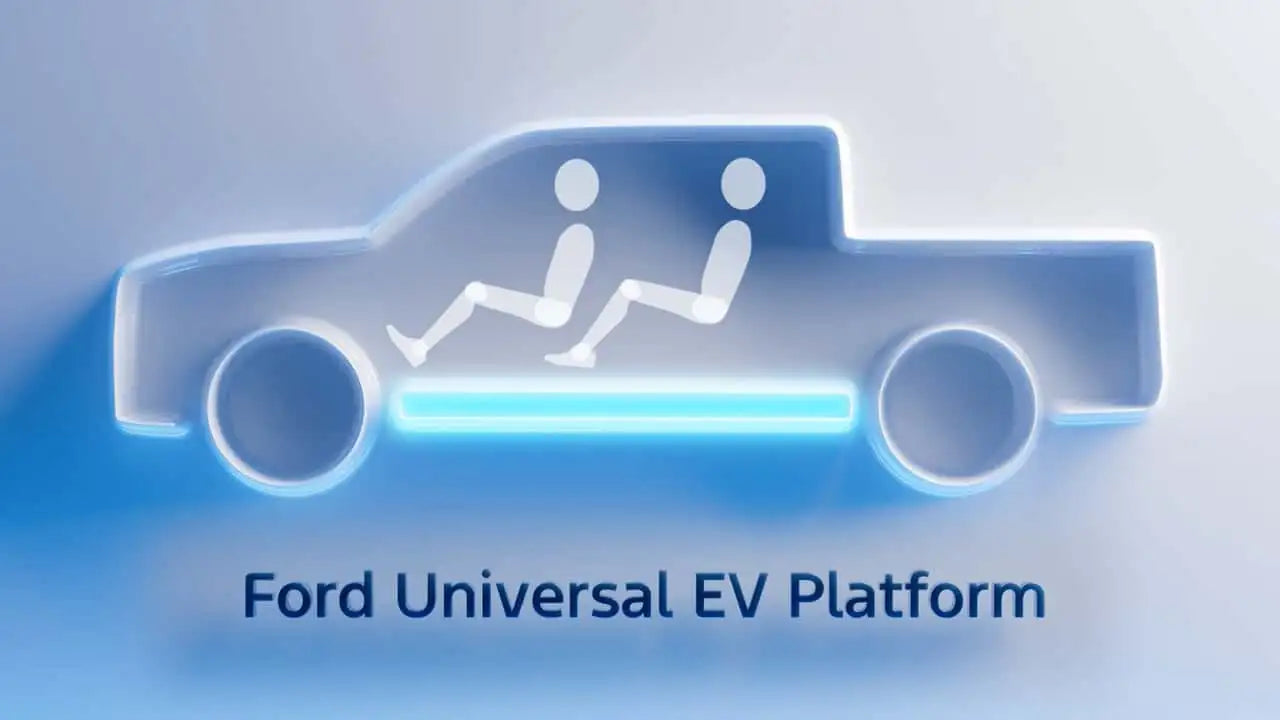
The truck will be the first model on Ford’s new Universal EV Platform, designed to support multiple vehicle types—from small cars to three-row SUVs—on the same skateboard chassis.

Ford’s Universal EV Production System will assemble vehicles in three parallel modules: front, rear, and battery/structural section. This modular approach enables significant flexibility and efficiency.


Efficiency Gains and Cost Targets

According to Ford, the new system will:

  • Reduce parts by 20%

  • Cut fasteners by 25%

  • Lower workstation count by 40%

  • Speed assembly by 15%

These improvements aim to keep vehicle prices competitive. Ford says the total cost of owning a universal Ford EV will be lower than buying a three-year-old Tesla Model Y.


Why Now?

Ford’s move is driven by advances in unicasting manufacturing technology, enabling faster, more flexible production. The company believes this approach will make affordable EVs possible while maintaining performance and versatility.

Recommend Reading: Ford’s 2026 F-150 Lightning STX Brings More Range at No Extra Cost

FAQs - Chinese Electric Vehicles for U.S. EV Users

What is Ford BlueCruise and how does it work?

Ford BlueCruise is Ford’s hands-free driving technology, available on select highways in North America known as Blue Zones. It uses a combination of adaptive cruise control, lane centering, GPS mapping, and driver-facing cameras to allow hands-free driving while ensuring the driver stays attentive.

Which Ford and Lincoln vehicles come with BlueCruise?

As of 2025, BlueCruise is available on popular models such as the Ford Mustang Mach-E, F-150 Lightning, F-150, Expedition, and Lincoln Navigator, Aviator, and Corsair. Ford plans to expand BlueCruise availability across more EVs and traditional vehicles in the coming years.

How much does Ford BlueCruise cost?

BlueCruise typically comes with a trial period (90 days to 3 years depending on the model) and requires a subscription afterward. Pricing starts around $800 per year or $75 per month, though packages vary by vehicle and dealer promotions.

What are Ford BlueCruise Blue Zones?

Blue Zones are pre-mapped divided highways where BlueCruise has been validated for hands-free driving. As of 2025, Blue Zones cover over 200,000 miles of highways in the U.S. and Canada, with Ford expanding coverage via over-the-air updates.

Is Ford BlueCruise the same as Tesla Autopilot or GM Super Cruise?

No. While all are advanced driver-assistance systems (ADAS), each works differently. Tesla Autopilot relies on camera-based vision AI, GM Super Cruise uses LiDAR-based HD maps, and Ford BlueCruise combines adaptive cruise control, lane centering, and driver monitoring. BlueCruise is designed for practical, safe highway driving rather than full autonomy.

Does Ford BlueCruise work in bad weather or heavy traffic?

BlueCruise can operate in rain, fog, and stop-and-go traffic, but performance may be limited in severe weather conditions such as snowstorms or when lane markings are not visible. The system always requires the driver to remain attentive and ready to take over.

Can Ford BlueCruise be updated with new features?

Yes. BlueCruise is designed with over-the-air (OTA) update capability, meaning Ford can release new features, expand Blue Zones, and improve system performance without requiring a dealership visit. This makes BlueCruise future-proof compared to traditional ADAS systems.

Does Ford BlueCruise make a vehicle fully self-driving?

No. Ford BlueCruise is classified as a Level 2 autonomous driving system under SAE standards. This means it offers hands-free capability under specific conditions, but the driver must remain alert and keep eyes on the road at all times.

What are the safety features of Ford BlueCruise?

BlueCruise uses infrared driver-facing cameras to ensure the driver’s eyes remain on the road. If the driver looks away too long, the system issues warnings and will gradually slow down the vehicle if no response is detected. This makes it safer than systems that allow driver inattention.

What is the future of Ford BlueCruise technology?

Ford plans to continue expanding BlueCruise with more mapped roads, improved lane-change automation, and integration with EV platforms such as the Mustang Mach-E and F-150 Lightning. By 2030, Ford aims to make BlueCruise a cornerstone of its connected vehicle ecosystem, competing directly with Tesla FSD and GM Super Cruise.

EV News

View all

Uber Turns to Lucid Gravity for Its Next Wave of Autonomous Ride Services

Uber Turns to Lucid Gravity for Its Next Wave of Autonomous Ride Services

Uber’s new robotaxi plan pairs Lucid’s Gravity SUV with Nuro’s autonomous tech, leveraging the EV’s built-in redundancy for faster deployment. A cheaper midsize Lucid platform may follow for larger-scale fleets.

Read more

Hyundai Ioniq 5

Heat Pumps Prove Crucial for Maintaining EV Range in Winter

New analysis shows EVs average 78% of their normal range in freezing weather, but models equipped with heat pumps lose far less efficiency. Heat pumps cut climate-control energy use, making them essential for winter driving and a key feature for EV shoppers.

Read more

Tesla Adds Detailed Supercharger Maps to Improve Charging Navigation

Tesla Adds Detailed Supercharger Maps to Improve Charging Navigation

Tesla’s holiday update adds a 3D Supercharger Site Map that shows stall availability, charger locations, and nearby amenities. The feature highlights Tesla’s software and integration advantage, making charging stops easier and more efficient.

Read more