



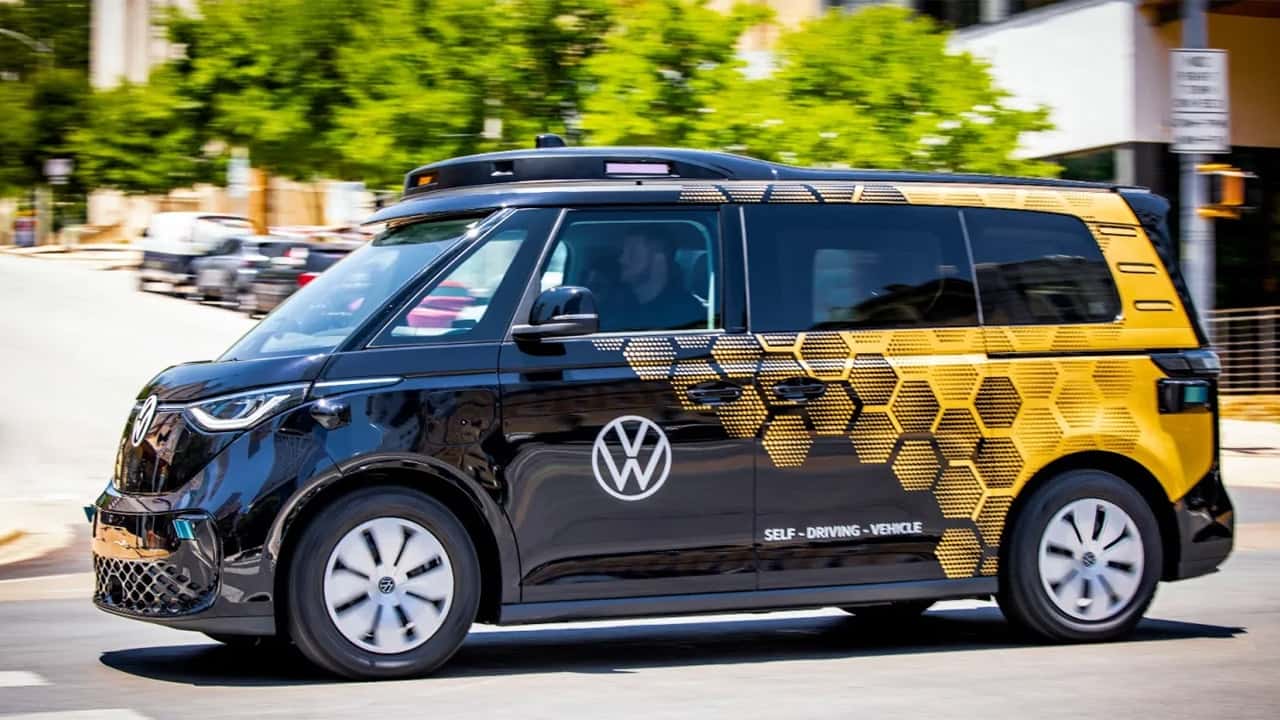
Volkswagen has taken another visible step toward autonomous mobility by testing a purpose-built robotaxi with no steering wheel or pedals on public roads in Germany. The experimental vehicle, known internally as Gen.Urban, is now operating on a defined route in Wolfsburg, signaling Volkswagen’s growing ambition to play a leading role in the future of driverless transport.

A Purpose-Built Vehicle for Autonomous Use
Unlike earlier concepts adapted from existing models, the Gen.Urban appears to be designed from the ground up for autonomous operation. Volkswagen has confirmed that the vehicle lacks traditional driver controls, reinforcing the idea that it is meant to function without human intervention.
Although the company has released minimal technical details, the exterior design suggests a dedicated robotaxi platform rather than a modified passenger car. The body resembles Volkswagen’s ID electric lineup but adopts a more futuristic shape, with rear-hinged back doors that may eliminate the need for a conventional B-pillar. This layout likely improves accessibility for passengers entering and exiting the cabin.
Testing Conditions and Safety Oversight
For now, the Gen.Urban is operating under controlled real-world conditions in Wolfsburg. A safety operator remains onboard, seated in the passenger position, with access to a joystick-based control system that can override the vehicle if necessary.
Volkswagen says the current phase of testing is focused on evaluating passenger comfort and trust in a vehicle that drives itself without visible controls. The prototype is clearly marked as a research vehicle and is believed to be carrying company employees rather than members of the public.
Sensors Replace Traditional Driving Hardware
The Gen.Urban’s exterior leaves little doubt about its autonomous role. Traditional side mirrors are absent, replaced by camera pods and sensor clusters mounted around the vehicle.
Visible hardware includes multiple cameras positioned at the corners of the glasshouse, a forward-facing camera system, and a raised module on the rear section of the roof that likely houses additional sensors. While Volkswagen has not confirmed the full sensor suite, the layout strongly suggests a combination of vision-based systems and supplementary detection hardware designed for self-driving operation.
How It Differs From Volkswagen’s ID. Buzz Robotaxi
Volkswagen has already announced a robotaxi version of the ID. Buzz, which is expected to enter service next year. The Gen.Urban, however, represents a different philosophy.
Rather than adapting a recognizable consumer vehicle, this prototype looks like a bespoke autonomous shuttle, optimized specifically for ride-hailing and urban transport. Its proportions, door configuration, and lack of manual controls suggest Volkswagen is experimenting with a clean-sheet approach to future robotaxi design.
Strategic Implications for Europe’s Robotaxi Market
Volkswagen has not publicly outlined commercialization plans for the Gen.Urban, but the investment required to develop such a vehicle suggests long-term intent. The automaker is unlikely to build an entirely new platform solely for research purposes.
The timing is notable. Autonomous ride-hailing services from U.S. and Chinese companies are beginning to expand into European markets, where regulatory frameworks and public acceptance differ significantly. Volkswagen appears to be positioning itself as a homegrown European alternative, potentially leveraging local manufacturing, regulation familiarity, and brand trust.

What Comes Next
For now, the Gen.Urban remains a research prototype operating on a limited route. Still, its existence signals that Volkswagen is thinking beyond retrofitted autonomy and toward vehicles designed entirely around self-driving use cases.
If successful, insights gained from this pilot could influence future production robotaxis, shaping everything from cabin layout to urban mobility services. While many questions remain unanswered, one thing is clear: Volkswagen intends to be more than a passive observer in the next phase of autonomous transportation.
Recommend Reading: Tesla Begins Unsupervised Robotaxi Tests in Austin, Raising Stakes for Autonomy
Partager:
Lucid Launches Factory-Backed Certified Pre-Owned EV Program
Ford Bets on a $30,000 Electric Truck to Reset Its EV Strategy