



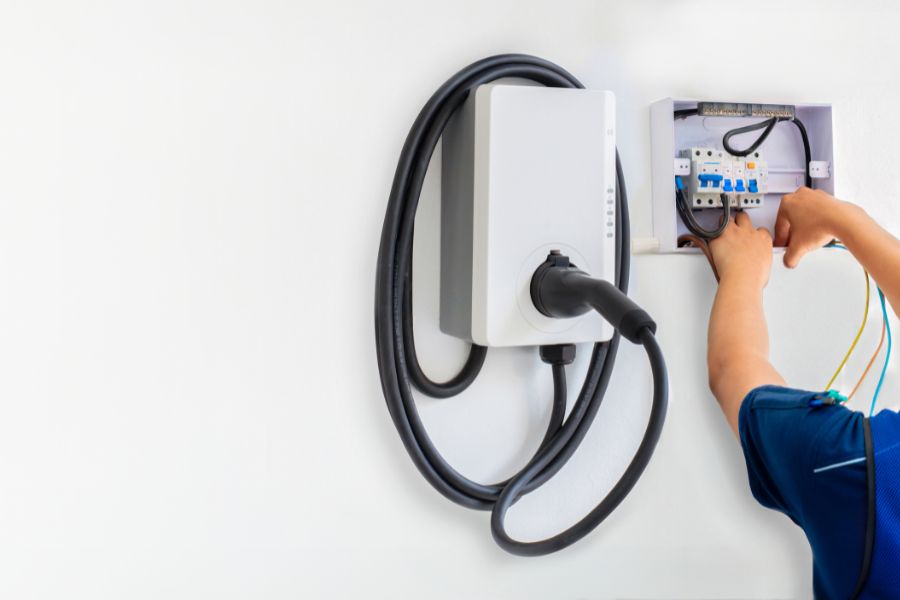
Home EV charging is often presented as simple: install a wall-mounted charger, plug in, and forget about it. In reality, many homeowners discover that a fixed charger does not always match how their driveway, garage, or daily routines actually work.
Once installed, a fixed charger is not flexible. And changing its position later can quickly become expensive, time-consuming, and disruptive. This is where an EV extension cable, when used correctly, becomes not a workaround—but a practical solution.

The Hidden Limitations of Fixed Home Chargers
Wall-mounted EV chargers are installed based on a snapshot in time: where your car is parked today, how your garage is laid out now, and where electrical access is easiest during installation.
However, fixed chargers come with three built-in limitations:
-
The charging cable length is usually fixed (often 18–25 feet)
-
The mounting position is permanent
-
The electrical routing is optimized for installation cost, not future flexibility
Once the charger is installed, its usable charging radius is locked in. If your parking habits change, that limitation becomes obvious very quickly.
When a Fixed Charger No Longer Reaches
Many EV owners run into charging issues not because the charger is faulty, but because the vehicle no longer parks exactly where it used to.
Common scenarios include:
-
A second EV is added to the household
-
A larger vehicle replaces a smaller one
-
The garage becomes partially used for storage
-
Outdoor parking replaces garage parking
-
Seasonal parking changes (snow, rain, driveway use)
In these cases, the factory cable often falls just a few feet short. That small gap creates a daily inconvenience—and sometimes makes charging impossible without repositioning the car every time.

Why Relocating a Fixed Charger Is So Costly
At first glance, moving a wall-mounted charger sounds simple. In practice, it is not.
Relocating a fixed charger often involves:
-
Hiring a licensed electrician again
-
Running new conduit or trenching
-
Cutting and repairing drywall
-
Upgrading breakers or load calculations
-
Pulling new permits and scheduling inspections
The total cost can easily run into the thousands, even though the original charger still works perfectly.
More importantly, the process can take weeks, not days. For many households, this level of disruption is not realistic for solving what is essentially a cable reach problem.
EV Extension Cables as a Practical Alternative
An EV extension cable addresses this exact issue by extending the usable reach of your existing charger without modifying the electrical installation.
When properly designed, a high-quality extension cable allows you to:
-
Charge in different parking positions
-
Reach vehicles parked outdoors or at an angle
-
Share one charger between two EVs
-
Avoid re-installation and rewiring costs
Instead of adapting your behavior to the charger, the charging setup adapts to your space.

Real-World Use Cases Where Extensions Make Sense
EV extension cables are not meant to replace fixed chargers. They are meant to solve specific, real-world problems.
Common use cases include:
-
Driveway charging when the wall charger is inside the garage
-
Two-EV households sharing a single charger
-
Rental or temporary homes where rewiring is not an option
-
Irregular parking layouts common in older homes
-
Seasonal repositioning due to weather or accessibility
In these situations, the alternative is either inconvenience or major electrical work. An extension cable offers a third option.
Addressing Safety Concerns the Right Way
It is true that many automakers discourage the use of extension cables. This warning is largely based on generic household extension cords, which are not designed for sustained high-current EV charging.
A proper EV extension cable is fundamentally different.
Key safety characteristics include:
- Be rated for EV charging: 50A, 240V, 12kW
- Use UL-recognized cable
- IP66 Waterproof
-
Flexible, durable and reliable
When used within rated limits, a purpose-built EV extension cable does not introduce the same risks as standard extension cords.
Flexibility as a Long-Term Value
Home charging setups should be resilient to change. Vehicles change. Families grow. Parking patterns shift.
A fixed charger offers efficiency, but no adaptability. An EV extension cable adds adaptability without sacrificing the original installation.
Instead of viewing extension cables as temporary fixes, it is more accurate to see them as flexibility tools—allowing your charging setup to evolve without rebuilding it.

Choosing the Right Solution for Your Home
If your charger already reaches your vehicle comfortably and consistently, you may never need an extension cable.
But if you are facing:
-
Cable reach limitations
-
Shared charging scenarios
-
Costly relocation quotes
-
Inconvenient daily charging routines
Then an EV extension cable is not an accessory—it is a practical infrastructure upgrade.
The goal is not to replace fixed charging, but to make it work where real homes and real parking situations fall short.
Recommend Reading: Maximizing Charging Efficiency in Multi-Car Households

Aktie:
Maximizing Charging Efficiency in Multi-Car Households
How to Prepare Your EV for Winter Storms: Practical Tips Every Owner Should Know