





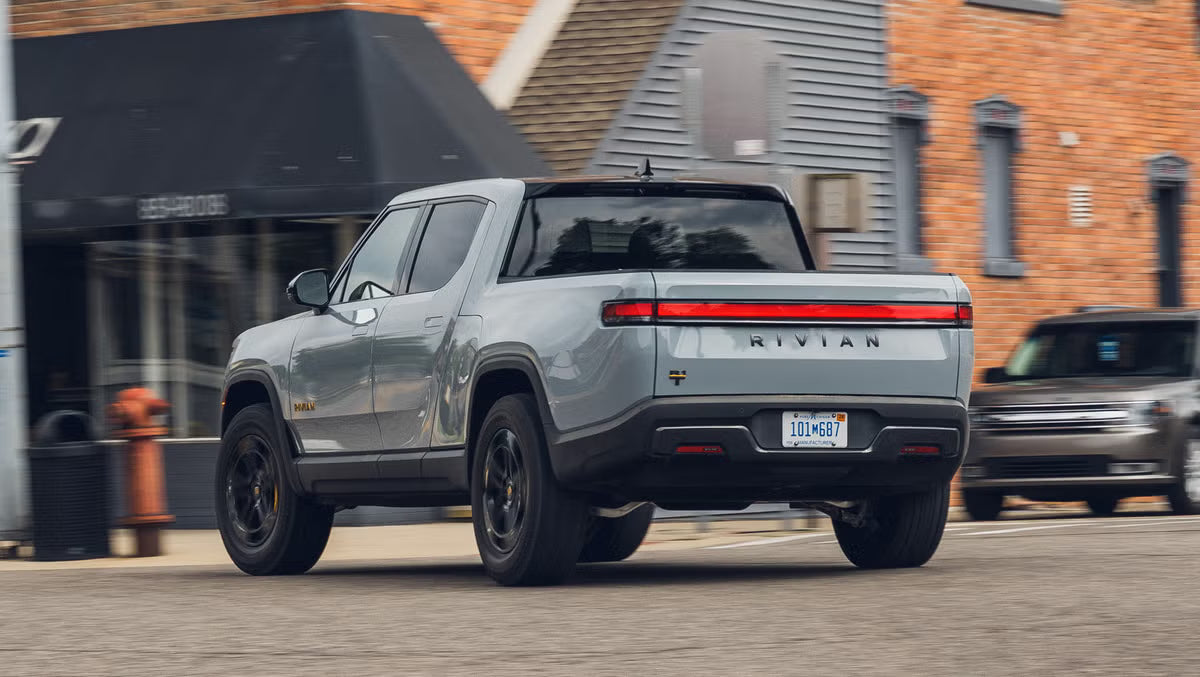
Rivian has announced a new recall affecting close to 20,000 electric vehicles, addressing a suspension-related problem that cannot be resolved through a software update. Unlike many recent recalls in the EV space, this one stems from a service procedure error, not a design flaw or manufacturing defect.
The recall covers certain Rivian R1T pickups and R1S SUVs built between the 2022 and 2025 model years, including some refreshed versions. Vehicles that previously underwent rear suspension service may be at risk, prompting Rivian to call affected owners back to service centers for inspection and repair.

What Triggered the Recall
According to documents filed with the National Highway Traffic Safety Administration (NHTSA), the issue is linked to rear suspension work involving the toe link joint, a critical component that helps maintain proper wheel alignment.
During certain service visits, Rivian technicians may have separated and reassembled the rear toe link joint as part of suspension-related repairs. The concern is not the part itself, but rather how the service was performed. If the joint was not reassembled correctly, the rear toe link could later separate while driving.
Such a failure could cause a sudden loss of vehicle control without prior warning, increasing the risk of a crash.
Models and Production Years Affected
The recall applies to Rivian R1T and R1S vehicles from model years 2022 through 2025 that were built before March 10, 2025, and that may have undergone rear suspension service involving the toe link joint.
Importantly, this means the recall is service-history dependent, not a blanket recall of all vehicles produced during that time frame. Still, because Rivian cannot easily determine which vehicles may have been affected without inspection, a broad group of vehicles is included.
Rivian’s Investigation and Response
Rivian stated that it launched an internal investigation after receiving reports of a very small number of rear toe link joint failures. Following that review, the company updated its service procedures and technician training on March 10, 2025.
Since implementing the revised procedure, Rivian reports that no additional toe link joint failures have been identified. However, out of an abundance of caution—and in coordination with federal regulators—the company decided to initiate a recall to address vehicles serviced under the earlier process.
To remedy the issue, Rivian will inspect affected vehicles and replace the rear toe link bolts as necessary, following the updated service instructions. All repairs will be performed at no cost to owners.
Complaints and Reported Incidents
While Rivian describes the issue as rare, it has not gone entirely unnoticed. The NHTSA informed the automaker in December that it had received two customer complaints related to rear toe link failures tied to suspension repairs conducted before the revised procedure took effect.
Additionally, Rivian has acknowledged one reported crash that may be associated with the issue. The incident allegedly involved minor injuries, and no fatalities have been reported in connection with the defect.
These reports were a key factor in pushing the recall forward, despite the relatively low number of known failures.
Why This Recall Matters
This recall stands out because it highlights a less-discussed risk in modern vehicle ownership: service-related errors, even at manufacturer-operated service centers. As automakers like Rivian rely heavily on centralized service operations rather than traditional dealerships, consistency in training and procedures becomes especially critical.
It also underscores the limits of over-the-air updates. While Rivian, like many EV makers, can resolve many issues digitally, hardware and mechanical concerns still require hands-on intervention.

What Owners Should Expect Next
Rivian will begin notifying affected owners directly, advising them to schedule a service appointment. Until the inspection and repair are completed, owners are encouraged to remain attentive to unusual handling behavior, though Rivian has not issued a stop-drive notice.
For Rivian, the recall is a reminder that scaling up production and service operations comes with growing pains. For owners, it is a prompt—but manageable—detour, backed by a fix that the company says has already proven effective.
Recommend Reading: Rivian Faces a Critical Test with the Affordable R2 After 2025 Sales Dip









Share:
2027 Chevy Bolt Gains Extra Range While Holding the Title of America’s Cheapest EV
Hyundai Enters the Robotaxi Race With Motional and the Ioniq 5