



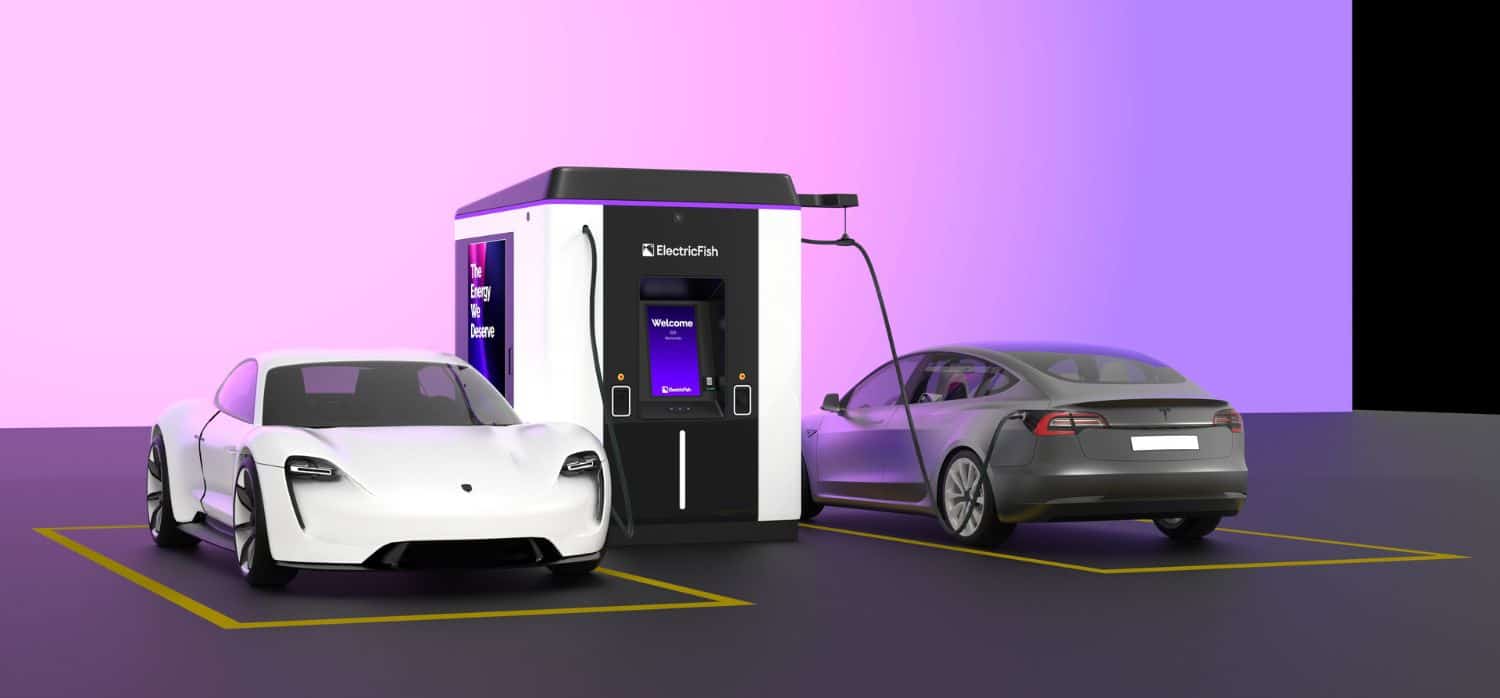
Solving EV Charging Bottlenecks
As the U.S. EV market grows, charging infrastructure remains a key challenge. While America now has over 14,000 DC fast charging stations with 67,000+ individual ports, long installation times and costly grid upgrades slow expansion.
California startup ElectricFish aims to change that with its 400squared DC fast charger, unveiled at CES 2026. The company says its solution can cut installation times dramatically by eliminating traditional power distribution barriers.

How the 400squared Charger Works
Most conventional 300-kilowatt chargers require extensive grid upgrades, which can take months or even years. ElectricFish avoids this by integrating large onboard batteries directly into the charger. The system stores 400 kilowatt-hours of energy and delivers up to 400 kilowatts of power, split as 200 kW per port when two vehicles charge simultaneously.
Batteries allow the charger to store energy when the stalls are free and dispense it to EVs as needed. This approach reduces dependency on heavy grid connections and simplifies installation. The 400squared can be powered by:
-
Split-phase 120- or 240-volt circuits providing at least 55 amps
-
Three-phase 208-volt circuits requiring 83 amps
-
Three-phase 480V at 115 amps for top-spec installations
The company reports a 99% uptime and claims some stations can be fully operational in as little as two hours, as demonstrated at Hyundai’s California Proving Ground.
Applications and Advantages
The 400squared charger is designed for gas stations, commercial centers, fleet operators, and emergency deployments. Its quick setup allows authorities and businesses to provide fast EV charging without relying on third-party stations, making it ideal for urgent or temporary needs.
By reducing the need for costly grid upgrades and simplifying installation, ElectricFish positions the 400squared as a scalable, flexible solution for expanding EV networks quickly and efficiently.
How It Compares to Other Solutions
Battery-backed chargers are gaining traction across the U.S. For example:
-
XCharge is building a 44-stall GridLink hub in Brooklyn, with each charger equipped with a battery
-
Electric Era in Seattle produces battery-powered DC fast chargers used by companies like Costco
ElectricFish’s approach differs by offering an all-in-one unit that stores energy, manages output intelligently, and supports dual-vehicle charging at high power. This combination of speed, flexibility, and ease of installation sets it apart from traditional chargers.

The Road Ahead
As EV adoption continues to grow, faster deployment of charging infrastructure is critical. Battery-powered chargers like the 400squared could play a major role in alleviating range anxiety, enabling EV drivers to charge quickly without waiting for utility upgrades.
If widely adopted, this technology may allow cities, commercial centers, and fleet operators to expand fast charging networks more efficiently and at lower cost, helping bridge the gap between EV growth and charging availability.
Recomend Reading: California’s EV Growth Demands Coordinated Infrastructure Planning
Aktie:
Americans Worry More About EV Range Than Cost, Survey Shows
Why Some EVs Are Designed to Be Charged to 100%