



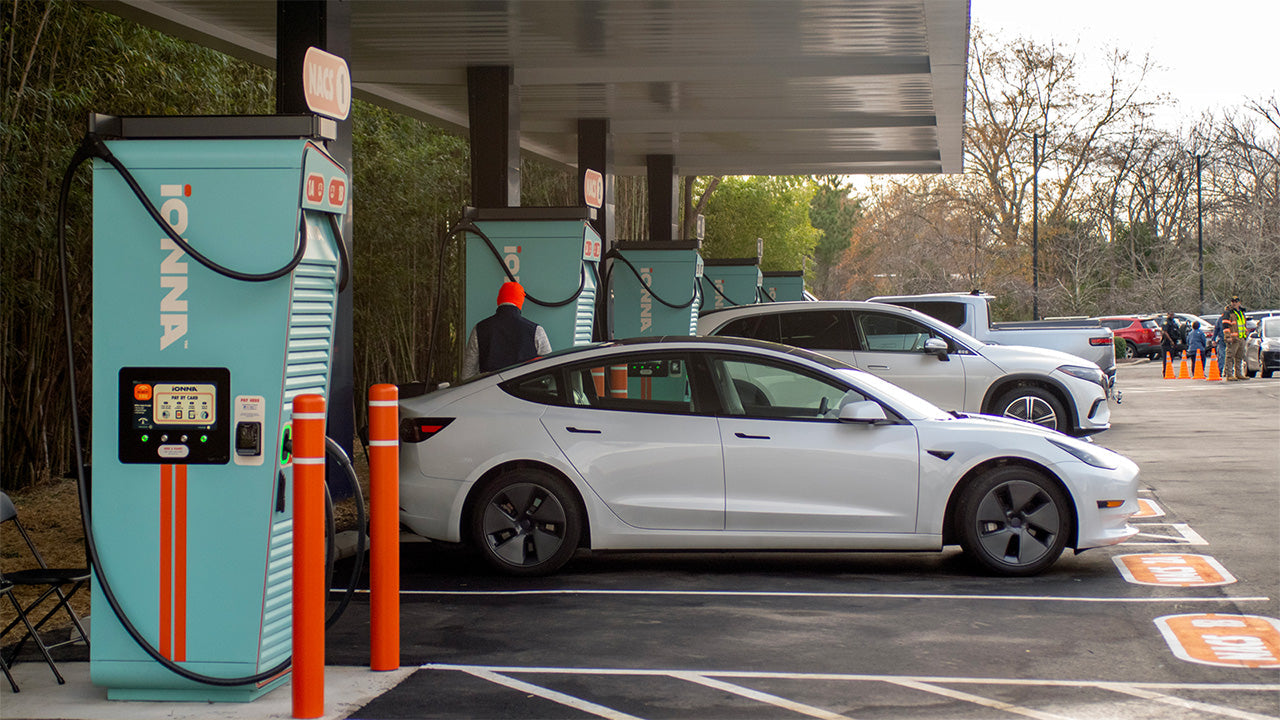
A New Charging Network Gains Momentum Quickly
Ionna, a DC fast-charging network backed by several major automakers, is expanding across the United States at a pace few expected so soon. Less than a year after opening its first locations, the company is already on track to reach a milestone that took earlier charging networks far longer to achieve.
According to company executives, Ionna expects to double both its number of sites and charging stalls by the end of this year, positioning it as one of the fastest-growing charging operators in the country. The network currently operates dozens of locations nationwide, but its expansion timeline suggests rapid scaling is now firmly underway.

Doubling Locations and Charging Stalls
At present, Ionna operates 51 charging locations with 478 active fast-charging ports across the U.S. Company officials say that number will grow significantly within weeks. By the end of December, or shortly after the new year begins, Ionna expects to reach approximately 100 locations and 1,000 charging bays.
This pace of growth is notable for a network that only began operations late last year. The company has already secured contracts for more than 4,000 charging bays, with the first 1,000 scheduled to come online soon. Longer term, Ionna has committed to building 30,000 fast-charging bays by 2030, signaling confidence in sustained EV adoption.
How Ionna Compares to Early Charging Networks
Even Tesla, now synonymous with fast charging, did not scale this quickly in its early years. When Tesla launched the Supercharger network in 2012, it took more than a year to build fewer than 100 locations worldwide. Installation accelerated later, but the initial rollout was comparatively slow.
Part of Ionna’s advantage comes from timing. Fast-charging technology, supply chains, and installation processes are far more mature today. Charging hardware is now sourced from established suppliers, reducing development time. Early players like Tesla had to design and engineer systems from the ground up, which inevitably slowed deployment.
Premium Charging Sites With High-Power Hardware
Speed alone is not Ionna’s only differentiator. The company’s charging sites, branded as “Rechargeries,” are designed with driver comfort and reliability in mind. Many locations feature canopies, on-site amenities, and high-power charging stalls capable of delivering up to 400 kilowatts.
Importantly, the stalls support both CCS and NACS connectors, making them compatible with nearly all modern EVs on U.S. roads. This dual-standard approach reduces friction for drivers and positions Ionna as a network built for the current transition period, rather than betting on a single connector ecosystem.
Automaker Backing Provides Long-Term Stability
Ionna’s rapid expansion is supported by nearly a dozen automakers, giving the network both financial backing and strategic relevance. During recent media briefings, representatives emphasized that charging infrastructure must continue expanding regardless of short-term market fluctuations.
That message comes at a time when EV incentives are shrinking and political support for electrification is less certain. With the federal $7,500 EV tax credit gone, some infrastructure providers may slow investments. Ionna’s partners, however, appear committed to maintaining momentum, viewing reliable fast charging as essential to long-term EV adoption.

Building for the Next Phase of EV Growth
While EV sales growth may fluctuate year to year, charging infrastructure remains a foundational requirement. Ionna’s strategy reflects the belief that robust, well-designed fast-charging networks will outlast policy cycles and market volatility.
By combining aggressive expansion, high-power hardware, and automaker backing, Ionna is positioning itself as a serious contender in the U.S. charging landscape. If it reaches its near-term goals on schedule, it will have achieved in one year what once took the industry several.
Recommend Reading: 300-Mile EV Road Trip Using Only Free Chargers: What One Driver Learned
Partager:
2025 Ford Mustang Mach-E Fixes a Major Usability Flaw
Why 2026 Could Be the Smartest Year to Buy a Used Electric Vehicle