



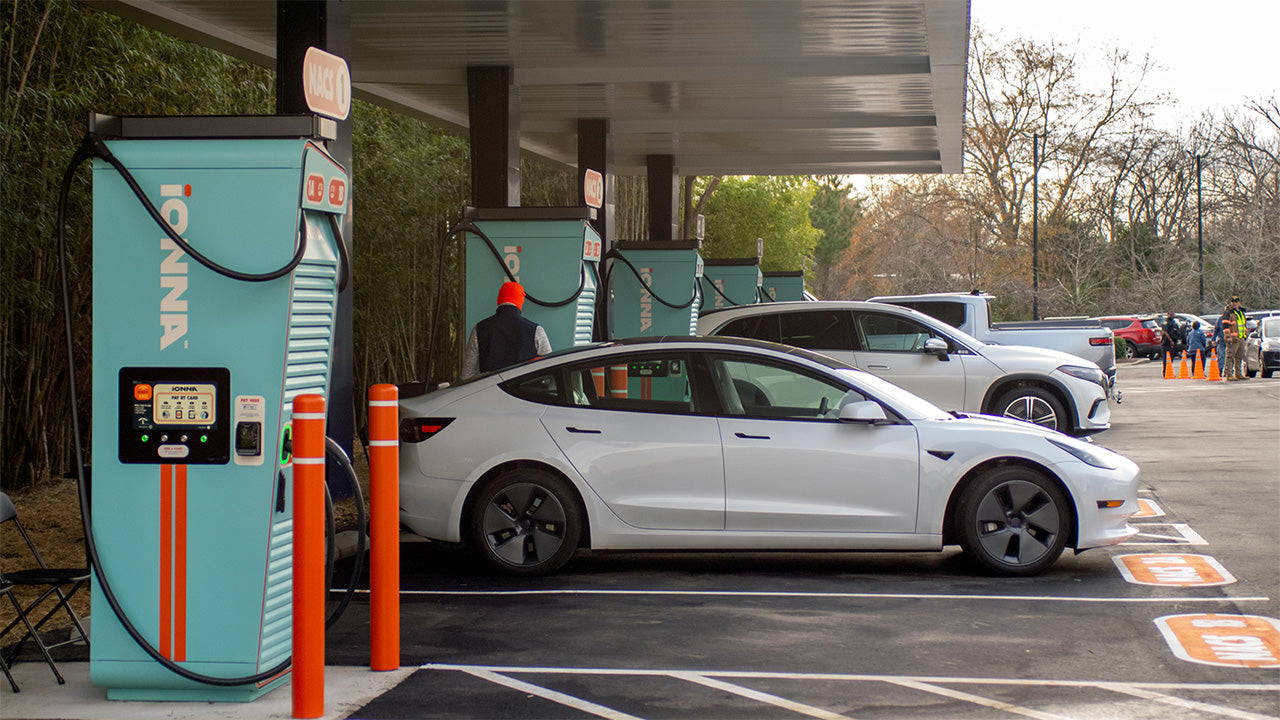
California Becomes a Core Market
Ionna—the fast-charging joint venture backed by eight major automakers including General Motors, Stellantis, Toyota, BMW, Hyundai, Kia and Mercedes-Benz—has announced a significant acceleration of its California deployment plans. Over the next three years, the consortium will invest $250 million in the state as it works to meet rising EV adoption and expand charging access.
Ionna has already contracted more than 1,000 charging bays in California alone, representing nearly one-quarter of the 4,000 stations it plans to build nationwide. The focus makes sense: California remains the largest EV market in the U.S., with 29.1% of new vehicles sold in Q3 being fully electric.

Building Stations Where Drivers Already Stop
Although the national charging landscape is improving, truly reliable stations with high-speed equipment and basic amenities are still less common than many EV drivers would like. Ionna’s model aims to fix that by placing chargers in locations people already frequent—such as Wawa, Sheetz, and similar retail and convenience chains.
In addition to host-partner sites, Ionna is also developing its own flagship facilities, known as “Rechargeries.” These locations feature pet-friendly lounges, Wi-Fi, restrooms and vending machines—designed to make mid-trip charging as comfortable and predictable as a traditional fuel stop.
Why Contracted Sites Don’t Mean Instant Chargers
However, a “contracted” site does not mean chargers are immediately operational. These arrangements typically indicate that Ionna has agreements in place with a property owner, but construction, permitting, and utility coordination may not yet be complete. Local approval processes can stretch for months, and utility upgrades often take even longer.
Even with these challenges, Ionna’s rollout appears to be moving faster than many expected. Less than a year after opening its first Rechargery in Apex, North Carolina, the company already manages 40 stations with 384 charging ports nationwide, according to the Alternative Fuels Data Center.
A Look at the Charging Experience
Real-world performance at Ionna stations has also been promising. One of the company’s newer installations in Scranton, Pennsylvania, integrates 400-kilowatt chargers directly into a Sheetz location. The site offers bright lighting, clean restrooms, and plentiful food options—providing an experience far more aligned with traditional travel stops than many early EV charging stations.
Using the station was described as straightforward: a simple tap-to-pay process, plug-in, and roughly 15 minutes of charging to add enough range for onward travel. This aligns with Ionna’s focus on creating dependable, high-power charging that reduces downtime for EV owners.
More Vehicles Now Support Plug-and-Charge
Convenience is also improving as more automakers enable plug-and-charge capability at Ionna locations. Drivers of electric BMW, General Motors, Hyundai, Kia and Mercedes models can now initiate a charging session simply by plugging in, without needing to authenticate payment.
Ionna confirms that Ford and Rivian vehicles have gained plug-and-charge access as well, which further broadens the seamless charging experience across vehicle brands.

Steady Infrastructure Growth Despite Market Uncertainty
Even though EV sales growth in the U.S. may fluctuate—especially as federal incentives shift and fuel economy regulations evolve—the underlying charging network continues to strengthen. With new stations opening nearly every week, long-distance electric travel is becoming increasingly accessible.
Ionna’s rapid expansion signals that major automakers are committed to building the infrastructure future EV drivers will depend on. And with more high-quality stations coming online, even cautious or older drivers may soon find road trips in an EV to be not just feasible, but enjoyable.
Recommend Reading: Electrify America Now Shows Live EV Charger Availability on Google Maps
Share:
Hyundai Pushes Toward Ultra-Fast EV Charging and Three-Minute Top-Ups
Waymo Accelerates U.S. Robotaxi Expansion Toward More Than 20 Cities