


A Major Step Toward Easier EV Charging

Electrify America, one of the largest electric vehicle fast-charging networks in the U.S., has officially integrated real-time charger availability into Google Maps.
The new feature, which went live earlier this week, allows EV drivers to see instantly which chargers are free—without having to switch between multiple apps.

Until now, users had to open the Electrify America (EA) app separately to check station status. With this new integration, Google Maps now displays up-to-the-minute information for every EA charging site, making trip planning simpler and more seamless.

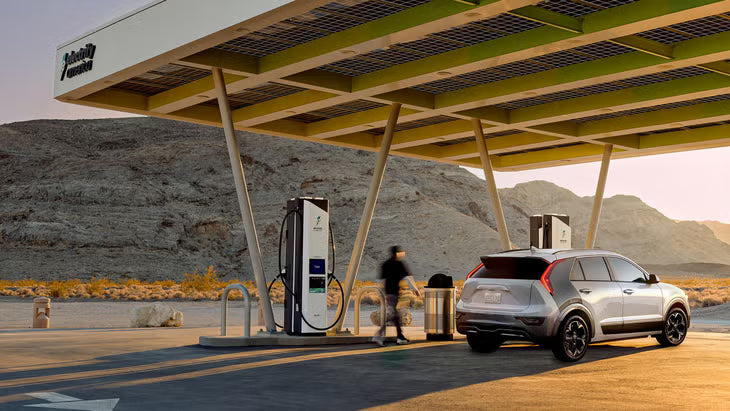
ElectrifyAmerica charging station


Simplifying the Charging Experience

For drivers tired of juggling countless apps, this update offers a big relief. Since Electrify America chargers support card payments, drivers who rely on Google Maps may no longer need the dedicated EA app to locate and access chargers.

By comparison, while Tesla Supercharger stations appear on Google Maps, real-time charger availability is not yet displayed for those locations. Electrify America’s move gives it a usability edge—especially for non-Tesla drivers looking for convenience and reliability.


Detailed Station Information at a Glance

When users tap an Electrify America station on Google Maps, they can now see:

  • Charger types available (CCS, CHAdeMO, or J1772)

  • Number of active connectors

  • Maximum charging power for each connector type

Electrify America’s current network includes 50-kilowatt CHAdeMO chargers and up to 400-kilowatt CCS fast chargers, providing some of the fastest public charging options available. Select locations even feature Level 2 J1772 chargers or pilot units supporting both CCS and NACS connectors, ensuring compatibility with an expanding range of EV models.


Boosting Confidence in Going Electric

EV adoption is accelerating, and with it comes the expectation of a seamless charging experience,” said Robert Barrosa, president and CEO of Electrify America.
He added, “By integrating real-time charging data, we’re empowering drivers with confidence—giving them access to accurate, up-to-date information right at their fingertips.

The update aligns with EA’s broader mission: to make charging as simple and dependable as fueling a gas car.


Expanding Plug & Charge Compatibility

Beyond the Google Maps integration, Electrify America continues to roll out Plug & Charge functionality—allowing compatible vehicles to start charging automatically once plugged in, with payment handled behind the scenes.

Currently, Plug & Charge is supported by Audi, BMW, Ford, Lucid, Mercedes-Benz, Nissan, Porsche, and Volkswagen, with more automakers joining soon. Rivian also announced that its R1T and R1S models will gain Plug & Charge capability through an upcoming software update.

This feature eliminates the need for RFID cards or mobile apps—further streamlining the EV ownership experience.

Electrify America


Nationwide Coverage and Future Growth

According to data from the U.S. Department of Energy’s Alternative Fuels Data Center, Electrify America operates 1,090 DC fast-charging stations across the country, offering a total of 5,199 DC fast-charging ports.

The company continues to expand its footprint in urban centers and along major highways, helping to close gaps in the public charging infrastructure.

With the addition of real-time charger availability on Google Maps and broader Plug & Charge adoption, Electrify America is positioning itself as a key player in improving EV accessibility and driver confidence across the U.S.

Recommend Reading: Comparing EV Charging Stations: Tesla Supercharger vs Electrify America, ChargePoint & More
1 comment

  • EV Driver
    • EV Driver
    • October 23, 2025 at 2:07 pm

    At busy chargers (most of them), the data shown on Google Maps is still nearly useless. “1/4” usually means someone just finished charging, and it will go back to “0/4” in a minute or two.

    There is a detailed writeup on the flaws with the EA charger reporting here: https://frequal.com/Perspectives/FirstAndLastIndependentEaChargerAudit.html

    The article also shows how in LA, you only have a real chance of pulling up and charging at an EA charger between 3AM and 6AM!

    This will only change if we lobby EA to restore detailed API information so we can have good charging tools again. Quick links are at the end: https://frequal.com/Perspectives/FirstAndLastIndependentEaChargerAudit.html

Leave a comment

Please note, comments need to be approved before they are published.

This site is protected by hCaptcha and the hCaptcha Privacy Policy and Terms of Service apply.

FAQs - Level 3 DC Fast Charging

What is Level 3 DC fast charging for electric vehicles?

Level 3 charging, also known as DC fast charging (DCFC), provides direct current at high power levels (typically 50 kW to 350 kW) to quickly recharge an electric vehicle battery. Unlike Level 1 and Level 2 charging, DC fast charging bypasses the onboard charger, enabling much faster energy transfer.

How fast is Level 3 DC fast charging compared to Level 2 charging?

Level 2 chargers (240V AC) usually add 20–30 miles of range per hour, while Level 3 DC fast chargers can add 100–300 miles of range in 20–40 minutes, depending on EV battery capacity and charging power.

Does Level 3 fast charging damage EV batteries?

Frequent use of DC fast charging can accelerate battery degradation over time due to higher heat generation and faster charge cycles. However, modern EVs have battery thermal management systems that minimize impact. Occasional fast charging is safe and convenient for road trips.

What connector types are used for Level 3 DC fast charging?

The main EV fast charging connectors in North America are:

  • CCS (Combined Charging System) – widely adopted by most automakers
  • CHAdeMO – mainly used by older Nissan LEAF models
  • NACS (Tesla plug) – now being adopted across multiple brands (Ford, GM, Rivian, etc.)
What is the maximum power output of Level 3 DC fast charging stations?

Most public DC fast chargers range from 50 kW to 150 kW, while ultra-fast chargers can reach 250 kW to 350 kW. Tesla Superchargers V3 deliver up to 250 kW, and upcoming next-gen chargers may exceed 500 kW for heavy-duty EVs.

How much does Level 3 DC fast charging cost?

Pricing varies by network and location. Costs are usually based on per kWh, per minute, or a flat session fee. In the U.S., rates typically range from $0.25 to $0.60 per kWh, which is higher than home charging but competitive compared to gasoline costs.

Where can I find Level 3 DC fast charging stations in the U.S.?

DC fast chargers are commonly located along highways, rest stops, shopping centers, and EV charging networks like Tesla Supercharger, Electrify America, EVgo, and ChargePoint. Apps like PlugShare and ChargeHub help drivers locate fast charging stations.

Can all EVs use Level 3 DC fast charging?

Not all EVs are compatible. Some plug-in hybrid EVs (PHEVs) and older models lack DC fast charging capability. The maximum charging speed also depends on the vehicle’s onboard DC charging acceptance rate, which can range from 50 kW to 270 kW.

How does weather affect Level 3 DC charging speed?

Extreme cold or heat impacts battery temperature management, reducing fast charging speeds. EVs often precondition the battery before arriving at a fast charger to optimize charging efficiency in winter or summer conditions.

What is the future of Level 3 DC fast charging technology?

The future includes ultra-fast chargers (500 kW+), widespread adoption of NACS connectors, and vehicle-to-grid (V2G) integration. As EV infrastructure expands, Level 3 charging will become even more essential for long-distance travel and heavy-duty electric trucks.

EV News

View all

Tesla Drops Lane-Centering From New Model 3 and Model Y Orders in the U.S.

Tesla Drops Lane-Centering From New Model 3 and Model Y Orders in the U.S.

Tesla has removed Autosteer from all new Model 3 and Model Y trims in the U.S., leaving only adaptive cruise control as standard. The move pushes drivers toward Full Self-Driving subscriptions and has sparked backlash.

Read more

Mercedes GLC EV Demand Surges as Orders Stretch Into 2026

Mercedes GLC EV Demand Surges as Orders Stretch Into 2026

Mercedes-Benz’s new electric GLC SUV is off to a strong start, with demand exceeding expectations and orders extending into 2026, driven by long range, fast charging, and familiar premium appeal across key European markets.

Read more

Scout’s Direct Sales Plan Faces Legal Challenge Over Hybrid EV Definition

Scout’s Direct Sales Plan Faces Legal Challenge Over Hybrid EV Definition

Scout Motors’ plan to sell extended-range electric trucks directly to consumers faces a legal challenge in Colorado, where dealers argue EREVs blur EV definitions and violate franchise laws, potentially reshaping direct sales rules.

Read more