



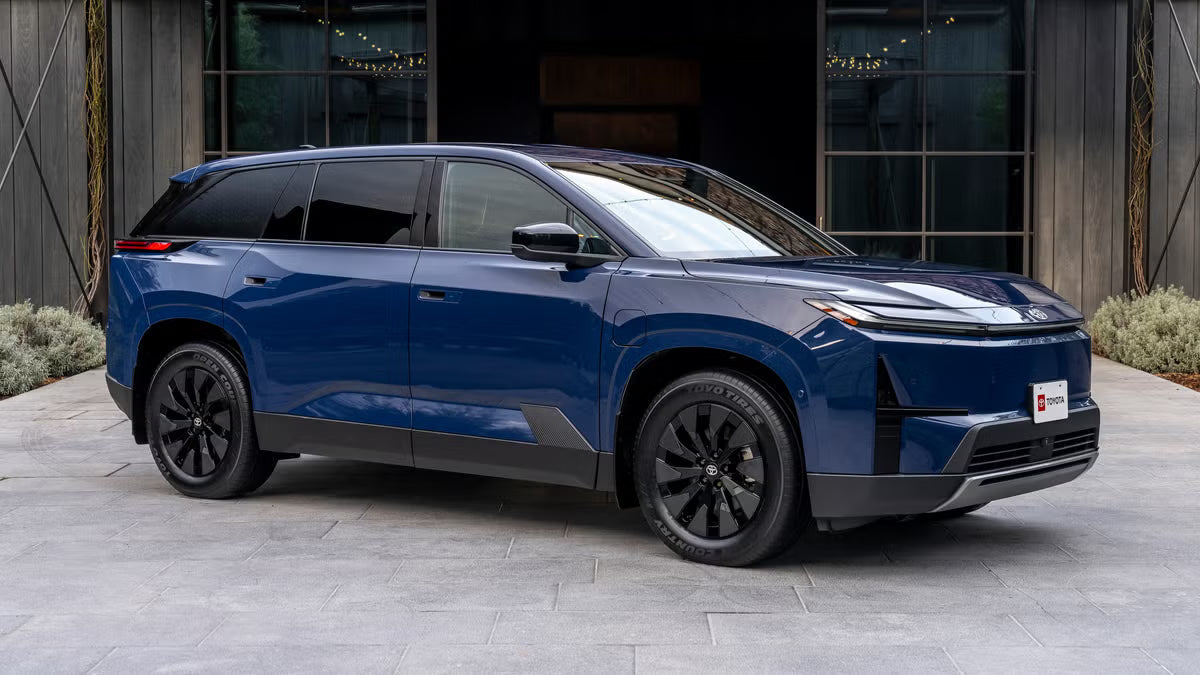
A New Entrant in the Three-Row Electric SUV Market
With the introduction of the Toyota Highlander EV, Toyota signals a stronger commitment to fully electric family vehicles. Entering the competitive three-row SUV category, the Highlander EV goes head-to-head with the Kia EV9 and the Hyundai Ioniq 9, two early mainstream players that brought large electric SUVs to more accessible price levels than premium models like the Rivian R1S or Tesla Model X.
Recent sales underline the importance of this segment. In the past year, the Kia EV9 recorded more than 15,000 deliveries, while the Hyundai Ioniq 9, which launched in May 2025, achieved nearly 5,200 units sold. Meanwhile, the higher-priced Rivian R1S reached almost 25,000 sales, demonstrating steady demand even above the Korean models’ price brackets. Toyota’s strategy appears aimed squarely at this growing market.

Interior Space and Exterior Dimensions
Among the trio, the Hyundai Ioniq 9 stands as the largest, stretching 199.2 inches in length and riding on a 123.2-inch wheelbase. That extra footprint translates into modestly improved third-row legroom and cargo capacity behind the rear seats, offering 21.9 cubic feet of storage.
The Kia EV9, slightly shorter at just over 197 inches with a 122-inch wheelbase, provides 20.2 cubic feet of cargo space in its standard configuration. The Toyota Highlander EV measures 198 inches overall but sits on the shortest wheelbase at 120.1 inches, and its cargo area behind the third row is smaller at 15.9 cubic feet.
Folding the third row alters the rankings. The Ioniq 9 retains its lead with 46.7 cubic feet, followed closely by the Highlander EV at 45.6 cubic feet, while the EV9 offers 43.5 cubic feet. Although Toyota has yet to release full passenger space figures, its shorter wheelbase suggests careful packaging will be required to match the Korean competitors’ rear-seat comfort.
Design philosophies also diverge. The EV9 adopts a traditional upright SUV silhouette, emphasizing practicality and cabin openness. By contrast, both the Ioniq 9 and Highlander EV incorporate more tapered rooflines, lending a sportier visual profile.
Battery Capacity and Driving Range
Battery configurations vary significantly. The Hyundai Ioniq 9 comes exclusively with a 110.3-kWh battery, delivering up to 335 miles of EPA range in rear-wheel-drive form and 320 miles with dual motors.
The Kia EV9 provides more choice. A 76.1-kWh pack offers approximately 230 miles, while an upgraded 99.8-kWh battery extends range to 305 miles.
Toyota plans two options for the Highlander EV: a 77-kWh battery and a larger 95.8-kWh unit. Early estimates suggest the bigger pack could enable up to 320 miles, though final EPA certification may adjust that figure.
Charging Technology and Performance
Charging capability marks a key distinction. Both the Ioniq 9 and EV9 use an 800-volt electrical system, allowing rapid replenishment at high-powered stations. When connected to a 350-kW DC fast charger, the Hyundai can move from 10% to 80% in about 20 minutes, while the Kia requires roughly 24 minutes.
The Highlander EV relies on a 400-volt platform, with Toyota projecting approximately 30 minutes for the same 10%–80% window. All three models feature native NACS ports, granting direct access to Tesla’s Supercharger network without adapters, and each supports bidirectional energy flow.
Power outputs also differ. The base Highlander EV employs a 221-horsepower front-mounted motor, exceeding the entry-level EV9 at 201 hp and Ioniq 9 at 215 hp, both rear-wheel drive. Dual-motor variants raise the Highlander’s output to 338 hp, compared with 379 hp for the EV9 and 422 hp for the Ioniq 9.

Market Position and Pricing Outlook
Toyota’s newest electric SUV aligns closely with its Korean rivals in size, capability, and feature set. It does not redefine the class in measurable terms, yet it competes across the same benchmarks. Pricing remains the critical unknown.
Given consumer trust in the Toyota brand and the demonstrated demand for large electric SUVs, the Highlander EV’s reception will likely depend on how it is positioned financially relative to the EV9 and Ioniq 9. If competitively priced, it could quickly secure a foothold in a segment that continues to expand.
Recommend Reading: Toyota Confirms Electric Highlander as Its First Three-Row EV SUV


Partager:
Why Ford’s CEO Says Software Is a Bigger Shift Than EVs
2026 Toyota C-HR EV Review: Strengths and Weaknesses