





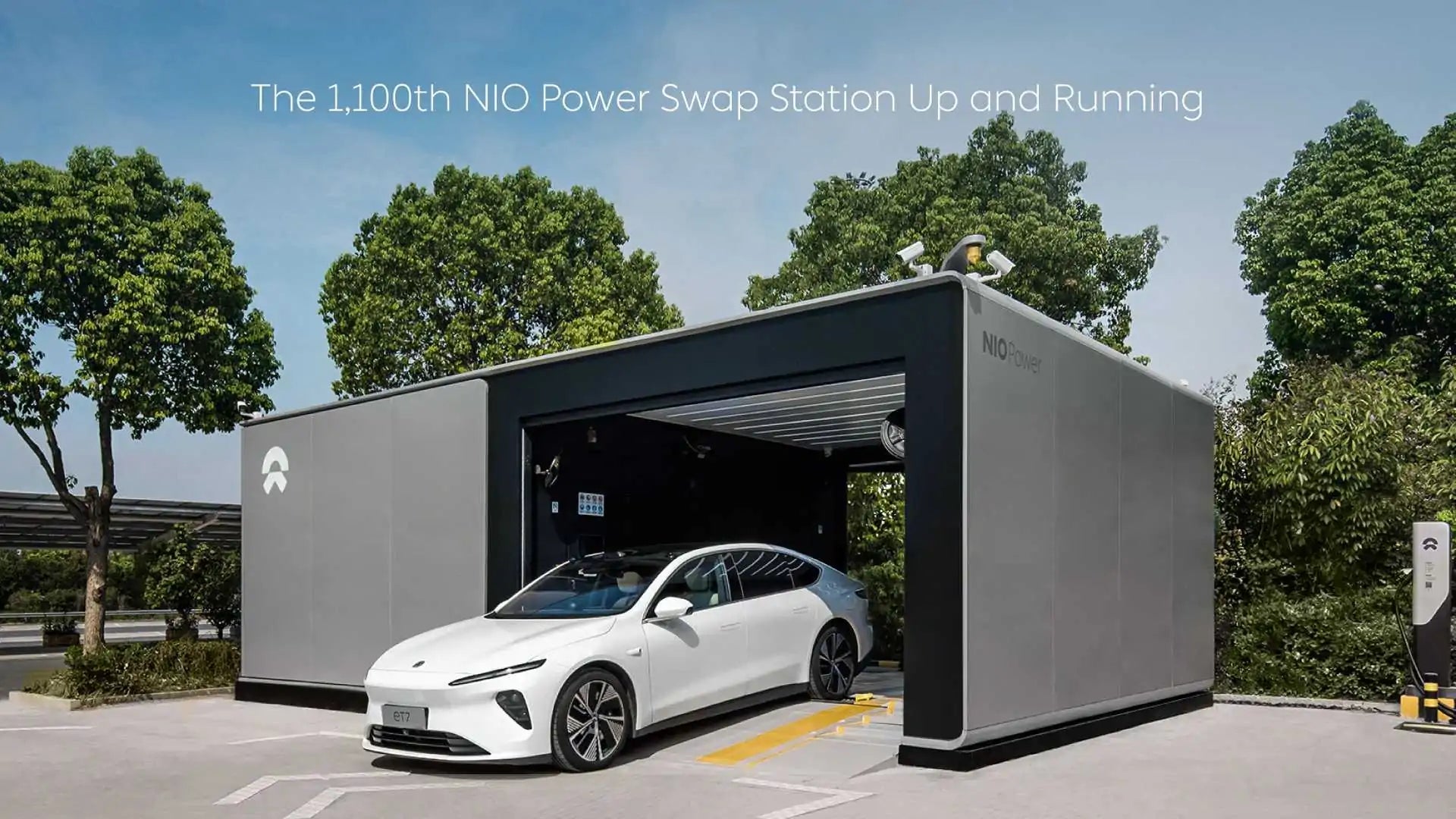
A Different Answer to the Charging Problem
While most electric vehicle discussions center on faster chargers and shorter wait times, Nio has pursued a fundamentally different solution. Instead of plugging in, drivers pull into an automated station where a depleted battery is removed and replaced with a fully charged unit. The entire process takes only a few minutes, offering an experience closer to refueling a gasoline car than waiting at a charger.
This approach has become a defining element of Nio’s brand identity, particularly in China, where dense urban living and limited private parking make home charging difficult for many drivers.

A Major Milestone for a Young Automaker
That strategy recently reached a symbolic benchmark. Nio completed its 100 millionth battery swap in China, marking a rare achievement in the global EV industry. The milestone swap was carried out by an owner of an ET5 Touring in the city of Haining, according to the company.
To mark the occasion, founder and CEO William Li hosted a livestream event that included customers, employees, and commercial partners. The celebration underscored how central swapping has become to Nio’s long-term vision, rather than a side experiment or niche service.
Since launching its first stations in 2018, Nio says its swap network has delivered a cumulative 5.28 billion kilowatt-hours of energy to vehicles worldwide.
Scale and Geographic Reach
The company’s swapping infrastructure has expanded rapidly. Nio currently operates 3,790 swap stations globally, with the vast majority located in China. However, the system has also been deployed in parts of Europe, including Norway, Germany, Sweden, and Denmark, where Nio has been testing whether the model can work outside its home market.
Although charging networks continue to dominate EV infrastructure investment, Nio has signaled that swapping will remain a parallel focus. The company has stated plans to add at least 1,000 new swap stations in 2026 alone, a pace that suggests long-term commitment rather than gradual winding down.
Why Drivers Are Drawn to Battery Swapping
For many customers, the appeal goes beyond speed. Nio allows buyers in several markets to separate the battery from the vehicle purchase, lowering the upfront cost of the car. In China, this “battery-as-a-service” option can reduce the purchase price by around $10,000, replacing it with a monthly subscription fee.
That subscription grants drivers access to the swap network and ensures that each battery installed meets health and performance standards. Owners are also not locked into a single battery size. A vehicle initially sold with a 75 kWh pack can temporarily or permanently switch to 100 kWh or even 150 kWh batteries, depending on availability and needs.
This flexibility is particularly attractive for drivers who occasionally need longer range but do not want to pay for a larger battery year-round.
Addressing Common Criticism
Despite its popularity, battery swapping has faced skepticism. Critics argue that the land requirements, station costs, and battery logistics make the system inefficient compared to expanding fast-charging networks. Managing thousands of large battery packs also introduces operational complexity that most automakers prefer to avoid.
Nio counters that swapping and charging are not mutually exclusive. The company continues to invest in public fast chargers while positioning swapping as a complementary solution for urban users, fleet customers, and drivers without reliable home charging access.
In China, where ultra-fast charging technology capable of adding significant range in minutes is emerging, availability remains limited. Until those systems are widespread, swapping offers a practical workaround.
Industry Support and Standardization Efforts
Battery swapping is no longer confined to a single brand. In 2025, major battery supplier CATL, along with other industry players, announced cooperation with Nio to explore standardized battery swap solutions in China. The goal is to make swapping compatible across multiple vehicle brands, potentially reducing costs and increasing adoption.
Nio has also confirmed that its expanding network will support not only its core lineup, but also vehicles from its newer Firefly and Onvo brands, broadening the system’s user base.

Environmental Claims and Open Questions
Nio maintains that its swapping ecosystem delivers environmental benefits as well. The company estimates that its vehicles have reduced carbon emissions by 4,169 tons compared with similar internal combustion models. While the exact methodology behind this figure has not been fully disclosed, the sheer scale of 100 million swaps in under a decade suggests significant displacement of gasoline use.
Whether battery swapping becomes a global standard remains uncertain. However, Nio’s experience shows that when infrastructure aligns with real-world driving constraints, consumer behavior can shift faster than expected.
Recommend Reading: GAC Enters Europe With Affordable EVs, Following Xpeng’s Lead










Share:
Lucid Plans a $50,000 Electric SUV, but Rules Out Budget EVs
How Kia’s EV2 Performed in Norway’s Winter Range Test