





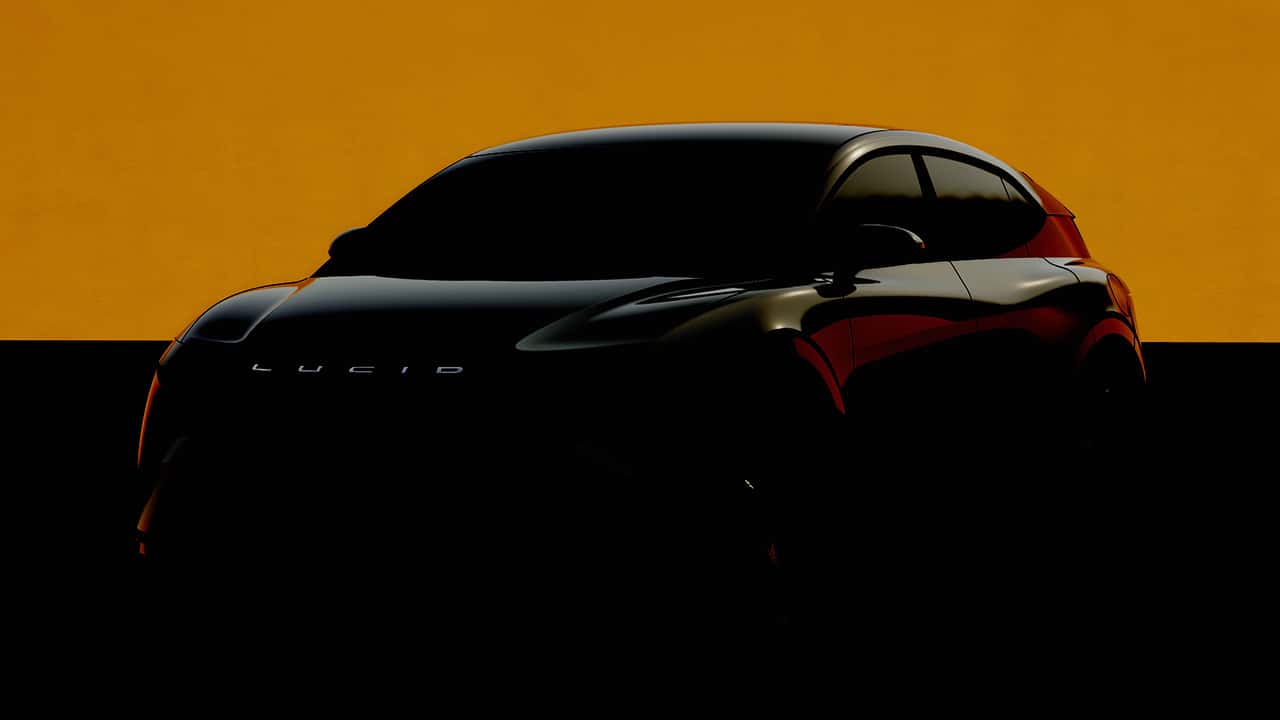
A Premium Automaker Sets Clear Price Boundaries
Lucid Motors has confirmed that its next major product will significantly expand its reach—but not its affordability beyond a certain point. Best known for the high-end Lucid Air sedan and the upcoming Gravity SUV, the California-based EV maker is preparing to enter a lower price tier while maintaining its premium positioning.
Today, Lucid’s vehicles span a wide range, with entry prices starting at roughly $71,000 and rising to well over $200,000 for fully equipped models. That pricing strategy will shift later this year, when the company begins producing its first mid-size electric vehicle, expected to land at approximately $50,000. Even so, company leadership has made it clear that this figure represents a floor, not a stepping stone toward mass-market EVs.

Why $50,000 Is as Low as Lucid Intends to Go
Speaking at a recent BloombergNEF Summit in San Francisco, Lucid CEO Marc Winterhoff emphasized that the brand has no intention of competing in the lower-cost EV category. According to Winterhoff, Lucid sees itself firmly rooted in the luxury and premium space, even as it broadens its lineup.
He noted that vehicles priced in the $30,000 to $35,000 range are not part of Lucid’s future planning. Instead, the company aims to deliver higher performance, efficiency, and refinement than mainstream competitors, rather than chasing volume through aggressive cost cutting.
This approach distinguishes Lucid from automakers attempting to scale down-market as EV adoption grows. For Lucid, preserving brand identity appears to outweigh the potential sales gains of entering the budget segment.
Entering One of the Most Competitive EV Segments
Lucid’s upcoming mid-size model is widely expected to take the form of a crossover SUV, placing it directly into the most crowded and competitive EV category globally. At an estimated $50,000, the vehicle will face established and upcoming rivals including the Tesla Model Y, Mercedes-Benz GLC, BMW iX3, Volvo EX60, and the future Rivian R2.
Winterhoff has argued that the chosen price point aligns closely with the broader U.S. automotive market, not just electric vehicles. He described it as roughly equivalent to the average transaction price across all vehicle types, including gasoline-powered cars, positioning the new model as Lucid’s gateway to a much larger audience.
Manufacturing Strategy Centers on Saudi Arabia
Production of Lucid’s most affordable vehicle is scheduled to begin in late 2026, with manufacturing split across multiple regions. A key pillar of this plan is the company’s growing facility in Saudi Arabia, which Lucid views as critical to its global expansion.
At present, the Saudi plant assembles Air sedans using partially completed kits. Over time, the site is expected to transition into a full-scale production hub capable of supplying markets well beyond the Middle East. Lucid plans to export vehicles from Saudi Arabia to Europe and Asia, while its U.S. factory is expected to focus primarily on North American demand.
According to Winterhoff, the long-term vision for the Saudi operation is not limited to serving local buyers but includes acting as a central export base for multiple international regions.
A Flexible Platform With Multiple Models Planned
The new mid-size vehicle will not be a one-off product. Lucid has confirmed that the underlying platform will support three distinct models over several years. The first is expected to be a crossover SUV, followed by a second variant slated for early 2028. A third model is planned to arrive approximately 18 months later.
Notably, Lucid has ruled out building a sedan on this platform. That decision removes the possibility of a direct competitor to vehicles like the Tesla Model 3, signaling that Lucid believes crossovers and SUVs offer stronger long-term demand in this segment.

Recent Momentum, With Challenges Ahead
Despite a broader slowdown affecting many EV manufacturers, Lucid reported a strong operational year. In 2025, the company produced 18,378 vehicles, roughly double its output from the previous year, and delivered 15,841 units to customers.
While these figures represent meaningful progress, Lucid remains a niche player compared with industry leaders such as Tesla and General Motors. The success of its mid-size platform will likely play a central role in determining whether the company can scale beyond its current low-volume status without compromising its premium image.
Recommend Reading: Lucid CEO Says EVs Were Sold the Wrong Way—and It’s Holding the Market Back









Share:
Toyota Confirms Electric Highlander as Its First Three-Row EV SUV
Why Nio’s Battery Swapping System Has Won Over Millions of EV Owners