



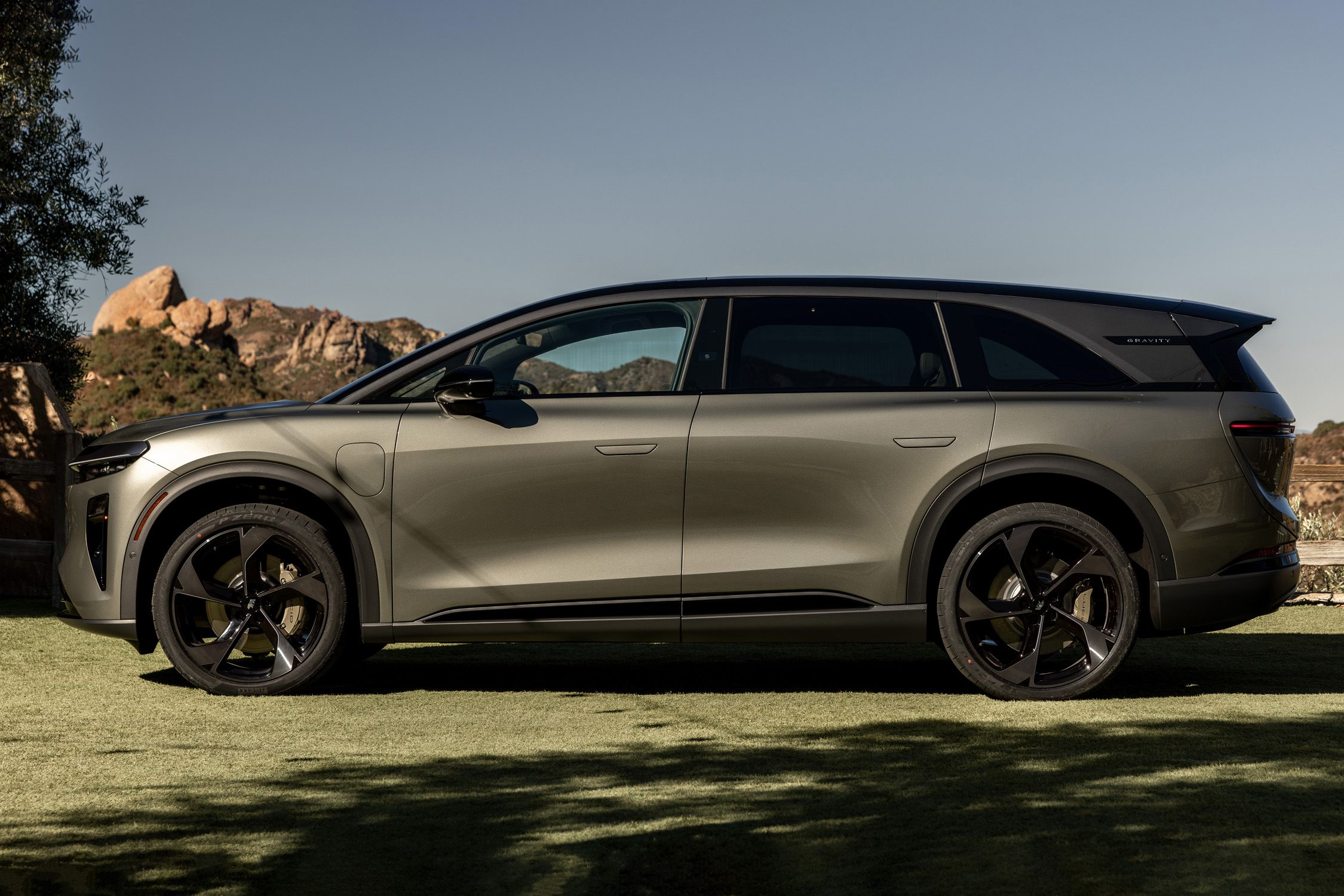
Lucid built its reputation on delivering electric vehicles with exceptional efficiency, long-distance capability, and advanced in-house engineering. Its first model, the Air, set new benchmarks for range in the EV market. Naturally, expectations for its second vehicle—the Gravity SUV—were sky-high. While early real-world tests left many observers puzzled, a recent retest has offered a much clearer picture of what the Gravity can truly deliver.

Gravity’s Range Promise and Early Disappointment
Lucid positioned the Gravity Grand Touring as a long-range electric SUV capable of up to 450 miles, according to EPA estimates. That figure comes from an aerodynamic body, Lucid’s proprietary electric motors, and a massive 123-kWh battery pack. Priced at just over $96,000, the Gravity aims for the upper tier of the premium EV segment.
Yet early independent testing didn’t go as planned. In an initial highway test conducted at a steady 70 mph, reviewer Tom Moloughney recorded just 345 miles—well below both the EPA rating and Lucid’s typical real-world performance. The efficiency number, 3.0 mi/kWh, was roughly 20% lower than the SUV’s EPA cycle results. Since EPA testing blends city and highway driving, some discrepancy is normal, but this drop was significant enough to raise eyebrows.
Lucid shared those concerns. After evaluating the test vehicle, the company discovered a mechanical issue in the rear drive unit, prompting a full motor replacement. With the SUV repaired, Moloughney agreed to conduct a fair, controlled retest.
A Dramatic Turnaround in the Second Test
Under similar conditions—but with a properly functioning drive unit—the Gravity delivered a dramatically different outcome. In the second test, Moloughney achieved 401.3 miles on a full battery, using 99.8% of its charge. That marked a 16% improvement over the first attempt and brought efficiency up to 3.43 mi/kWh, much closer to the 3.6 mi/kWh seen on the EPA cycle.
This result falls in line with expectations for a highway-only test, where EVs typically perform at their worst compared to blended city/highway cycles. While still shy of its 450-mile EPA rating, a 400-mile highway range is a strong result for a family-sized electric SUV.
Another observation from the retest stood out: the Gravity appeared unusually sensitive to temperature changes. Even a 20–30°F shift during the day in Arizona resulted in a 6% gain in efficiency. The first test, conducted in colder New Jersey conditions, suggests that ambient temperature may influence the Gravity more than many competing EVs.
Comparisons With Other Independent Tests
Moloughney’s highway drive was not the only recent range test of the Gravity. Another independent test reported 358 miles, aligning more closely with typical real-world highway expectations and hinting that the SUV’s actual range may sit in the 360–400-mile band, depending on driver behavior and conditions.
These variations underline the complexity of EV testing. Terrain, temperature, and driving style can all create significant swings in final results. Still, the consistency of results above 350 miles indicates that the Gravity has substantial long-distance capability.

What the New Results Mean for Lucid
Lucid designed the Gravity to serve as a luxury, long-range alternative in the rapidly expanding electric SUV category. While the first test raised concerns about whether the SUV could meet its ambitious claims, the retest shows the vehicle is far closer to expectations when operating as intended.
Delivering over 400 miles at highway speeds places the Gravity among the most capable long-range EV SUVs on the market today. It still trails Lucid’s Air Grand Touring, which remains the king of ultra-long-range EVs, but the Gravity’s performance is more than adequate for long trips, daily commuting, and real-world family use.
The retest also highlights the importance of correct calibration and mechanical condition in evaluating EV performance. With its engineering foundations validated, the Gravity appears far better positioned to meet the expectations set by its EPA rating and Lucid’s reputation for efficiency.
Recommend Reading: Uber Turns to Lucid Gravity for Its Next Wave of Autonomous Ride Services


Share:
How Porsche Improved the Taycan’s Range and Charging Speed
BMW Names New CEO as the Company Enters a High-Stakes EV Transition