





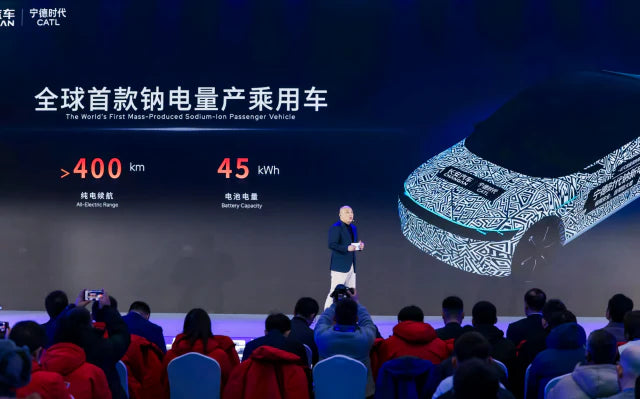
China’s battery and automotive industries are preparing for a major milestone. CATL and Changan Automobile are targeting mid-2026 to introduce the world’s first mass-market passenger EV powered by sodium-ion batteries, a move that could reshape how electric vehicles handle cost, safety, and extreme weather.

A New Battery Chemistry Enters Production
CATL confirmed that its Naxtra sodium-ion battery will make its production debut in the Changan Nevo A06 sedan. The vehicle is expected to deliver approximately 400 kilometers (249 miles) of range under the China Light-Duty Test Cycle.
Following the initial rollout, CATL plans to expand sodium-ion batteries across Changan’s broader lineup, including models from Avatr, Deepal, Qiyuan, and Uni. According to CATL, this marks a strategic shift toward offering multiple battery chemistries tailored to different use cases rather than relying on a single dominant technology.
Why Sodium-Ion Matters for the EV Industry
Sodium-ion batteries are emerging as a serious alternative to lithium-based chemistries, particularly lithium iron phosphate (LFP), which currently dominates China’s EV market.
Sodium offers several structural advantages:
-
It is far more abundant than lithium
-
It is significantly cheaper to source
-
It eliminates dependence on geopolitically sensitive lithium supply chains
More importantly, sodium-ion batteries are inherently safer, with studies indicating no risk of thermal runaway—a key concern for lithium-ion packs.
Energy Density and Vehicle Applications
From a performance standpoint, CATL’s Naxtra battery is competitive but not designed to replace high-energy-density chemistries.
The battery delivers 175 watt-hours per kilogram, placing it roughly on par with LFP batteries and below nickel-rich lithium chemistries. This makes sodium-ion best suited for:
-
Entry-level and mid-range EVs
-
Urban-focused vehicles
-
Stationary energy storage systems
To maximize usable range, CATL employs a cell-to-pack architecture, integrating cells directly into the battery pack. This design efficiency enables the Nevo A06 to reach its 400-kilometer range despite lower energy density.
Long-Term Range Improvements on the Roadmap
CATL says sodium-ion technology still has significant headroom for improvement.
As manufacturing scales and the supply chain matures, the company expects:
-
Up to 600 kilometers (373 miles) of range in future battery-electric vehicles
-
Around 400 kilometers (249 miles) of electric-only range in extended-range EVs and hybrids
According to CATL, these figures would satisfy more than half of the typical range needs in China’s passenger EV market.
Cold-Weather Performance Is the Real Breakthrough
Where sodium-ion batteries truly stand apart is performance in extreme cold.
CATL claims that the Naxtra battery delivers:
-
Three times the discharge power of LFP batteries at -30°C (-22°F)
-
More than 90% range retention at -40°C (-40°F)
-
Stable power output down to -50°C (-58°F)
If validated by independent testing, this would address one of the most persistent EV complaints: severe winter range loss.
Real-World Validation Still Pending
Despite promising specifications, CATL’s claims remain unverified outside the lab. Independent testing and real-world usage will ultimately determine whether sodium-ion batteries live up to their potential.
While the Naxtra battery is not expected to launch in the U.S., its cold-weather advantages could make it particularly attractive in regions with harsh winters, such as northern China, Northern Europe, and parts of Canada.

A Future Defined by Multiple Battery Chemistries
Lithium-ion batteries are not going away. Instead, the EV industry appears to be moving toward a multi-chemistry future, where different battery types coexist based on cost, climate, and driving needs.
Much like internal combustion engines evolved into multiple formats over time, battery diversity may become a defining feature of the next phase of electric mobility—giving consumers more choice and better performance in the conditions that matter most to them.
Recommend Reading: CATL's New 5C Battery: Ultra-Fast Charging Without Early Degradation


Share:
Solid-State Battery Claims Face Reality Check as Verge Motorcycle Deliveries Slip
Ford Targets Affordable Electric Pickups With a New Universal EV Platform