





From Early Export Model to Major Overhaul
Chinese automakers have rapidly shifted global perceptions over the past decade. Once associated with low-cost imitations, many brands now deliver competitive electric vehicles that challenge established Western manufacturers. Among the first wave of exports was BYD’s compact crossover known as the Atto 3, or Yuan Plus in several regions.
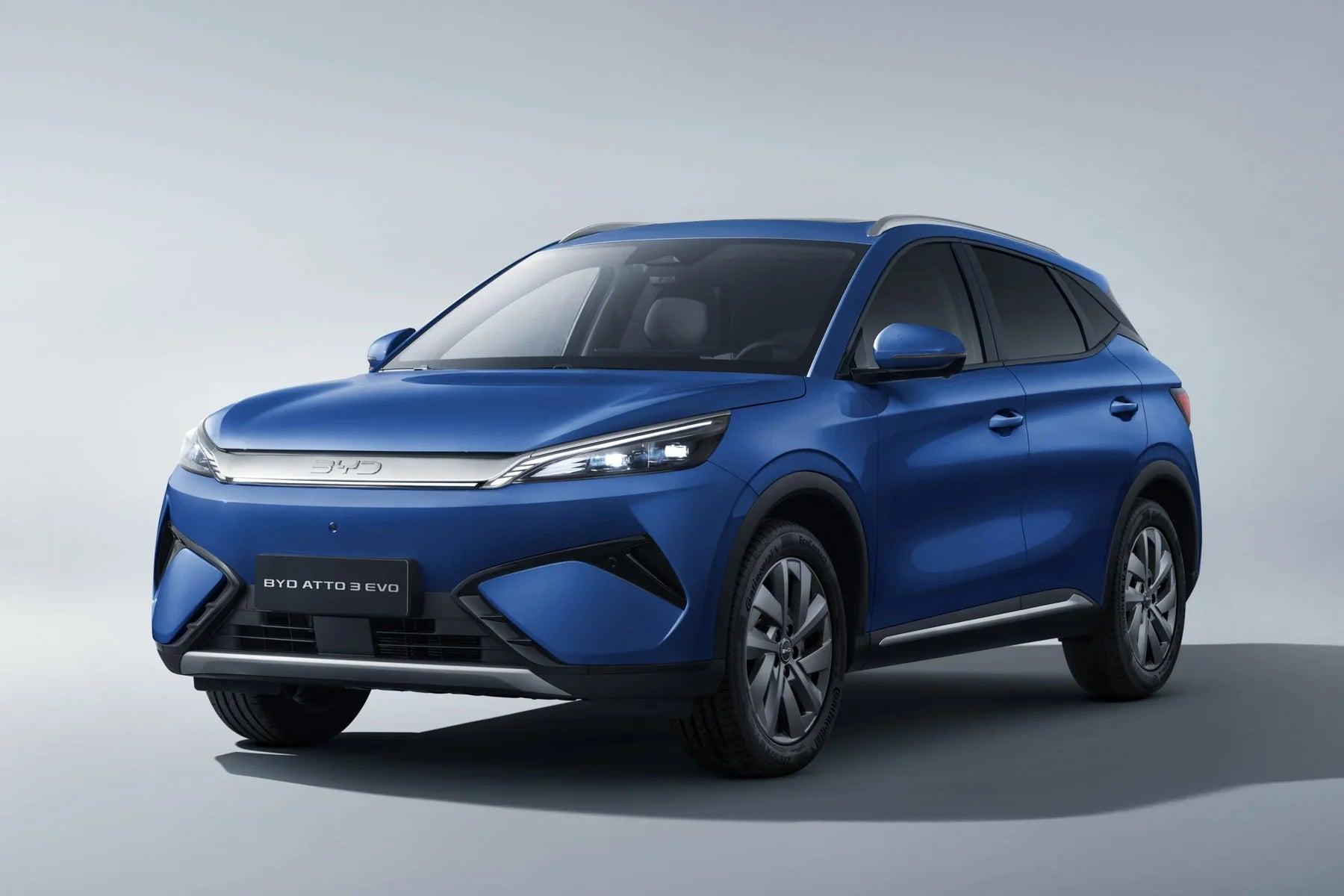
Introduced to European buyers as an affordable, practical EV, the model found moderate success. However, competition in the compact electric SUV segment has intensified. For the 2026 model year, BYD has introduced a substantially revised version for Europe, renaming it the Atto 3 Evo and implementing changes that extend far beyond cosmetic tweaks.

A Shift in Drivetrain Philosophy
One of the most significant mechanical revisions involves the vehicle’s layout. The earlier version relied solely on a front-mounted motor driving the front wheels. In contrast, the updated model adopts a rear-wheel-drive configuration as standard, altering both balance and performance characteristics.
Higher trims add a second motor at the front axle, creating an all-wheel-drive system. This dual-motor arrangement transforms the crossover into a much quicker vehicle than before.
Output figures highlight the scale of the change. The rear-drive Atto 3 Evo now produces 308 horsepower, enabling a sprint from 0 to 62 mph in 5.5 seconds. The all-wheel-drive version raises total output to 443 horsepower, cutting the same acceleration benchmark to just 3.9 seconds. These figures represent more than a simple incremental improvement; they reposition the model within its segment.
Battery Expansion and Faster Charging
Powertrain upgrades are accompanied by a larger energy pack. The previous generation used a battery with roughly 60 kWh of capacity. That unit has been replaced with a 75 kWh pack, delivering a WLTP-rated range of 317 miles (510 km). The outgoing model offered approximately 261 miles (420 km) under the same test cycle.
Charging capability has also improved substantially. Maximum DC fast-charging now reaches 220 kW, allowing the battery to move from 10% to 80% state of charge in around 25 minutes under optimal conditions. BYD attributes part of this improvement to a new 800-volt electrical platform, which supports higher charging speeds and improved thermal management.
In practical terms, these updates bring the Atto 3 Evo closer to segment leaders that emphasize both long range and reduced charging downtime.
Design Evolution Rather Than Reinvention
Externally, the Atto 3 Evo retains the recognizable proportions of its predecessor. The overall silhouette remains compact, similar in footprint to popular electric crossovers such as the Hyundai Kona Electric. Visual revisions are subtle, focusing on refined trim elements, updated wheel designs, and additional paint options.
Inside, adjustments are similarly restrained. The cabin layout has been simplified in certain areas, with improved material finishes and minor ergonomic refinements. One noticeable practical change involves the charging port location, which has moved from the front passenger-side fender to the rear quarter panel on the same side. This repositioning aligns the vehicle with common European charging infrastructure layouts.
While the styling changes are incremental, the underlying hardware revisions are far more extensive.
Market Positioning and Competitive Context
When the Atto 3 first entered overseas markets, its specifications were considered adequate for the time. With 204 horsepower, an acceleration time of roughly eight seconds to 60 mph, and a peak charging rate below 100 kW, it met expectations for a value-oriented electric crossover in the early 2020s.
However, industry benchmarks have advanced quickly. Competing models now routinely exceed 300 horsepower and offer significantly faster charging. BYD’s response appears designed to eliminate any perception that the Atto 3 lags behind.
Although official European pricing for the Evo has not yet been disclosed, the strategy will hinge on maintaining competitive cost positioning. If the upgraded model remains close to the outgoing version’s price bracket, it could present a compelling alternative to vehicles such as the Tesla Model Y and other midsize electric SUVs.

Limited Prospects in North America
Despite its enhanced specifications, the likelihood of the Atto 3 Evo reaching the United States remains minimal due to regulatory and trade barriers. Canada may present a more plausible entry point, though no formal plans have been announced.
Even so, the significance of the Atto 3 Evo extends beyond a single region. The model illustrates how Chinese manufacturers are iterating quickly to remain relevant in export markets. By doubling output, increasing range, and adopting high-voltage charging technology within a familiar body style, BYD signals a willingness to upgrade mainstream products at a rapid pace.
Whether the Atto 3 Evo achieves strong sales will depend largely on final pricing and brand perception. What is clear is that the revised model no longer competes on affordability alone. Its technical credentials now align more closely with higher-performing electric crossovers in Europe’s increasingly crowded EV landscape.
Recommend Reading: BYD Seal U Tops Europe’s Plug-In Hybrid Sales in 2025


Share:
How Rivian Used R1 Feedback to Develop the New R2 SUV
Why Honda’s EV Sales Fell and What It Means for GM