





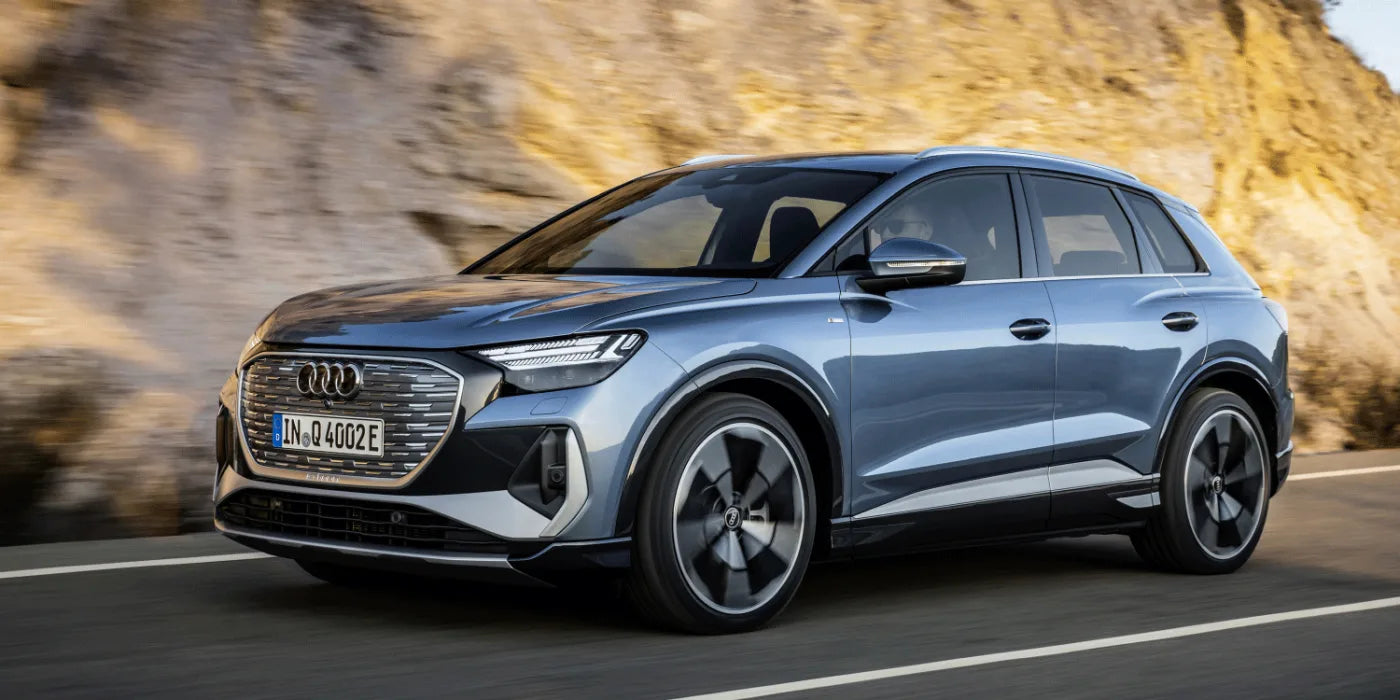
Audi’s updated Q4 e-tron delivers longer driving range, improved charging speeds, and upgraded in-car technology, making it more competitive without a full redesign. The changes focus on efficiency, usability, and digital features rather than a complete overhaul.

Improved Efficiency and Extended Range
One of the most meaningful updates lies beneath the surface. Audi has introduced a revised electric motor that is roughly 10% more efficient than before. This improvement directly translates into increased driving range across multiple variants.
For the rear-wheel-drive SUV version with the largest battery, maximum WLTP range now reaches 578 km (359 miles). The more aerodynamic Sportback version goes slightly further, achieving 592 km (368 miles). Even all-wheel-drive configurations benefit, gaining between 9 and 20 additional miles, depending on the setup.
These gains may appear incremental, but in a segment where range comparisons heavily influence buying decisions, even small improvements can shift competitiveness.
Powertrain and Charging Enhancements
Audi has also adjusted performance outputs across the lineup. Entry-level versions now produce 201 horsepower, while higher-spec rear-wheel-drive models reach 282 horsepower. Dual-motor variants see outputs increase to 295 hp and 335 hp, respectively.
Charging performance has been refined as well. The top-tier versions now support peak DC fast charging of 185 kW, an increase over previous figures. Other trims continue to charge at 160–165 kW, maintaining solid mid-tier performance.
With the 82 kWh battery, charging from 10% to 80% takes approximately 27 minutes under optimal conditions. A short 10-minute session can add around 180 km (112 miles) of range, reinforcing the vehicle’s practicality for longer trips.
Bidirectional Charging Capabilities
A notable addition is support for bidirectional energy use. The updated Q4 e-tron now includes vehicle-to-load (V2L) and vehicle-to-home (V2H) functionality.
Through a standard-style outlet located in the cargo area, the car can deliver up to 2.3 kW of power, enabling users to run household devices or small appliances directly from the vehicle. This feature expands the car’s utility beyond transportation, particularly in outdoor or emergency scenarios.
Exterior and Lighting Updates
Visually, the changes are subtle but modernizing. The front end receives redesigned LED headlights with customizable daytime running light signatures, allowing drivers to personalize the vehicle’s appearance.
The grille and bumper have been revised for a cleaner look, while the rear now features second-generation digital OLED taillights. These also support multiple lighting patterns, aligning with the customization theme introduced at the front.
Overall, the design evolution is conservative, focusing on refinement rather than reinvention.
Interior Technology and Infotainment
Inside the cabin, Audi has updated the digital interface significantly. The vehicle now comes standard with two curved displays: an 11.9-inch driver screen and a 12.8-inch central touchscreen. An optional 12-inch passenger display is also available.
The infotainment system runs on a new platform based on Android Automotive OS, branded as One Connected. It includes an AI-powered voice assistant capable of handling more natural interactions and integrating advanced language processing features.
An optional augmented-reality head-up display projects navigation and assistance data onto the windshield, appearing as a large virtual overlay within the driver’s field of view.
One physical change worth noting is the steering wheel. The previous squared-off design has been replaced with a more traditional round wheel, improving familiarity and ergonomics.
Expanded Driver Assistance Features
Audi has broadened the list of standard driver assistance systems. These now include adaptive cruise control, lane departure warning, traffic sign recognition, and fatigue monitoring.
Additional safety technologies such as front cross-traffic alert, evasive steering assist, and automatic emergency braking are also integrated. Parking sensors with visual distance indicators further enhance everyday usability.
Together, these systems reflect a continued push toward semi-automated driving support in this segment.
Pricing and Market Position
In Germany, the entry-level Q4 e-tron equipped with a 63 kWh battery starts at approximately €47,500, while the Sportback variant begins at €49,450. Upgrading to the larger 82 kWh battery requires an additional €6,000.
This pricing keeps the model positioned within the premium compact EV category, competing on a balance of brand value, technology, and usability rather than aggressive cost leadership.

FAQ
What is the new range of the updated Audi Q4 e-tron?
The maximum WLTP range reaches 578 km (359 miles) for the SUV and 592 km (368 miles) for the Sportback. All-wheel-drive versions also see smaller range increases.
How fast can the updated Q4 e-tron charge?
Top variants support up to 185 kW DC fast charging, enabling a 10–80% charge in about 27 minutes under ideal conditions.
Does the Q4 e-tron support bidirectional charging?
Yes. It now includes V2L and V2H functions, allowing the car to supply up to 2.3 kW of power to external devices or a home setup.
What changes were made to the interior technology?
The vehicle features a new infotainment system based on Android Automotive, dual curved displays, and an optional passenger screen, along with an AI-enabled voice assistant.
Is the design significantly different from the previous model?
No. The updates focus on lighting elements, grille design, and minor refinements, rather than a complete redesign.
Recommend Reading: Audi Updates Its A6 and Q6 E-Tron With New Software and a Charging “Rest Mode”


Share:
Do EV Batteries Lose Range Over Time? New Data Explained
GM Super Cruise Data Strategy and Level 3 Plans Explained