



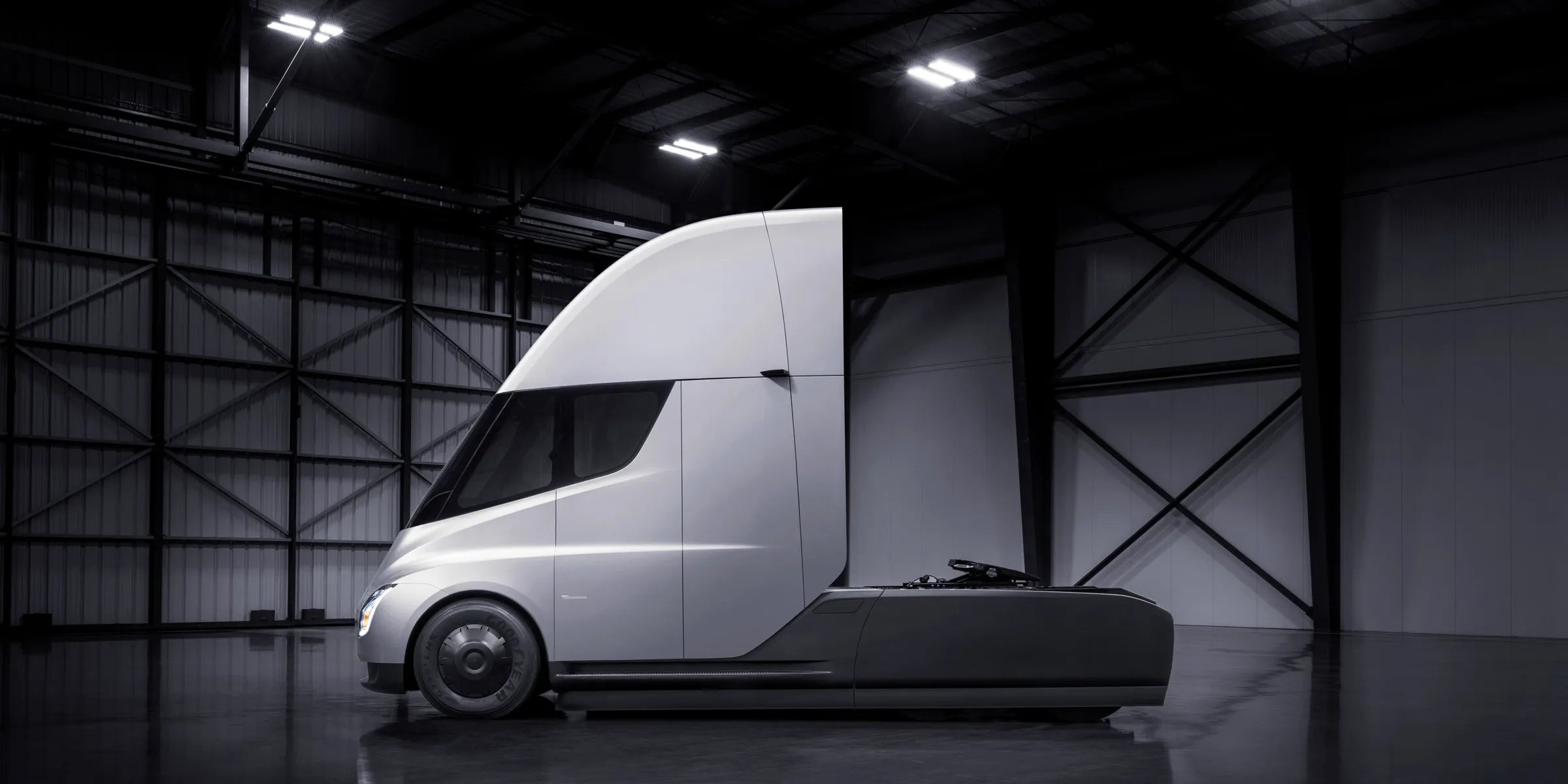
A Facelift Before Full Production
The Tesla Semi has received a major visual and technical update—despite not yet entering full-scale production. Originally unveiled in 2017 and promised for launch in 2019, the truck’s rollout has been repeatedly delayed. Now, as Tesla refines its strategy, a redesigned Semi was quietly shown during the company’s annual shareholder meeting, suggesting that the long-awaited production phase may finally be within sight.
Elon Musk reaffirmed that volume production is scheduled for 2026, marking a new chapter for the electric heavy-duty hauler that has remained in limited pilot operation for years.

New Design: A Cybertruck-Inspired Front End
Tesla’s latest Semi update introduces a sleeker, more futuristic design that aligns it with the company’s evolving aesthetic, particularly the Cybertruck’s bold styling cues.
The new full-width LED light bar replaces the previous headlight layout, giving the truck a unified front profile. Its revised bumper design includes what appear to be aerodynamic channels—likely to optimize cooling and airflow—and new side cameras housed in pods behind the front wheels.
Although Tesla released only one official image, enthusiasts have noted subtle differences: a higher beltline, potentially reshaped aero wheels, and more pronounced plastic cladding along the lower sides. Together, these updates make the Semi look closer to a vehicle from the future than a prototype from the past.
Efficiency and Powertrain Enhancements
Tesla claims the updated Semi features improvements in both payload capacity and overall efficiency. The truck remains rated for 500 miles of range on a single charge, supported by a 1.2-megawatt charging system that restores 70% of its range in just 30 minutes.
Real-world data has shown promising results. In prior freight trials with ArcBest Logistics, the Semi achieved 1.55 miles per kWh while carrying full loads. Tesla says the new model improves on that, targeting an average of 1.7 miles per kWh, making it one of the most efficient long-haul electric trucks in development.
Additionally, the vehicle is now “designed for autonomy,” signaling Tesla’s intent to integrate advanced driver-assistance and eventual self-driving capabilities as hardware and software mature.
Production Challenges Continue
Despite technical progress, production readiness remains a hurdle. The Nevada Gigafactory dedicated to Semi manufacturing was originally expected to start operations in late 2025, but construction delays have shifted the target to early 2026.
During Tesla’s Q3 earnings call, company executives described the facility as “nearing completion,” though no firm timeline was provided. Until the plant becomes operational, Tesla’s Semi output will remain limited to small batches for testing and corporate fleet use.
Industry analysts note that while the updated design reinforces Tesla’s commitment to the commercial EV segment, the ongoing delays highlight the challenges of scaling electric truck production—especially amid rising competition from companies like Daimler, Volvo, and Nikola.

The Road Ahead
The refreshed Tesla Semi represents both renewed ambition and lingering uncertainty. On one hand, it showcases Tesla’s continued innovation in design and efficiency; on the other, it underscores the complexity of mass-producing heavy-duty electric vehicles.
If Tesla meets its new timeline, the Semi could finally transition from a symbol of potential to a reality on highways by mid-2026. Until then, its “cyber makeover” may serve as a visual reminder that even futuristic trucks can take a long road to market.
Recommend Reading: Las Vegas Police Unveil Nation’s First Tesla Cybertruck Patrol Fleet


Share:
Toyota Unveils All-Electric Hilux Pickup With 150-Mile Range
Renault Revives the Twingo as a Budget EV to Rival Low-Cost Chinese Cars