



Solving EV Charging Bottlenecks

As the U.S. EV market grows, charging infrastructure remains a key challenge. While America now has over 14,000 DC fast charging stations with 67,000+ individual ports, long installation times and costly grid upgrades slow expansion.

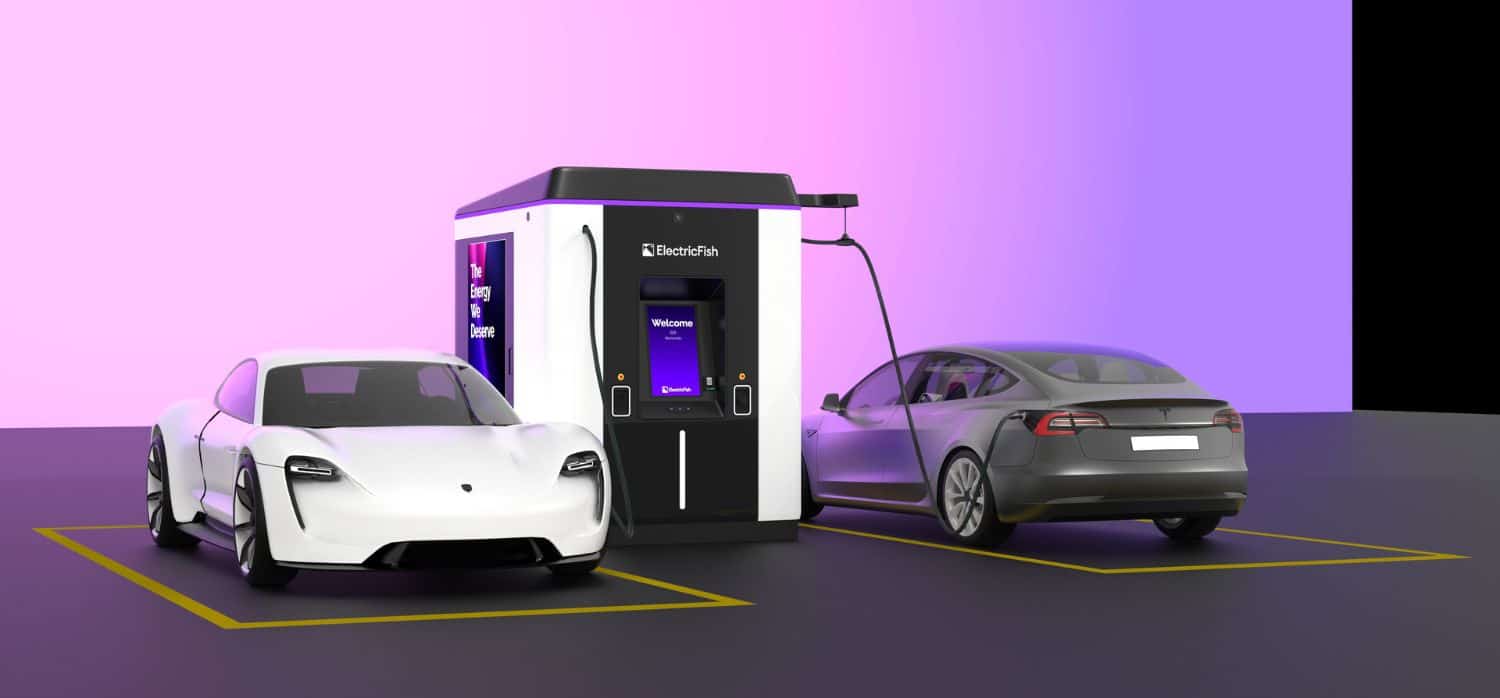
California startup ElectricFish aims to change that with its 400squared DC fast charger, unveiled at CES 2026. The company says its solution can cut installation times dramatically by eliminating traditional power distribution barriers.

This New Battery-Powered DC Fast Charger Can Be Installed in Hours


How the 400squared Charger Works

Most conventional 300-kilowatt chargers require extensive grid upgrades, which can take months or even years. ElectricFish avoids this by integrating large onboard batteries directly into the charger. The system stores 400 kilowatt-hours of energy and delivers up to 400 kilowatts of power, split as 200 kW per port when two vehicles charge simultaneously.

Batteries allow the charger to store energy when the stalls are free and dispense it to EVs as needed. This approach reduces dependency on heavy grid connections and simplifies installation. The 400squared can be powered by:

  • Split-phase 120- or 240-volt circuits providing at least 55 amps

  • Three-phase 208-volt circuits requiring 83 amps

  • Three-phase 480V at 115 amps for top-spec installations

The company reports a 99% uptime and claims some stations can be fully operational in as little as two hours, as demonstrated at Hyundai’s California Proving Ground.


Applications and Advantages

The 400squared charger is designed for gas stations, commercial centers, fleet operators, and emergency deployments. Its quick setup allows authorities and businesses to provide fast EV charging without relying on third-party stations, making it ideal for urgent or temporary needs.

By reducing the need for costly grid upgrades and simplifying installation, ElectricFish positions the 400squared as a scalable, flexible solution for expanding EV networks quickly and efficiently.


How It Compares to Other Solutions

Battery-backed chargers are gaining traction across the U.S. For example:

  • XCharge is building a 44-stall GridLink hub in Brooklyn, with each charger equipped with a battery

  • Electric Era in Seattle produces battery-powered DC fast chargers used by companies like Costco

ElectricFish’s approach differs by offering an all-in-one unit that stores energy, manages output intelligently, and supports dual-vehicle charging at high power. This combination of speed, flexibility, and ease of installation sets it apart from traditional chargers.

This New Battery-Powered DC Fast Charger Can Be Installed in Hours


The Road Ahead

As EV adoption continues to grow, faster deployment of charging infrastructure is critical. Battery-powered chargers like the 400squared could play a major role in alleviating range anxiety, enabling EV drivers to charge quickly without waiting for utility upgrades.

If widely adopted, this technology may allow cities, commercial centers, and fleet operators to expand fast charging networks more efficiently and at lower cost, helping bridge the gap between EV growth and charging availability.

Recomend Reading: California’s EV Growth Demands Coordinated Infrastructure Planning

Leave a comment

Please note, comments need to be approved before they are published.

This site is protected by hCaptcha and the hCaptcha Privacy Policy and Terms of Service apply.

FAQs - Level 3 DC Fast Charging

What is Level 3 DC fast charging for electric vehicles?

Level 3 charging, also known as DC fast charging (DCFC), provides direct current at high power levels (typically 50 kW to 350 kW) to quickly recharge an electric vehicle battery. Unlike Level 1 and Level 2 charging, DC fast charging bypasses the onboard charger, enabling much faster energy transfer.

How fast is Level 3 DC fast charging compared to Level 2 charging?

Level 2 chargers (240V AC) usually add 20–30 miles of range per hour, while Level 3 DC fast chargers can add 100–300 miles of range in 20–40 minutes, depending on EV battery capacity and charging power.

Does Level 3 fast charging damage EV batteries?

Frequent use of DC fast charging can accelerate battery degradation over time due to higher heat generation and faster charge cycles. However, modern EVs have battery thermal management systems that minimize impact. Occasional fast charging is safe and convenient for road trips.

What connector types are used for Level 3 DC fast charging?

The main EV fast charging connectors in North America are:

  • CCS (Combined Charging System) – widely adopted by most automakers
  • CHAdeMO – mainly used by older Nissan LEAF models
  • NACS (Tesla plug) – now being adopted across multiple brands (Ford, GM, Rivian, etc.)
What is the maximum power output of Level 3 DC fast charging stations?

Most public DC fast chargers range from 50 kW to 150 kW, while ultra-fast chargers can reach 250 kW to 350 kW. Tesla Superchargers V3 deliver up to 250 kW, and upcoming next-gen chargers may exceed 500 kW for heavy-duty EVs.

How much does Level 3 DC fast charging cost?

Pricing varies by network and location. Costs are usually based on per kWh, per minute, or a flat session fee. In the U.S., rates typically range from $0.25 to $0.60 per kWh, which is higher than home charging but competitive compared to gasoline costs.

Where can I find Level 3 DC fast charging stations in the U.S.?

DC fast chargers are commonly located along highways, rest stops, shopping centers, and EV charging networks like Tesla Supercharger, Electrify America, EVgo, and ChargePoint. Apps like PlugShare and ChargeHub help drivers locate fast charging stations.

Can all EVs use Level 3 DC fast charging?

Not all EVs are compatible. Some plug-in hybrid EVs (PHEVs) and older models lack DC fast charging capability. The maximum charging speed also depends on the vehicle’s onboard DC charging acceptance rate, which can range from 50 kW to 270 kW.

How does weather affect Level 3 DC charging speed?

Extreme cold or heat impacts battery temperature management, reducing fast charging speeds. EVs often precondition the battery before arriving at a fast charger to optimize charging efficiency in winter or summer conditions.

What is the future of Level 3 DC fast charging technology?

The future includes ultra-fast chargers (500 kW+), widespread adoption of NACS connectors, and vehicle-to-grid (V2G) integration. As EV infrastructure expands, Level 3 charging will become even more essential for long-distance travel and heavy-duty electric trucks.

EV News

View all

This New Battery-Powered DC Fast Charger Can Be Installed in Hours

This New Battery-Powered DC Fast Charger Can Be Installed in Hours

ElectricFish unveils its 400squared DC fast charger at CES 2026. Battery-backed and dual-port capable, it can be installed in hours, bypassing expensive grid upgrades and supporting rapid EV infrastructure growth.

Read more

Americans Worry More About EV Range Than Cost, Survey Shows

Americans Worry More About EV Range Than Cost, Survey Shows

A Deloitte survey finds that U.S. buyers worry more about EV range and charging time than cost. Loss of the federal tax credit slowed adoption, but interest remains, especially for affordable, long-range models.

Read more

Tesla’s Cybercab Could Get Regulatory Boost From Congress

Tesla’s Cybercab Could Get Regulatory Boost From Congress

Tesla’s Cybercab aims to be a $30,000 fully autonomous ride-hailing vehicle. Congressional approval could raise production limits, but software, charging infrastructure, and branding challenges still remain.

Read more