

High-Power Family SUVs Enter a New Era

The American EV market has reached an unusual moment: families can now purchase three-row SUVs with acceleration once reserved for high-end supercars. In the $110,000–$120,000 price range, buyers can choose electric SUVs that deliver extraordinary power while retaining everyday practicality. Two of the most talked-about options are the 2026 Lucid Gravity Grand Touring and the 2025 Rivian R1S Tri-Motor—both recently tested in Edmunds’ well-known U-Drags evaluation.


Power Output and Technical Setup

Lucid’s flagship Gravity Grand Touring features a dual-motor system producing 828 horsepower and 909 lb-ft of torque. Rivian’s updated R1S Tri-Motor counters with three drive units delivering 850 hp and a massive 1,103 lb-ft of torque.

While the Rivian holds a torque advantage on paper, the real-world results from Edmunds’ testing reveal a more nuanced story. Both SUVs weigh well over 6,000 pounds, yet each achieves sports-car-level acceleration.


How the U-Drags Test Works

The U-Drags format is designed to showcase more than straight-line speed. Two vehicles launch down a quarter-mile stretch, brake hard, execute a tight U-turn, and accelerate back to the start/finish point. After the first run, drivers swap vehicles and lanes to ensure fairness.

This structure exposes a vehicle’s strengths in acceleration, braking stability, and cornering agility, making it an ideal test bed for comparing large electric SUVs.


Race One: Lucid Closes the Gap and Pulls Ahead

At the start of the first run, the Rivian R1S launched harder using its Launch Control, jumping ahead of the Gravity. But as both vehicles approached the quarter-mile mark, the Lucid’s power delivery and mid-range efficiency allowed it to gradually regain ground.

The U-turn marked the decisive moment. With the Gravity set to Sprint Mode and Launch Mode active, its more composed chassis allowed it to carry far greater speed through the turn. On the return sprint, the Rivian quickly hit its 112-mph speed limiter, while the Lucid pushed all the way to 130 mph, finishing well ahead.


Race Two: Earlier Overtake, Same Result

The second race followed a similar script, but the Lucid Gravity gained the advantage earlier. It overtook the Rivian sooner after launch and maintained its lead throughout the course. By the end of the second run, the Gravity had clearly established itself as the quicker real-world performer.


By the Numbers: Straight-Line Metrics vs. Track Results

Measured strictly by standard performance metrics, the Rivian holds narrow advantages:

  • 0–60 mph: R1S at 3.0 seconds, Gravity at 3.5 seconds

  • Quarter mile: R1S at 11.3 seconds, Gravity at 11.4 seconds

However, the full 3,900-foot U-Drags course tells a different story. The Lucid Gravity finished in 33.2 seconds, beating the R1S Tri-Motor’s 34.5-second result by more than a full second.
This highlights how sustained speed, chassis balance, and high-speed stability matter just as much as off-the-line acceleration.

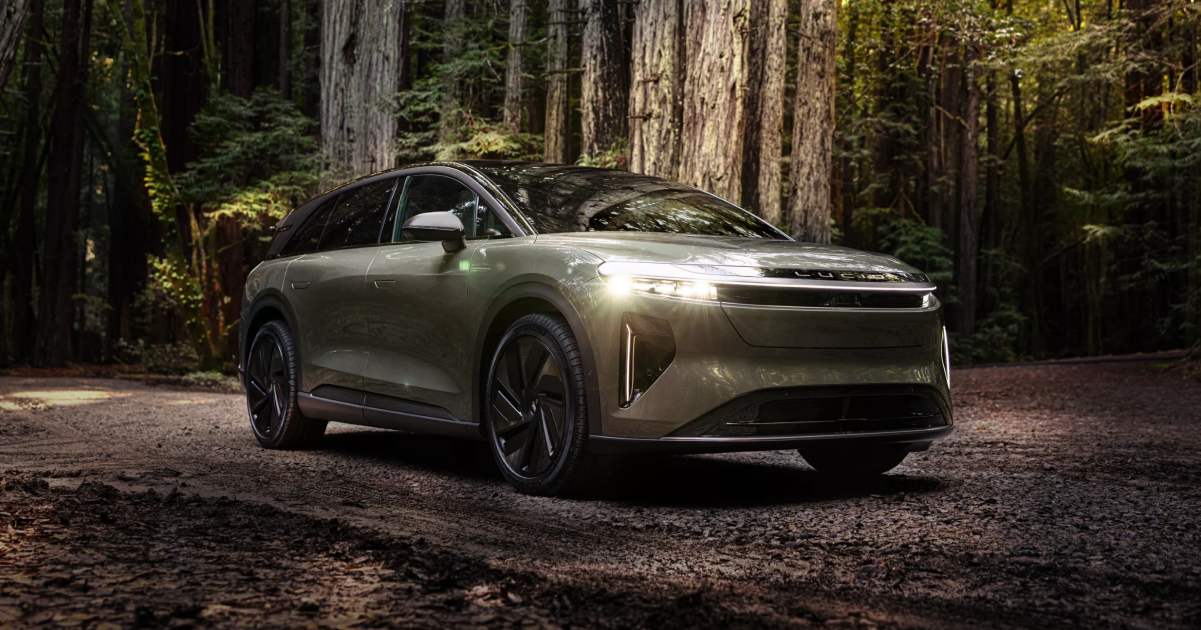
Lucid Gravity SUV


Practical Differences Beyond Performance

While both vehicles seat seven and function as family SUVs, they cater to different audiences:

  • The Lucid Gravity leans toward a more car-like driving experience with refined dynamics.

  • The Rivian R1S maintains its image as an adventure-ready SUV, built for versatility and off-road capability.

It is also important to note that the tested Gravity Grand Touring represents Lucid’s most powerful version currently available. Meanwhile, Rivian offers an even stronger Quad-Motor R1S, giving performance-focused buyers additional options.

Recommend Reading: Chevy Bolt vs. Nissan Leaf: Battle of America’s Cheapest EVs

Hinterlassen Sie einen Kommentar

Bitte beachte, dass Kommentare vor der Veröffentlichung freigegeben werden müssen.

Diese Website ist durch hCaptcha geschützt und es gelten die allgemeinen Geschäftsbedingungen und Datenschutzbestimmungen von hCaptcha.

FAQs

Wie groß ist die tatsächliche Reichweite des Lucid Air?

Der Lucid Air bietet eine von der EPA geschätzte Reichweite von bis zu 835 Kilometern (je nach Modell) und damit die beste seiner Klasse. Die Grand-Touring-Version weist die höchste Reichweite auf und ist damit ideal für Langstreckenfahrten mit Elektrofahrzeugen.

Wie lange dauert das Aufladen eines Lucid Air?

Mit einem DC-Schnellladegerät kann der Lucid Air in etwa 15 Minuten eine Reichweite von bis zu 200 Meilen erreichen. Das Laden zu Hause auf Stufe 2 dauert je nach Stromstärke in der Regel 9 bis 12 Stunden für eine vollständige Ladung.

Unterstützt der Lucid Air Tesla Supercharger?

Derzeit verwenden Lucid-Fahrzeuge den CCS-Ladestandard und sind ohne Adapter nicht nativ mit Tesla Superchargern kompatibel. Die Einführung von NACS könnte dies jedoch in Zukunft ändern.

Was kostet ein Lucid Air?

Ab 2025 beginnen die Preise für den Lucid Air bei rund 69.900 US-Dollar für den Air Pure und können für die Grand Touring- oder Sapphire-Edition über 139.000 US-Dollar liegen. Die Preise variieren je nach Ausstattung, Batteriegröße und optionalen Funktionen.

Ist Lucid Motors eine zuverlässige Marke?

Lucid Motors hat sich als Premium-Elektrofahrzeugmarke mit starker Leistung, luxuriösen Materialien und modernster Technologie positioniert. Obwohl das Unternehmen noch relativ neu ist, ist das Kundenfeedback überwiegend positiv, wobei das Serviceangebot noch ausgebaut wird.

Wo werden Lucid-Fahrzeuge hergestellt?

Lucid Motors stellt seine Fahrzeuge in Casa Grande, Arizona, in seiner hochmodernen AMP-1-Anlage her – der ersten auf der grünen Wiese errichteten Elektrofahrzeugfabrik in Nordamerika.

Bietet Lucid einen Leasing- oder Finanzierungsplan an?

Ja, Lucid Financial Services – ein Partnerunternehmen der Bank of America – bietet Leasing- und Finanzierungsoptionen an. Einige Kunden haben jedoch Bedenken hinsichtlich der Gebühren am Ende des Leasingvertrags geäußert. Daher ist es wichtig, die Leasingbedingungen genau zu prüfen.

Was sind die Hauptunterschiede zwischen Lucid Air Pure, Touring und Grand Touring?
  • Air Pure : Einstiegsmodell mit RWD oder AWD und minimalistischem Luxus
  • Air Touring : Mittelklasse-Leistung mit mehr Funktionen und Allradantrieb serienmäßig
  • Air Grand Touring : Premium-Reichweite, Leistung und Luxusfunktionen mit über 500 Meilen Reichweite
Wie schneidet Lucids DreamDrive im Vergleich zum Tesla Autopilot ab?

Lucids DreamDrive bietet fortschrittliche Fahrerassistenzfunktionen wie adaptive Geschwindigkeitsregelung, Spurführung und Autobahnassistent. Obwohl es nicht vollständig autonom ist, konkurriert es eng mit Tesla Autopilot und GMs Super Cruise.

Gibt es eine Lucid-App zur Fernsteuerung des Autos?

Ja, Lucid bietet eine mobile App für iOS und Android, die eine Fernüberwachung des Fahrzeugs, Ladesteuerung, Vorkonditionierung und Standortverfolgung in Echtzeit ermöglicht.

Haben Sie Ihre Antwort nicht finden?

Zögern Sie nicht, uns zu kontaktieren

EV-Neuigkeiten

Alle anzeigen

Voice Command Error Linked to Headlight Shutdown Crash in China

Voice Command Error Linked to Headlight Shutdown Crash in China

A Lynk & Co Z20 driver in China says a voice command intended for interior lights disabled the headlights, leading to a crash. The automaker issued an emergency over-the-air update, raising broader concerns about voice control safeguards.

Weiterlesen

BYD Testing 1.5 MW EV Chargers in China

BYD Testing 1.5 MW EV Chargers in China

New images suggest BYD is testing 1.5 MW charging stations in China, exceeding its previous 1,360 kW systems. The move marks a major step in ultra-fast EV charging expansion.

Weiterlesen

2026 Subaru Trailseeker Review: Specs, Range and Driving Impressions

2026 Subaru Trailseeker Review: Specs, Range and Driving Impressions

Subaru’s 2026 Trailseeker combines 375 horsepower, up to 281 miles of range and generous cargo space in a two-row electric SUV starting at $41,445. Strong driving dynamics and off-road ability stand out, though software features lag rivals.


Weiterlesen