





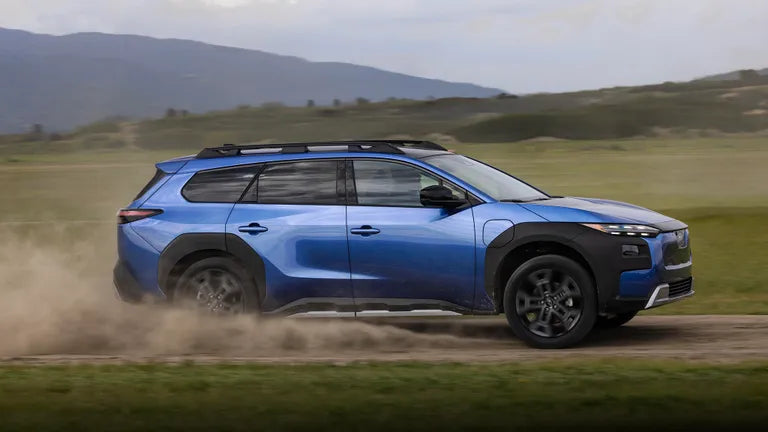
A New Direction for Subaru’s Electric Lineup
Subaru has long been associated with practical wagons and outdoors-focused SUVs, but its electric efforts have felt tentative. The 2026 Trailseeker signals a more confident step. Roughly the size of an Outback yet powered solely by batteries, this two-row crossover aims to blend everyday usability with genuine capability.
Rather than chasing luxury buyers or three-row family haulers, Subaru is targeting customers who want space, ground clearance and strong performance without stretching into oversized or premium territory. On paper, the numbers suggest it has identified an underserved niche.

Powertrain, Range and Core Specifications
Every Trailseeker uses the same dual-motor setup, delivering all-wheel drive as standard. Energy comes from a 74.7 kWh battery pack, which is modest compared with several rivals. Despite that, Subaru estimates a driving range of up to 281 miles in base trim, dipping slightly to 274 miles in higher Limited and Touring versions.
Output is rated at 375 horsepower, enabling a claimed 0–60 mph time of 4.4 seconds. That places it among the quicker options in its class. Ground clearance measures 8.5 inches, a figure that exceeds many mainstream crossovers and even tops some pickup configurations.
Pricing begins at $41,445 including destination, positioning it well below certain competitors with similar power and all-wheel drive.
Below is a summary of key figures:
| 2026 Subaru Trailseeker Specs | |
|---|---|
| Base Price | $41,445 |
| EV Range | Up to 281 miles (274 on Limited/Touring) |
| Battery | 74.7 kWh |
| Drive Type | Dual-motor all-wheel drive |
| Output | 375 horsepower |
| Ground Clearance | 8.5 inches |
| Cargo Volume | 31.3 cu ft (seats up); 74.0 cu ft (seats folded) |
Efficiency Compared With Larger-Battery Rivals
Several competitors rely on significantly bigger battery packs to achieve similar range estimates. Yet the Trailseeker’s projected mileage nearly matches models equipped with 85 kWh or even 100 kWh-plus capacities. That suggests Subaru has focused on efficiency rather than simply increasing battery size.
Cargo capacity is another differentiator. With 31.3 cubic feet behind the rear seats and 74.0 cubic feet when folded, it provides meaningful room for bulky gear. Buyers stepping up from compact EVs such as the Tesla Model Y or Hyundai Ioniq 5 will notice the extra space, while avoiding the scale and price of three-row electric SUVs.
Notably, a closely related Toyota variant exists, but it enters the market at roughly $5,000 higher in a more upscale configuration. The Trailseeker therefore occupies a more accessible price band.

On-Road Driving Experience
At approximately 4,465 pounds in base form, the Trailseeker undercuts some rivals by several hundred pounds. That weight advantage contributes to a composed and responsive character.
Steering feels direct, and the chassis maintains balance through corners. Unlike certain all-wheel-drive systems that heavily favor either the front or rear axle, Subaru’s symmetrical layout distributes power in a more neutral manner. The result is predictable handling without the sensation of being pushed or pulled by one end.
Ride comfort is another highlight. The suspension tuning absorbs rough pavement with a controlled, supple feel, allowing the vehicle to remain comfortable during daily commuting while retaining stability at higher speeds. Some road noise does filter into the cabin, but overall refinement meets expectations for the segment.
Capability Beyond Pavement
Subaru’s reputation for light off-road use carries over into this electric model. With 8.5 inches of clearance, short overhangs and dedicated traction modes such as X-Mode and Grip Control, the Trailseeker demonstrates confidence on loose surfaces.
During low-speed trail driving, the system automatically manages braking and torque distribution to maintain traction. Electric torque delivery provides immediate response when climbing uneven terrain, eliminating concerns associated with traditional transmissions overheating or hunting for gears.
However, one omission stands out: there is no spare tire. For a vehicle positioned toward outdoor exploration, that absence may concern buyers who travel far from paved roads.

Infotainment and Digital Features
Inside, the Trailseeker adopts a 14-inch touchscreen running software derived from Toyota. The interface is responsive and relatively straightforward, but functionality remains limited compared with leading EV platforms.
One significant shortcoming is the lack of integrated route planning that factors in charging stops and state-of-charge projections. Drivers must rely on third-party apps for long-distance travel planning, which cannot access real-time battery data. For many EV owners, predictive energy estimates are essential for reducing uncertainty.
The vehicle also does not offer true one-pedal driving. Instead, regenerative braking levels are adjusted via steering-wheel paddles, and the system resets after shutdown. The car creeps forward when the brake is released, mimicking conventional automatic behavior unless auto-hold is activated.
On the positive side, Subaru includes native NACS charging compatibility, allowing access to Tesla Superchargers with plug-and-charge functionality. The company estimates a 10% to 80% recharge time of about 28 minutes, competitive within the segment. Battery preconditioning is supported, though it activates automatically only when using the built-in navigation to locate a charger.
Market Position and Overall Assessment
The Trailseeker arrives at a time when many buyers seek larger two-row EVs without entering luxury price brackets. By offering strong acceleration, generous cargo room and credible off-road capability for just over $41,000, Subaru has crafted a compelling value proposition.
There are clear areas for improvement, particularly in software integration and trip planning tools. These digital features are increasingly central to the EV ownership experience. Nonetheless, the underlying vehicle—its chassis balance, efficiency and practicality—demonstrates thoughtful engineering.
For shoppers wanting an electric crossover larger than compact options yet more manageable and affordable than full-size SUVs, the 2026 Subaru Trailseeker stands out as a well-rounded alternative. With enhancements to its digital ecosystem and the addition of a spare tire, it could move from strong contender to segment benchmark.
Recommend Reading: 2026 Subaru Uncharted Review: Range, Price and EV Gaps









Share:
How Volkswagen Reached 2 Million EV Sales Worldwide
BYD Testing 1.5 MW EV Chargers in China