





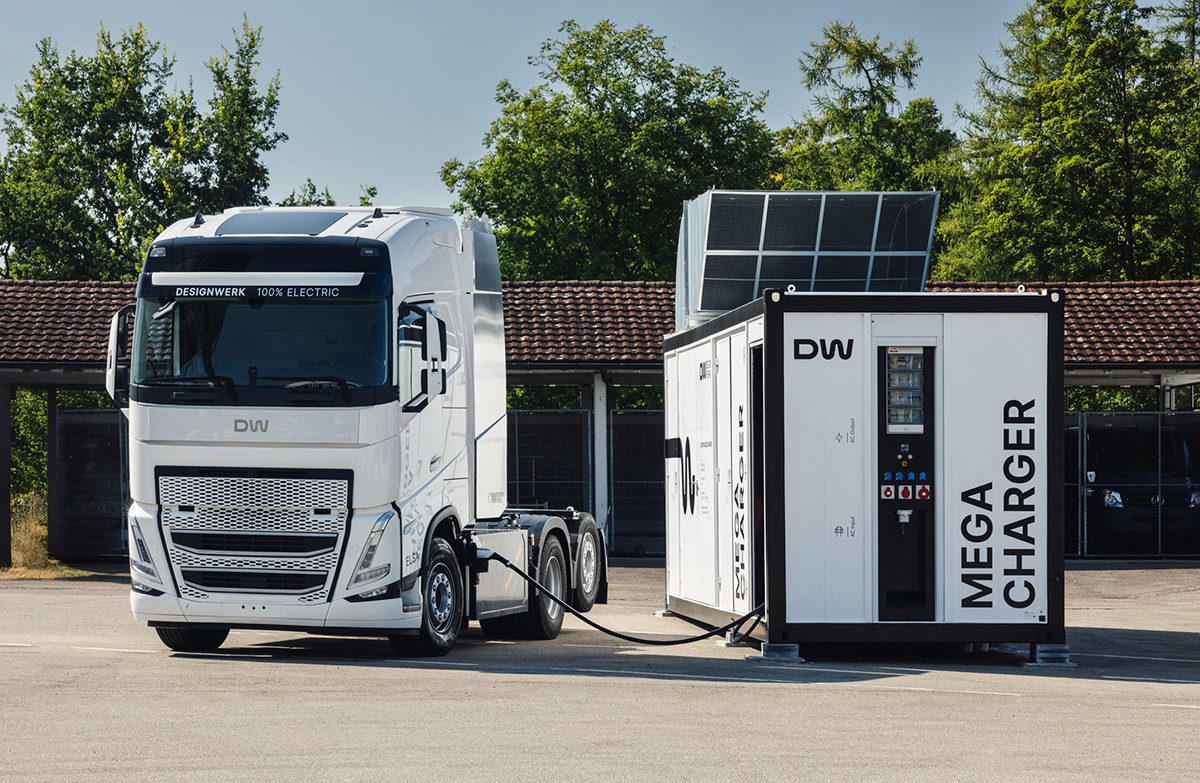
Ultra-Fast Charging Moves Forward
A new generation of high-power charging systems is beginning to take shape in the United States. Italian hardware manufacturer Alpitronic has started testing its latest solution, the HYC1000, at its North American base in Charlotte, North Carolina. This equipment is designed to deliver extremely high output levels—up to 1,000 kW for heavy-duty vehicles and roughly 600 kW for passenger cars.
These figures significantly exceed the charging limits of today’s production electric vehicles. Still, the introduction of such infrastructure marks a step toward reducing one of the most persistent barriers to EV adoption: charging time. If future vehicles can utilize this capacity, recharging could approach the convenience of traditional refueling.

A Network Built on Rapid Expansion
Alpitronic’s presence in the U.S. has grown quickly over a relatively short period. The company has secured agreements with several major charging operators, including Ionna, Walmart, Mercedes-Benz High Power Charging, Electrify America, and BP Pulse. Through these partnerships, hundreds of its earlier HYC400 units have already been deployed nationwide.
The HYC1000 represents the next phase in this rollout. Rather than simply increasing power output, the system is designed to support a wide range of use cases. Its flexibility allows operators to configure stations for both passenger vehicles and commercial fleets, depending on local demand.
Design and Compatibility Features
Physically, the new charging units follow a vertical, compact design and typically include two connectors per dispenser. They are compatible with multiple standards, including NACS, CCS, and the emerging Megawatt Charging System (MCS) for heavy-duty applications. This multi-standard approach reflects the fragmented nature of the North American charging landscape.
Additional design elements aim to improve usability. Overhead cable supports reduce handling effort, while integrated displays provide real-time charging data. Payment functionality is also built in, enabling direct transactions at the station rather than relying solely on mobile applications.
Power Delivery and System Architecture
Each dispenser can supply up to 600 amps at 1,000 volts, translating into a maximum output of 600 kW per connector under certain configurations. For context, some of the fastest charging installations currently available in the U.S. are rated at around 500 kW, and even that level remains beyond the capabilities of most vehicles.
Behind the scenes, the system uses a modular architecture. A central power cabinet contains eight 125 kW modules, which can be dynamically allocated across multiple charging points. Each module is further divided into smaller units, allowing the system to distribute energy precisely based on real-time demand.
This approach ensures that available power is used efficiently. For example, if two vehicles with different charging limits are connected, the system can deliver tailored output to each without underutilizing capacity.
Matching Output to Vehicle Capabilities
Despite the impressive specifications, a practical limitation remains: current passenger EVs cannot fully utilize such high charging rates. Many of the latest models peak at approximately 350 to 400 kW, and even those levels are only sustained briefly under optimal conditions.
Charging behavior also varies depending on battery state. Vehicles typically accept higher power at lower charge levels before gradually reducing intake as the battery fills. This makes intelligent load management critical, as it prevents energy waste and improves overall station efficiency.
Dynamic power sharing—already implemented by several providers including Tesla, ChargePoint, and Electrify America—has become an industry standard. Alpitronic’s system builds on this concept with greater scalability and higher maximum output.
Competition and Global Context
High-capacity charging is not limited to one company or region. In the United States, Tesla has introduced its own megawatt-level infrastructure for the Semi truck, while other firms such as Kempower are developing similar solutions for commercial transport.
Meanwhile, developments in China suggest that ultra-fast charging could extend beyond heavy-duty vehicles. Some manufacturers there are already integrating higher charging capabilities into mainstream electric models, supported by dense infrastructure and vertically integrated supply chains.
This contrast highlights a key question for the U.S. market: whether vehicle capabilities will evolve quickly enough to take advantage of increasingly powerful charging stations.

What This Means for the Future
The arrival of megawatt-class chargers signals a forward-looking investment in infrastructure. Even if current vehicles cannot fully benefit, the groundwork is being laid for future models designed around higher charging thresholds.
For automakers, this creates both an opportunity and a challenge. Increasing charging speeds requires advances in battery chemistry, thermal management, and overall vehicle architecture. Without those improvements, much of the available power will remain unused.
From a broader perspective, reducing charging time remains central to improving the appeal of electric vehicles. If the gap between charging and refueling continues to narrow, consumer hesitation may gradually decline.
In the near term, however, the technology is ahead of the vehicles it is meant to serve. The success of megawatt charging will ultimately depend on whether the next generation of EVs can keep pace with the infrastructure now being built.
Recommend Reading: BYD Introduces 1.5 MW EV Chargers That Add Hundreds of Miles in Minutes










Share:
Why Volkswagen Is Ending ID.4 Production in the U.S.