





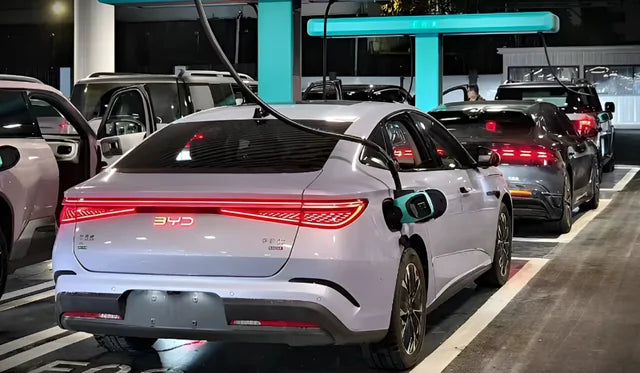
A New Benchmark for EV Charging Speed
Electric vehicle charging has long been one of the main concerns for drivers considering the switch from gasoline-powered cars. Long charging stops often make EV road trips feel less convenient than traditional refueling. Chinese automaker BYD is now attempting to narrow that gap with a new ultra-fast charging system designed to dramatically shorten charging times.
The company recently revealed an upgraded generation of high-power chargers known as “Flash” charging stations, capable of delivering up to 1.5 megawatts (1,500 kilowatts) of peak power. This level of output is far beyond what most public charging stations currently provide.
The new infrastructure works in combination with an updated battery design and vehicle platform. Together, these technologies allow compatible vehicles to replenish large amounts of range in just a few minutes—approaching the time drivers typically spend filling a gasoline vehicle.

Combining New Chargers With an Updated Battery
The impressive charging performance relies on more than just powerful stations. BYD also introduced a second-generation version of its Blade lithium-iron-phosphate battery, engineered to accept extremely high charging currents without compromising durability or safety.
Vehicles using the new battery pack operate on a 1,000-volt electrical architecture and support charging currents reaching 1,500 amps. When connected to a Flash station, the system can deliver extraordinary charging performance.
According to the company, a compatible vehicle can move from 10% to 70% battery capacity in roughly five minutes, while reaching about 97% charge in approximately nine minutes. BYD intentionally stops charging slightly below full capacity, reserving around 3% of the battery to maintain regenerative braking performance.
Even in harsh winter conditions, charging remains relatively fast. BYD says the battery can increase from 20% to 97% in about 12 minutes when temperatures fall to –30°C (–22°F).
Demonstrating the Technology in Real Driving
To showcase the system outside the laboratory, BYD conducted a public charging demonstration using the Denza Z9 GT, a premium electric model within the company’s broader brand ecosystem.
During the test, the vehicle was driven until its battery level dropped to roughly 9%, leaving around 93 kilometers (58 miles) of remaining driving range. It was then connected to a 1.5-megawatt Flash charging station.
Less than ten minutes later—specifically 9 minutes and 51 seconds—the vehicle’s dashboard displayed a projected range of 1,008 kilometers (626 miles).
It is important to note that this figure relies on the China Light Duty Test Cycle (CLTC), which tends to produce higher range estimates than testing standards used in other regions such as the U.S. EPA methodology. Even after adjusting the number to approximate EPA-style results, the demonstration still suggests that nearly 400 miles of driving range could be restored in under ten minutes.
Faster Than Most Chargers in the United States
To understand the significance of these figures, it helps to compare them with charging speeds available in other markets.
Many public charging stations in the United States currently operate in the 250 to 400 kW range, while some high-power units are rated for 350 kW. Even the most advanced chargers widely available today rarely exceed those levels.
For example, an independent charging evaluation conducted by Tom Moloughney, who runs the State Of Charge YouTube channel, tested the Lucid Gravity on a 350 kW EVgo station. In that session, the vehicle increased from 0% to 50% battery capacity in about 12.5 minutes, adding approximately 200 miles of range.
While this remains impressive by today’s standards, BYD’s megawatt-level system suggests an entirely different performance category.
Charging Stations Designed Like Gas Stations
The physical layout of the new charging sites also reflects their intended use. Rather than resembling conventional EV charging areas where vehicles remain parked for extended periods, BYD’s Flash stations are designed to mimic the quick-stop experience of gasoline stations.
Drivers pull in, connect the charger, wait only a few minutes, and continue their journey. The stations feature T-shaped charging towers equipped with what the company describes as “zero-gravity” charging connectors, designed to reduce the weight drivers must handle.
The system also includes plug-and-charge functionality, allowing vehicles to authenticate automatically and begin charging without requiring a mobile app or payment setup.
Rapid Expansion Across China
BYD is aggressively expanding this infrastructure. The company says it has already completed construction of approximately 4,200 Flash charging stations across China.
Its goal is to deploy 20,000 stations by the end of the year. If that target is achieved, more than 90% of urban areas in China would have at least one of these high-power chargers within 5 kilometers (about 3 miles).
The company also plans to bring the technology to Europe, Latin America, the Middle East, Africa, and the Asia-Pacific region as part of its global expansion strategy.
Managing Power Demand on the Grid
Charging systems capable of delivering megawatt-level power create new challenges for electrical infrastructure. Drawing such high power from the grid could place significant stress on local networks during peak usage.
To address this issue, BYD plans to install stationary energy storage batteries alongside many Flash charging sites. These storage systems can accumulate electricity during periods of lower demand and release it when multiple vehicles are charging simultaneously.
The approach also allows the stations to integrate electricity generated from renewable sources such as solar power, helping balance supply and demand across the network.
A Growing Technology Race in China
BYD is not alone in pursuing megawatt-scale EV charging. Other Chinese manufacturers and technology companies are developing similar systems as competition intensifies.
Automaker Zeekr has introduced high-power charging solutions of its own, while technology company Huawei is also working on infrastructure capable of supporting extremely fast charging speeds.
This rapid progress is creating a widening technological contrast between markets. In North America, the fastest public charging stations generally top out around 500 kW, and even those units remain relatively uncommon.

A Technology Gap Between Markets
The limited availability of ultra-fast charging infrastructure in the United States partly reflects policy decisions. Trade restrictions and tariffs have reduced the presence of Chinese EV technology in the American market.
While those measures were intended to provide domestic manufacturers with room to develop their own capabilities, they may also slow the introduction of some of the newest charging technologies.
Meanwhile, Chinese automakers continue investing heavily in advanced EV platforms and infrastructure. As a result, many of the most aggressive developments in battery performance and charging speed are emerging in that market first.
Recommend Reading: BYD Testing 1.5 MW EV Chargers in China


Share:
Volkswagen Dealers Sue Scout Motors Over Direct EV Sales Plan
Kia Delays EV6 GT Launch in the U.S. Amid Weak Sales