





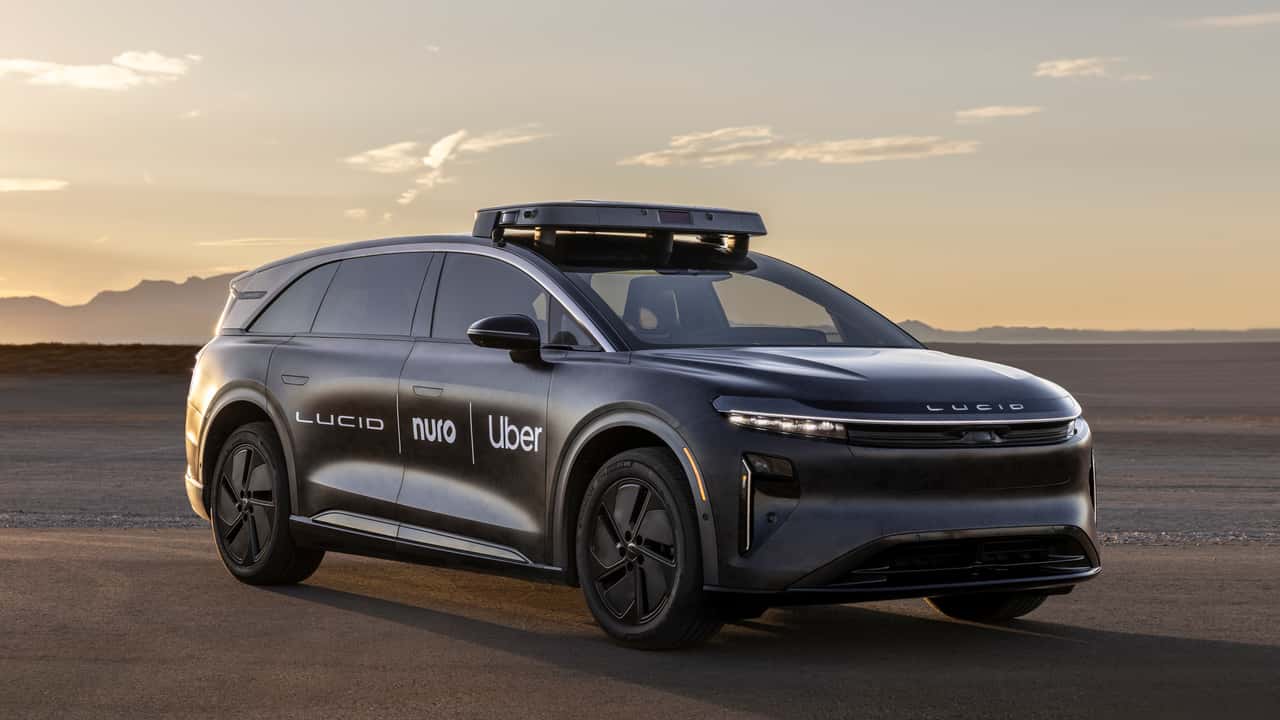
Lucid Motors’ push into autonomous mobility is moving from concept to reality. The luxury EV maker, working alongside ride-hailing giant Uber and self-driving technology firm Nuro, has revealed a production-intent version of its Gravity-based robotaxi and confirmed that testing is already underway on public roads in San Francisco.
Unveiled at CES 2026 in Las Vegas, the autonomous Gravity marks a major milestone for Lucid as it looks to diversify beyond consumer EV sales and secure long-term fleet partnerships.

Early Testing Begins Ahead of Public Launch
Lucid confirmed that Gravity robotaxis began supervised road testing in San Francisco in December 2025, operating with safety drivers behind the wheel. These early trials are designed to validate real-world performance ahead of a broader public rollout planned for the Bay Area later in 2026.
The vehicles are built in Lucid’s Arizona manufacturing facility, using the same core platform as the production Gravity SUV. While the exterior closely mirrors the consumer model, the robotaxi version integrates additional autonomous hardware and software developed by Nuro.
Lucid and Nuro expect to deploy more than 100 vehicles in an engineering test fleet, combining public-road testing, closed-course validation, and large-scale simulation to accelerate development.
A Strategic Partnership With Long-Term Ambitions
The collaboration between Lucid, Uber, and Nuro, first announced in mid-2025, represents a significant strategic shift for Lucid. The companies have set an ambitious goal to deploy 20,000 or more autonomous Gravity vehicles globally over the next six years.
For Lucid, the deal offers a degree of financial and operational stability similar to Rivian’s long-term commercial agreement with Amazon. Uber, meanwhile, gains exclusive access to a premium autonomous vehicle platform tailored for ride-hailing use, while Nuro brings its proven autonomy stack into a passenger-focused application.
As part of the agreement, Uber has committed $300 million in investment into Lucid, underscoring the scale of the partnership.
Level 4 Autonomy Built Into the Gravity Platform
The robotaxi is equipped with Nuro’s Level 4-capable autonomous driving system, featuring a comprehensive sensor suite that includes high-resolution cameras, radar units, and solid-state lidar. Together, these sensors deliver a full 360-degree field of view around the vehicle.
Some components are discreetly integrated into the Gravity’s bodywork, while others sit on a purpose-built roof module that also incorporates illuminated displays. These visual elements are designed to help riders easily identify the correct vehicle during pickup.
Lucid says the integration preserves the Gravity’s aerodynamics and design language while meeting the technical demands of autonomous operation.
A Premium Robotaxi Experience
Lucid and Uber are positioning the Gravity as one of the most luxurious robotaxis on the road. The electric SUV can accommodate up to six passengers, and its interior remains largely unchanged from the consumer version.
Uber has added a custom in-ride interface, allowing passengers to adjust climate settings, control seat heating, manage audio playback, and communicate with support. Riders will also be able to request pullovers or assistance directly through the vehicle’s onboard displays.
This approach reflects Uber’s strategy to differentiate autonomous rides through comfort and user experience, rather than focusing solely on cost.

Production Plans and What Comes Next
Lucid expects the production-intent robotaxi to enter assembly later in 2026, pending final validation and regulatory approvals. Once ready, the vehicles will be available exclusively through the Uber platform, initially in select U.S. markets.
For Lucid, the Gravity robotaxi represents more than a new vehicle variant. It signals a broader push into mobility services, autonomous fleets, and long-term commercial partnerships that could help reshape the company’s future beyond traditional EV sales.
Recommend Reading: Lucid Gravity vs. Rivian R1S: A Clear Winner in Real-World Performance


Share:
Production-Ready Solid-State Battery Promises Ultra-Fast Charging
Lucid Reports Strong Late-2025 Growth Despite EV Market Headwinds