





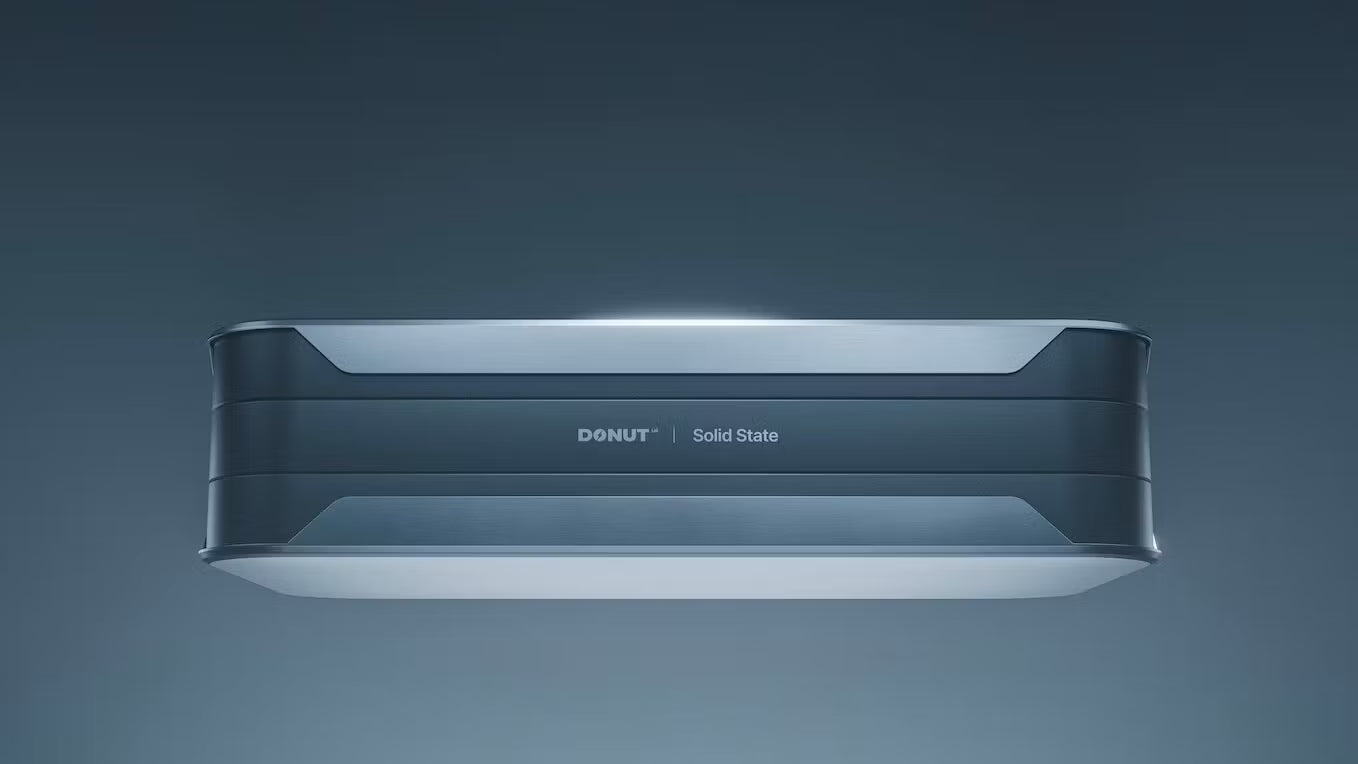
A Major Step Toward Solid-State EV Batteries
After years of promises and delays across the industry, a production-ready all-solid-state battery has officially entered the market. Donut Lab, a Finland-based startup best known for its advanced in-wheel electric motors, says its new battery technology is now available at commercial scale and ready for real-world applications.
According to the company, this marks the first time an all-solid-state battery has reached gigawatt-hour-level production capacity and is being supplied to manufacturers worldwide. Unlike traditional lithium-ion batteries, Donut Lab’s design eliminates liquid electrolytes entirely, replacing them with a solid-state architecture intended to improve performance, safety, and longevity.

Commercial Availability, Not Just a Lab Prototype
Solid-state batteries have long been described as “five years away.” Donut Lab claims that timeline has finally ended. The company says its solid-state battery cells and modules are already being manufactured and shipped, not limited to research labs or pilot programs.
The first confirmed production vehicle using the technology is the updated Verge TS Pro electric motorcycle, which is scheduled to reach customers in the first quarter of the year. Verge Motorcycles has confirmed that this model will become the world’s first production EV powered by an all-solid-state battery.
Energy Density, Charging Speed, and Cycle Life
Donut Lab’s claims stand out even in a rapidly advancing EV battery landscape. The company says its solid-state battery achieves an energy density of 400 Wh/kg, significantly higher than most premium lithium-ion batteries, which typically fall between 250 and 300 Wh/kg.
Even more notable is charging performance. Donut Lab claims the battery can be fully charged in as little as five minutes and can sustain up to 100,000 full charge cycles without limiting the maximum state of charge. By contrast, conventional lithium-ion packs usually last around 3,000 to 5,000 cycles and often require charging limits of 80% to preserve longevity.
Performance Across Extreme Temperatures
Thermal performance is another area where solid-state technology promises major advantages. Donut Lab says its battery retains over 99% of capacity in extreme conditions, from -22°F (-30°C) to 212°F (100°C).
If validated at scale, this would address one of the most persistent challenges for EV adoption: range loss and degradation in cold or high-heat environments. The company suggests this thermal stability makes the battery suitable not only for passenger vehicles, but also for motorcycles, heavy trucks, and industrial equipment.
Safety, Materials, and Manufacturing Claims
Safety is often cited as a key advantage of solid-state batteries, and Donut Lab leans heavily into that narrative. The company claims its battery will not ignite if damaged, addressing fire risks associated with liquid electrolytes.
Donut Lab also says its cells are made from widely available materials, avoiding rare or geopolitically sensitive resources. While the company has not disclosed specific material compositions, it describes the battery as “100% green” and claims it can be manufactured globally without supply chain constraints. The startup also asserts that its solid-state batteries are cheaper to produce than comparable lithium-ion batteries, though independent cost data has not yet been released.
Real-World Use: Verge TS Pro Motorcycle
The Verge TS Pro provides the clearest real-world benchmark so far. The previous version, powered by a conventional lithium-ion battery, offered 217 miles of city range and charging times under 35 minutes.
With Donut Lab’s solid-state battery, the standard range remains the same, but a Large Battery option boosts range to 370 miles using the same physical battery enclosure. Charging time has been reduced dramatically to under 10 minutes, though Verge says it intentionally slowed charging slightly to allow riders time for a break.

Industry Implications and What Comes Next
While skepticism remains around solid-state battery timelines, Donut Lab CEO Marko Lehtimäki says the debate is over. He argues that the technology is no longer theoretical and is already operating in customer vehicles.
Donut Lab’s all-solid-state battery will be showcased at CES 2026 in Las Vegas, offering the industry a closer look at a technology that could reshape EV performance, charging expectations, and battery safety standards in the years ahead.
Recommend Reading: Understanding All Major EV Battery Types and Their Applications


Share:
Toyota Launches Affordable Electric Crossover in 2026
Lucid Starts Gravity Robotaxi Testing in San Francisco