



A Platform Strategy for the Autonomous Era
Electric drivetrains and automated driving systems are reshaping transportation worldwide. While traditional carmakers such as Tesla and General Motors are advancing driver-assistance features for privately owned vehicles, the most immediate disruption may occur in app-based ride services.
Uber is positioning itself as the central marketplace for that transition. Rather than engineering its own self-driving stack, the company has assembled more than 20 alliances with vehicle manufacturers and autonomy developers in recent years. Its goal is to ensure that, as automated fleets expand, they operate through Uber’s network.
The company has stated it intends to introduce autonomous ride options in 15 cities by the end of 2026 and to become the largest intermediary for such trips by 2029. Achieving that requires more than software integration—it involves charging, fleet servicing, logistics and customer support infrastructure.

A Broad Web of Global Collaborations
Uber’s autonomy partners span several regions. In the United States, it works with companies including Waymo and Nuro. In Europe, it collaborates with firms such as Wayve and Momenta, while in the Middle East it has agreements with players like WeRide and Baidu’s Apollo Go unit.
Vehicle production is also part of the equation. Manufacturers such as Stellantis, Lucid, and Foxconn are involved in supplying purpose-built robotaxi models. Beyond passenger mobility, Uber is integrating automated delivery robots into Uber Eats and supporting autonomous freight operations through partnerships with companies like Aurora.
To support these fleets, Uber has committed $100 million toward expanding high-speed charging facilities. In the U.S., it is cooperating with EVgo and Revel, while in Europe it has aligned with providers including Ionity, Hubber and Electra. A newly launched Autonomous Solutions program will supply partners with data tools, fleet management systems, remote assistance services and in-vehicle interface support designed to accelerate commercialization.
Uber’s Partners
| Uber's Partners | Category | Vehicle/Platform | Geography |
|---|---|---|---|
| Waymo | Robotaxi (Ride-hail) | Waymo AV fleet | Austin & Atlanta |
| Lucid + Nuro | Robotaxi (Ride-hail) | 20,000 Lucid Gravity w/ Nuro stack | U.S. |
| May Mobility | Robotaxi (Ride-hail) | Toyota Sienna w/ May AV tech | Arlington, Texas |
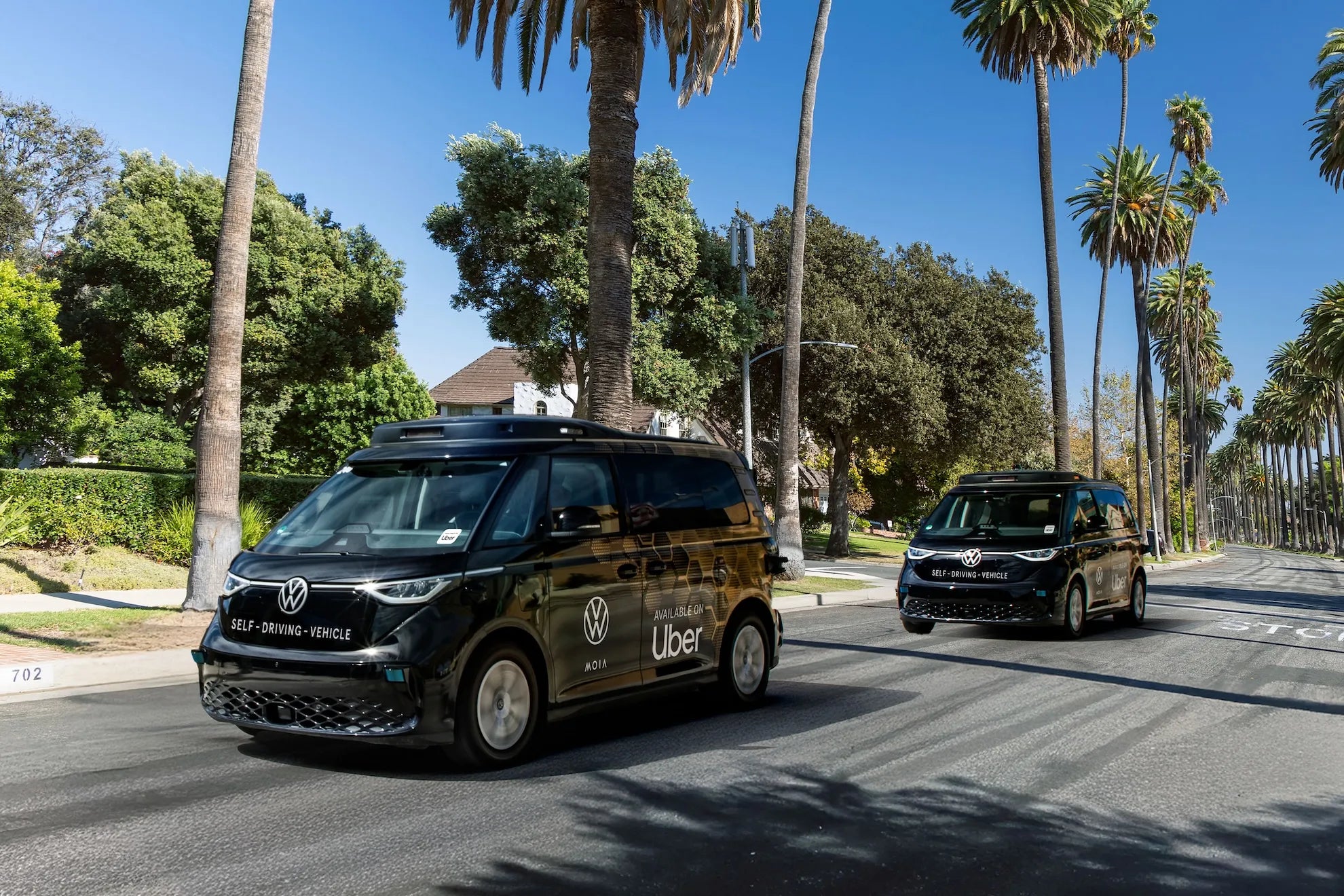
| Volkswagen | Robotaxi (Ride-hail) | ID. Buzz autonomous vans | U.S. |
| Waabi | Autonomous Trucking / Robotaxi | 25,000+ robotaxis (planned) | TBD (U.S.) |
| Wayve | Robotaxi (Ride-hail) | Wayve AV tech | U.K. |
| WeRide | Robotaxi (Ride-hail) | 1,200 robotaxis | Abu Dhabi, Dubai, Riyadh |
| Pony.ai | Robotaxi (Ride-hail) | Pony.ai AV fleet | Middle East |
| Momenta | Robotaxi (Ride-hail) | Momenta AV platform | Europe |
| Baidu (Apollo Go) | Robotaxi (Ride-hail) | - | Dubai |
| Aurora | Autonomous Trucking (Freight) | Class 8 semi trucks | Dallas-Houston |
| Nvidia + Stellantis | Robotaxi (Ride-hail) | 5,000 Stellantis vehicles w/ Drive Hyperion | U.S. & overseas |
| Nvidia + Mercedes-Benz | Robotaxi (Ride-hail) | Mercedes-Benz S-Class w/ Drive Hyperion | Abu Dhabi, global cities |
| Avride | Robotaxi + Delivery | Hyundai Ioniq 5 robotaxis + sidewalk robots | Dallas, Austin, Jersey City |
| Tawasul | Fleet Management | - | Middle East |
| New Horizon | Fleet Management | - | Middle East |
| Serve Robotics | Autonomous Delivery (Sidewalk) | Serve delivery robots | U.S. |
| Cartken + Mitsubishi Electric | Autonomous Delivery (Sidewalk) | Cartken delivery robots | Japan |
| Coco Robotics | Autonomous Delivery (Sidewalk) | Coco delivery robots | U.S. & Finland |
| Flytrex | Drone Delivery Pilot | Flytrex drones | U.S. |
| Starship | Autonomous Delivery (Sidewalk) | Starship delivery robots | Europe |
| Torc Robotics | Autonomous Trucking (Freight) | Class 8 semi trucks | U.S. |
| EVGo & Revel | AV Charging | - | U.S. |
| Hubber | AV Charging | - | London |
| Ionity | AV Charging | - | London |
| Electra | AV Charging | - | Paris, Madrid |
Leveraging a Massive User Base
Uber reports having over 200 million monthly active users globally and more than 40 million paid trips recorded by the end of last year. Analysts argue that such scale provides a built-in demand pool for autonomous services.
For most robotics startups, attracting riders independently would require substantial marketing expenditure. By integrating into Uber’s application—where customers already have accounts and payment credentials—partners can access demand without building a parallel marketplace.
Some companies are pursuing independent strategies. Waymo, backed by Alphabet, is completing more than 400,000 paid driverless rides per week in several U.S. cities, some via Uber and others through its own app. Tesla has also begun limited robotaxi trials in Austin, though with safety operators onboard. Larger firms with deep financial resources may be able to sustain standalone platforms, but smaller entrants often favor collaboration.
From Developer to Integrator
Uber previously attempted to create its own automated driving division, investing over $1 billion before divesting the unit in 2020 and taking an equity stake in Aurora. The shift reflects a strategic pivot: instead of competing on hardware and perception software, Uber aims to coordinate fleets and aggregate demand.
Chief Executive Dara Khosrowshahi recently described autonomous mobility as a “multi-trillion dollar opportunity.” He argued that while the supply side of trips will evolve, consumer demand will still flow through digital platforms capable of maximizing utilization and reliability.
Early results suggest potential benefits. Uber says autonomous rides offered in Austin and Atlanta have achieved 30% higher utilization and 25% faster estimated arrival times compared with certain directly operated fleets elsewhere.

Economics, Employment and Industry Outlook
One high-profile initiative involves purchasing 20,000 Lucid Gravity SUVs equipped with Nuro’s automated systems. The Gravity’s projected driving range—up to 450 miles in higher trims—and rapid charging capability could reduce downtime between trips. However, vehicle costs and city-specific operating factors will influence profitability.
Industry observers expect consolidation as the market matures. It remains unclear how many technology providers will survive long term. Meanwhile, robotaxis represent only a small portion of total ride volume. Research from Goldman Sachs estimates roughly 35,000 robotaxis in the U.S. by 2030, accounting for about 8% of ride-hailing activity. Uber has noted that autonomous trips currently represent approximately 0.1% of global rides.
Operational challenges persist, including regulatory variation, weather performance limitations and high capital expenditures. Substantial funding—such as Waymo’s recent multibillion-dollar raise—underscores the scale of investment required.
Human drivers are unlikely to disappear in the near future. Hybrid networks combining automated vehicles and traditional drivers may remain common, particularly during peak demand periods. For now, autonomy appears poised for gradual expansion rather than abrupt transformation.
Recommend Reading: Uber Turns to Lucid Gravity for Its Next Wave of Autonomous Ride Services
Partager:
Can Rivian Handle R2 Demand With Its Service Network?