





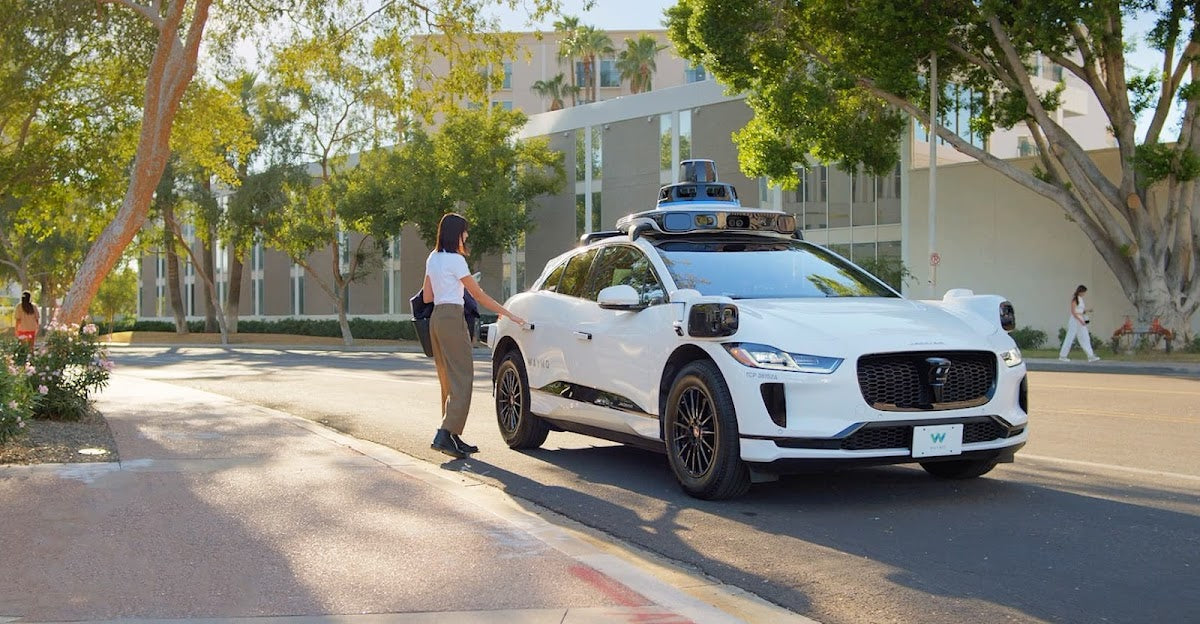
Waymo’s Robotaxi Vision Still Needs Humans to Handle Simple Tasks
Autonomous vehicles are often marketed as a near-future solution where human involvement is minimal or unnecessary. Waymo, widely regarded as the most advanced robotaxi operator in the United States, has already removed drivers from its vehicles in several cities. Yet even with years of real-world testing and millions of autonomous miles logged, some surprisingly basic problems still require human intervention.
One of those problems is as simple as closing a car door.

A Small Detail That Can Stop a Driverless Car
Waymo’s robotaxi fleet relies primarily on Jaguar I-Pace electric SUVs, vehicles originally designed for human drivers. Unlike purpose-built autonomous shuttles, these cars use traditional manually operated doors, without motors or automated closing mechanisms.
For safety reasons, a Waymo vehicle will not move if any door is not fully closed. The system treats an open or partially latched door as a critical fault. While this makes sense from a safety perspective, it introduces a vulnerability when passengers exit a driverless vehicle and fail to shut the door completely.
In a conventional ride-hailing scenario, a driver could immediately fix the issue. In a fully autonomous system, the car is left stranded.
When Urban Disruptions Make the Problem Worse
The issue becomes more visible during unusual citywide events. In a recent incident in San Francisco, a major power outage disabled traffic lights across multiple intersections. Several Waymo vehicles paused operations and requested remote assistance while stopped in the roadway.
Some passengers, frustrated by delays, ended their rides early and walked away, leaving doors partially open. Because the cars could not move, they became obstacles until the issue was resolved manually.
This scenario highlights a gap between autonomous driving capabilities and real-world human behavior. Passengers do not always act as expected, especially when there is no driver present to guide them.
Paying Humans to Keep Robotaxis Moving
Waymo’s workaround is straightforward but revealing. The company pays gig workers to physically intervene and close doors on stranded robotaxis. In Los Angeles, workers earn between $20 and $24 per job to respond to these situations.
According to reporting from The Washington Post, Waymo requests assistance through Honk, a smartphone app typically used by towing companies and roadside service providers. Workers receive a location, arrive on-site, and perform simple tasks such as closing doors or removing obstructions.
Cesar Marenco, a towing company owner in Inglewood, California, described becoming a regular Waymo contractor after freeing a robotaxi whose rear door was blocked by a trapped seat belt. He now completes up to three Waymo-related jobs per week, underscoring how frequently these minor issues arise.
Human Behavior Remains the Weak Link
These interventions do not point to a failure of autonomous driving software. Instead, they expose a broader challenge: autonomous vehicles must still coexist with unpredictable human behavior.
Without a driver to provide instructions or reminders, passengers may forget basic actions such as closing doors or adjusting seat belts. Even small mistakes can render a fully autonomous vehicle immobile.
As Marenco noted, “There’s always going to be human error when someone’s riding in a vehicle and there’s no one to tell them what to do.”
Hardware Design May Offer a Long-Term Fix
The most obvious solution is automatic door systems, which remove passenger responsibility entirely. However, Waymo’s current fleet was not designed with this feature in mind.
The company is testing newer vehicles, including the Hyundai Ioniq 5, but that model also lacks automatic closing doors. More promising are Waymo’s plans to deploy custom-built robotaxis developed with Zeekr, which feature minivan-style powered sliding doors.
Competitors are already moving in this direction. Amazon’s Zoox autonomous pods, currently operating in Las Vegas and San Francisco, are designed from the ground up for autonomy and include electrically powered doors that eliminate this problem entirely.

Autonomy Is Advancing, But Not Fully Independent Yet
Waymo’s reliance on paid door-closers may sound ironic, but it reflects a transitional phase in autonomous mobility. Software alone cannot compensate for hardware limitations and human unpredictability.
Until purpose-built robotaxis become the standard, even the most advanced autonomous systems will occasionally need people on the ground to keep them moving.
Recommend Reading: Waymo Expands Driverless Taxi Network to More U.S. Cities in 2026











Share:
China’s EV Export Boom Accelerates Across Mexico, Europe, and Asia
Tesla Cybertruck Slowdown Triggers Major Losses for a Key Battery Supplier