


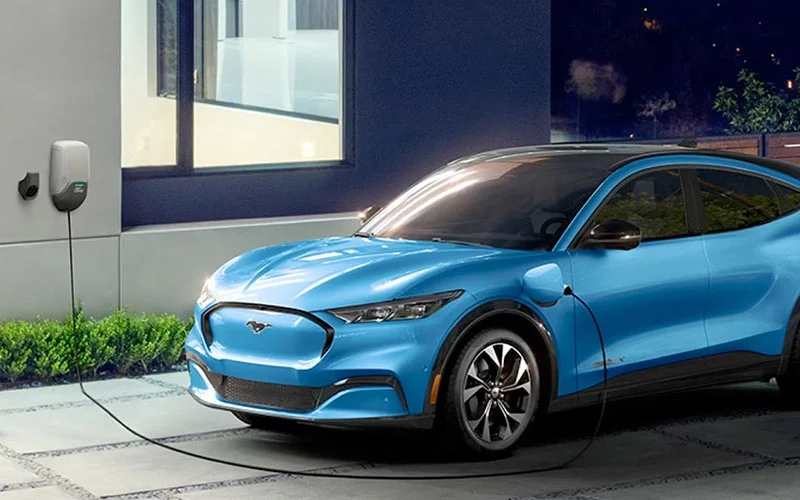
Charging a Ford Mustang Mach-E or F-150 Lightning is easy once you know the options and best practices. At home, Ford provides the Mobile Charger (standard with the vehicle), which can plug into 120V or 240V outlets. On a 120V outlet it adds only ~3 miles of range per hour, so it’s mainly for slow “Level 1” charging overnight. With a 240V outlet (NEMA 14-50), the Mobile Charger delivers roughly 21 miles of range per hour. For faster home charging, Ford offers the Connected Charge Station (hardwired wall box up to 48A), which can recharge a Mach-E’s extended-range battery from 0–100% in about 11 hours (~27 mi/hr). Third-party Level 2 chargers (ChargePoint Home Flex, Enel X JuiceBox, Siemens, etc.) are also compatible with Ford EVs and can deliver up to 9–11 kW. In practice, a Level 2 charger at home or work will typically add about 20–27 miles of range per hour for these vehicles.
DC Fast Charging: Electrify America & Tesla Superchargers
On the road, both vehicles support DC fast charging. The Mach-E can charge at up to ~150 kW and the F-150 Lightning peaks around 150–170 kW. On a 150+kW DC fast charger (CCS connector), you can add hundreds of miles of range in under an hour. For example:
-
Mach-E Extended Range: 10%–80% in ~36 minutes
-
Mach-E Standard Range: 10%–80% in ~32 minutes
-
F-150 Lightning SR: 15%–80% in ~36 minutes
-
F-150 Lightning ER: 15%–80% in ~41 minutes
Ford now also supports the Tesla Supercharger network via an official NACS adapter. The adapter works with Tesla’s Superchargers but not their home/destination chargers. With this, you can access more than 17,800 Tesla Superchargers across the U.S.
Charging Network Coverage in the U.S.
Ford EV drivers have excellent public charging access:
-
Electrify America: 1,000+ stations, ~4,800 chargers
-
EVgo: 1,100+ fast-charging locations, ~4,080 DC stalls
-
ChargePoint: thousands of Level 2 and DCFC chargers
-
Tesla Superchargers: 17,800+ now open to Ford via adapter
All of these are integrated into the Ford BlueOval™ Charge Network, the largest unified public charging network in North America. Through the FordPass app or your in-car SYNC system, you can:
-
Find real-time charger locations
-
Filter by speed, availability, or plug type
-
Start Plug & Charge sessions without cards or apps
Finding and Using Chargers
Use the FordPass app to find chargers near you. Go to Energy → Public Charging and filter for the type you want (Level 2, fast DC, etc.). You can also use:
-
PlugShare for community reviews and map overlays
-
ChargePoint / EVgo apps for station-specific access
-
ABRP for EV routing
At the station:
-
Plug in your vehicle (use adapter for Tesla)
-
Use Plug & Charge or start session via app
-
Unplug and go when done
Tips:
-
Arrive at fast chargers with 10–20% charge for fastest speeds
-
Only charge to 80% unless needed for trip range
-
Confirm station supports CCS or NACS
Charging Times & Range Estimates
At home:
-
40A/NEMA 14-50 (Mobile Charger): ~21 mi/hr
-
48A Wall Charger (Connected Charge Station): ~27 mi/hr
Full charge estimates:
-
Mach-E Extended (91 kWh): ~11 hours at 48A
-
F-150 Lightning SR (98 kWh): ~10–11 hours at 40A
-
F-150 Lightning ER (131 kWh): ~15 hours at 40A, or ~8 hours at 80A
DC Fast Charging:
-
Expect 100–200 miles added in 30–40 minutes depending on model and battery level
Incentives, Rewards & FordPass
Charging incentives:
-
Federal tax credit: 30% up to $1,000 for home charger installation
-
State/local utility rebates: vary, often $250–$500
-
BlueOval Rewards: earn FordPass points for charging
Use the FordPass app to:
-
Monitor charge level remotely
-
View your charging history
-
Find charging stations
-
Earn and redeem rewards
Recommend Reading: Ford’s 2026 F-150 Lightning STX Brings More Range at No Extra Cost


Share:
5 Hidden EV Settings That Boost Range
Scientists Warn Against Overnight EV Home Charging