A New Benchmark for Porsche EV Technology

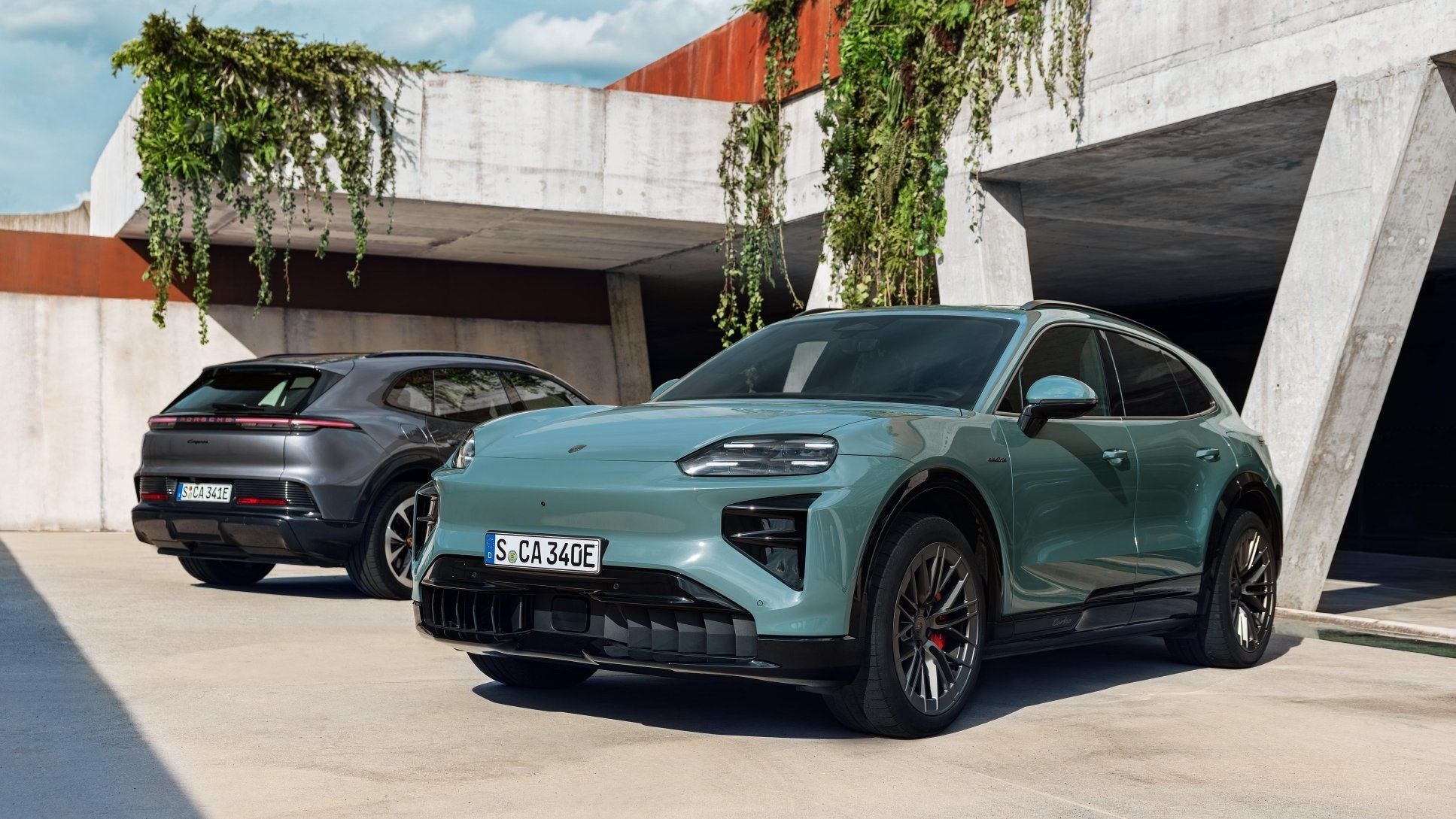
The Porsche Cayenne Electric represents the brand’s most ambitious step into the battery-electric SUV segment. While its styling may spark debate, its engineering leaves little room for argument. This is Porsche’s most advanced EV to date, built to compete directly with leading electric SUVs from both the U.S. and China.

The first wave includes two dual-motor, all-wheel-drive variants, each equipped with air suspension and a 108-kWh usable battery pack. Both models peak at 400-kW DC fast charging, allowing exceptionally quick energy recovery. Regenerative braking has also received a major upgrade, capable of feeding up to 600 kW back into the battery—far above the Taycan’s 400-kW limit.


Charging Performance and Real-World Range

Porsche claims the new system can add 201 miles in about 10 minutes, and reach 10% to 80% in under 16 minutes, provided the charger supports 850 volts and 520 amps. Wireless charging—up to 11 kW—is available as an option via a floor pad.

In terms of range, both versions approach the 400-mile mark on the WLTP cycle, putting the Cayenne Electric in the upper tier of long-range EV SUVs. These numbers are competitive even against the Lucid Gravity, which also peaks at 400 kW but carries a larger and higher-voltage battery.

Porsche Cayenne Wireless Charging


Power, Performance, and Driving Dynamics

Base Cayenne Electric

The entry model produces 402 hp in normal conditions, rising to 435 hp with Launch Control. Torque sits at 618 lb-ft, enabling a 0–62 mph sprint of 4.8 seconds and a WLTP range of 399 miles.

Cayenne Turbo Electric

The Turbo model dramatically escalates performance. With Launch Control, it delivers 1,140 hp and 1,106 lb-ft of torque, rocketing from 0–62 mph in 2.5 seconds and reaching a 161-mph top speed. Everyday output is a still-massive 845 hp, with a 10-second Push-to-Pass burst adding 174 hp. WLTP range stands at 387 miles.

Rear-wheel steering is optional across the lineup. The Turbo can also be equipped with ceramic brakes and Porsche’s Active Ride system, which adjusts each corner independently for improved stability.


Design Highlights and Aerodynamic Features

Aesthetically, the Cayenne Electric retains the model’s polarizing look, but adds several EV-specific touches. Active aerodynamic elements—like frameless windows, active front flaps, a dynamic roof spoiler, and rear aero blades—help reduce drag and enhance efficiency at highway speeds.

Practicality remains strong. The SUV can tow up to 7,716 pounds, offers 56 cubic feet of cargo space with the rear seats folded, and includes a 3.1-cu-ft frunk. U.S. specs may vary slightly from the European measurements.


A Modern, Screen-Forward Interior

Inside, the cabin introduces a more digital direction for the Cayenne line. A curved OLED display merges into the center console, complemented by a standard 14.25-inch digital gauge cluster and an optional 14.9-inch passenger screen. An augmented-reality head-up display covers an impressive 87-inch virtual field.

Despite the tech-forward layout, Porsche retains physical controls for climate and volume—an important touch for everyday usability.

2026 Porsche Cayenne Electric


Pricing and Market Outlook

The Cayenne Electric is already available in Germany, starting at $122,400 for the base model and $192,550 for the Turbo. U.S. pricing and launch timing are still pending. The EV will be sold alongside gasoline and plug-in hybrid Cayennes, which use a separate platform.

Whether buyers fully embrace Porsche’s latest electric flagship remains to be seen, but as a technological showcase, the Cayenne Electric sets a new benchmark for premium EV SUVs.

Recommend Reading: Porsche’s Wireless EV Charger: Convenience at a High Price
FAQs - Porsche EV Series

What Porsche EV models are currently available?

As of 2025, Porsche’s EV lineup includes the Porsche Taycan (sedan and Cross Turismo variants), the Porsche Macan EV (luxury compact SUV), and upcoming models like the electric Porsche Boxster and Cayman (718 EV series). Porsche plans to electrify over 80% of its lineup by 2030.

How much does a Porsche EV cost?

The Porsche Taycan price starts around $90,000 USD for the base trim, while high-performance models like the Taycan Turbo S exceed $185,000 USD. The new Macan EV is priced lower, starting around $78,000 USD. Future Porsche EV sports cars, such as the Boxster EV, are expected to start in the $70,000–$80,000 range.

What is the range of Porsche electric vehicles?
  • Taycan EV: Between 200–300 miles (EPA rating) depending on trim and battery size.
  • Macan EV: Expected range up to 310–350 miles (WLTP) with Porsche’s next-gen PPE platform.
  • 718 Boxster EV (upcoming): Projected range of 250–280 miles.
How fast can Porsche EVs charge?

Porsche EVs support 800-volt architecture, enabling some of the fastest charging speeds in the EV market.

  • A Taycan can charge from 5% to 80% in about 20 minutes at a DC fast charger (270 kW).
  • Macan EV also supports up to 270 kW charging speeds. For home charging, Porsche offers 11 kW and optional 19 kW AC chargers.
How does Porsche Taycan compare to Tesla Model S?

The Porsche Taycan vs. Tesla Model S debate centers on priorities:

  • Taycan: Superior driving dynamics, luxury craftsmanship, 800V fast charging.
  • Model S: Longer range (up to 400+ miles), broader charging network (Superchargers), lower starting price.
    Porsche appeals to performance and brand prestige, while Tesla emphasizes range and tech ecosystem.
Does Porsche offer over-the-air software updates like Tesla?

Yes, Porsche provides OTA updates for its EVs, including improvements in infotainment, navigation, charging optimization, and driver assistance systems. While not as frequent as Tesla’s updates, Porsche is expanding its digital ecosystem to offer subscription-based features in the future.

What warranty does Porsche provide for its EV batteries?

Porsche EV batteries come with an 8-year / 100,000-mile warranty (whichever comes first). Warranty covers defects and significant capacity loss, giving owners peace of mind about long-term reliability.

How reliable are Porsche EVs compared to gasoline Porsche models?

Porsche EVs like the Taycan have shown strong reliability in performance and handling, but owners note that software issues and charging network availability can be weak points. Compared to combustion Porsches, EVs have fewer mechanical issues (no oil changes, no exhaust system), but rely heavily on software and charging infrastructure.

How much does it cost to maintain a Porsche EV?

Maintenance costs for Porsche EVs are lower than gasoline Porsches due to fewer moving parts. Owners save on oil changes, exhaust repairs, and fuel costs. However, brake pads, tires, and software service plans can be costly. Porsche also recommends regular battery health checks.

What is the resale value of Porsche EVs like Taycan and Macan EV?

The Porsche Taycan resale value has held up better than some EV competitors due to strong brand prestige, though depreciation is still higher than Porsche 911 or Cayenne. With growing EV adoption, Porsche EVs are expected to have better long-term value retention than mass-market EVs.

Which charging networks are compatible with Porsche EVs?

Porsche EVs in North America currently use CCS (Combined Charging System) plugs. Starting in 2025–2026, Porsche plans to adopt the NACS (Tesla charging standard), giving access to the Supercharger network. In Europe, Porsche EVs use CCS2 connectors with access to Ionity ultra-fast chargers.

What is Porsche’s future plan for electric vehicles?

Porsche aims for 80% of global sales to be fully electric by 2030. The roadmap includes:

  • Taycan updates with longer range.
  • Macan EV global rollout.
  • 718 Boxster and Cayman EVs launching by 2026.
  • A potential all-electric Cayenne and even an electric Porsche Panamera in the next decade.

EV News

View all

This New Battery-Powered DC Fast Charger Can Be Installed in Hours

This New Battery-Powered DC Fast Charger Can Be Installed in Hours

ElectricFish unveils its 400squared DC fast charger at CES 2026. Battery-backed and dual-port capable, it can be installed in hours, bypassing expensive grid upgrades and supporting rapid EV infrastructure growth.

Read more

Americans Worry More About EV Range Than Cost, Survey Shows

Americans Worry More About EV Range Than Cost, Survey Shows

A Deloitte survey finds that U.S. buyers worry more about EV range and charging time than cost. Loss of the federal tax credit slowed adoption, but interest remains, especially for affordable, long-range models.

Read more

Tesla’s Cybercab Could Get Regulatory Boost From Congress

Tesla’s Cybercab Could Get Regulatory Boost From Congress

Tesla’s Cybercab aims to be a $30,000 fully autonomous ride-hailing vehicle. Congressional approval could raise production limits, but software, charging infrastructure, and branding challenges still remain.

Read more