





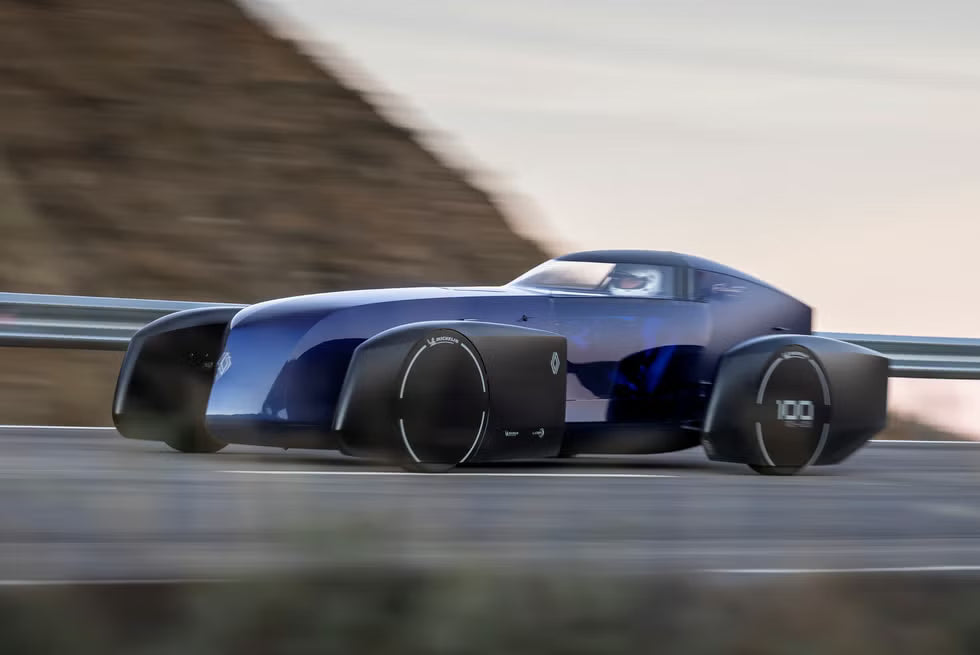
Renault Pushes EV Efficiency Limits
Electric vehicles continue to improve in efficiency with each new generation, gradually extending their driving range. Renault’s latest experimental effort, the Filante, serves as a laboratory on wheels to explore how far an EV can travel using current technology. The vehicle uses a battery pack similar in size to those found in today’s midsize electric cars.
In a recent test, the streamlined Filante drove 626 miles (1,008 km) in under 10 hours, averaging over 63 mph (102 km/h). Remarkably, the car completed the run with 11% battery remaining, indicating that it could have either maintained the same speed and achieved nearly 680 miles (1,100 km) or increased its speed to 75 mph (120 km/h) without losing efficiency.

Record-Breaking Energy Efficiency
During the test, the Filante achieved an average electricity consumption of just 7.8 kWh/100 km, equating to nearly 8 miles per kWh. This is significantly higher than current production EVs, including the Mercedes-Benz CLA, Tesla Model 3, and Lucid Air, which typically reach around 5 miles per kWh, even with advanced 800-volt systems.
The car’s exceptional efficiency results from a combination of low-drag aerodynamics, lightweight construction (just 2,200 pounds/1,000 kg), and narrow, low-resistance tires. These design choices allow Renault to maximize the output of its 87-kWh battery pack, stretching its capabilities far beyond conventional EVs.
Innovative Design and Technology
The Filante incorporates multiple energy-saving technologies. It features steer-by-wire and brake-by-wire systems, which reduce power consumption compared with traditional mechanical systems. Additionally, Michelin specially designed tires minimize rolling resistance, further lowering energy use.
Renault notes that the Filante’s design demonstrates how strategic engineering can maximize range without relying solely on larger batteries. Insights from this study are expected to influence future production models, potentially improving efficiency in everyday EVs.
Implications for Production Vehicles
For comparison, Renault’s current production model, the Scenic E-Tech electric crossover, uses the same battery pack but is rated at around 380 miles (610 km) on the WLTP cycle. Real-world sustained high-speed driving typically reduces this by about 30%. Meanwhile, the 5 E-Tech, Renault’s most efficient current EV, averages around 4.3 miles/kWh under real-world conditions.
Looking ahead, the upcoming Twingo EV, which is smaller and lighter than the 5 E-Tech, is expected to improve efficiency even further. Renault’s ongoing research with the Filante illustrates the company’s commitment to extending EV range while maintaining practicality for daily use.

Conclusion
The Renault Filante demonstrates that high-speed efficiency is achievable with careful design, advanced aerodynamics, and lightweight construction. While real-world production vehicles may not yet match these results, the insights gained from this test are likely to inform future EVs, bringing longer ranges and better energy efficiency to everyday drivers.
Recommend Reading: Renault 4 E-Tech Revives a Classic as a Practical Urban EV for 2025


Share:
Hyundai Prepares Its Largest Electric Van for European Debut
Waymo Explains Why Robotaxis Stalled During San Francisco Power Outage