





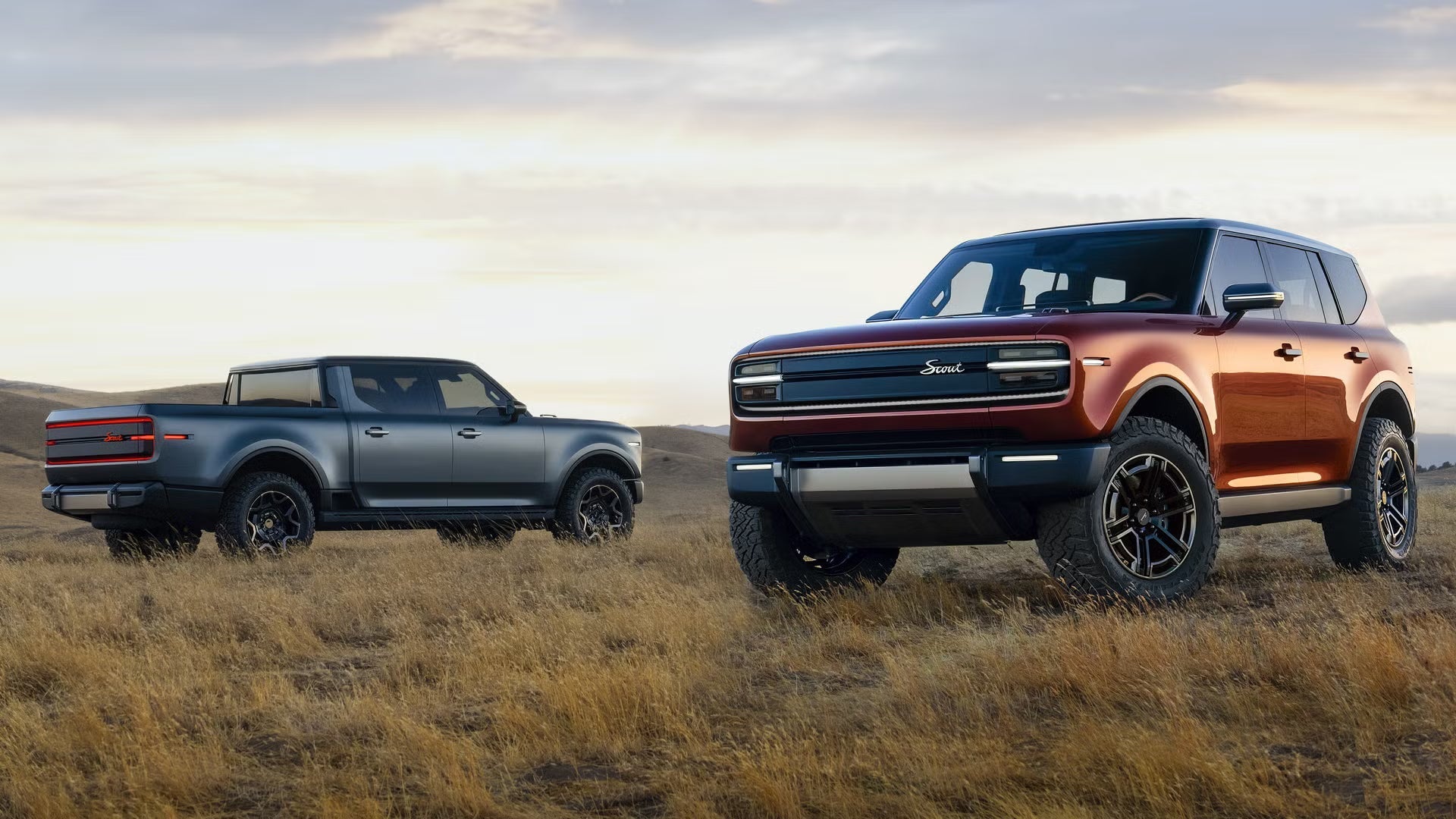
Brand Revival Focused on the U.S. Market
More than four decades after the original Scout II ended production, Volkswagen Group has brought the historic Scout name back as a standalone electric-focused brand. The new venture is aimed squarely at American buyers who prioritize utility and trail capability over luxury features.
The first two models under this revived badge are the Terra pickup and the Traveler SUV. Both are designed with off-road performance in mind and will be manufactured in the United States. While battery-electric versions are planned, customer interest has leaned heavily toward variants equipped with a gasoline-powered range extender.
During the reservation phase, Scout collected roughly 150,000 refundable pre-orders, with approximately 85% selecting extended-range configurations rather than fully electric models. That preference is expected to influence the order in which the vehicles reach showrooms.

New Body-on-Frame Platform
Unlike most of Volkswagen’s electric lineup, the Terra and Traveler will not rely on existing group architectures. Instead, they ride on a dedicated ladder-frame chassis developed specifically for Scout.
This construction method is typically associated with traditional trucks and large SUVs, offering increased durability for towing and rugged terrain. It also differentiates Scout from many electric competitors that use unibody designs.
Standard equipment will include a dual-motor all-wheel-drive system, along with a solid rear axle and locking differentials at both ends. These features reinforce the brand’s positioning as a serious off-road option rather than a lifestyle-oriented crossover.
Although the frame itself is unique, the vehicles will draw from Volkswagen Group’s extensive component library. Core systems such as electric motors, control units, and electronic modules are expected to benefit from shared development resources.
Battery Capacity and Driving Range
According to Scout Motors CEO Scott Keogh, the fully electric Terra and Traveler will use a large battery pack estimated between 120 and 130 kilowatt-hours. Target range for these models stands at roughly 350 miles per charge, though final certification figures have yet to be announced.
For buyers opting for the extended-range setup—branded under the Harvester name—the configuration changes significantly. These versions will feature a smaller 63-kWh lithium iron phosphate battery, delivering about 150 miles of electric-only driving.
A naturally aspirated four-cylinder engine positioned near the rear axle serves as a generator to recharge the battery when needed. Importantly, this engine does not drive the wheels directly; propulsion remains fully electric. When combining a full fuel tank with a charged battery, total driving distance is projected to reach approximately 500 miles.
All variants will use the NACS charging connector, enabling DC fast-charging speeds of up to 350 kW when connected to compatible infrastructure.
Dimensions and Exterior Design
Prototype versions of both vehicles were revealed in late 2024 and are expected to remain largely unchanged for production.
The Traveler SUV measures 190.9 inches in length without its rear-mounted spare, 79.9 inches wide, and 76.3 inches tall, with a 120.4-inch wheelbase. The Terra pickup stretches significantly longer at 229.2 inches, riding on a 148.6-inch wheelbase. Width is shared between the two, while the pickup stands slightly taller at 77.7 inches.
Design cues reflect a nod to earlier Scout models, featuring upright proportions and short overhangs. Inside, the cabin emphasizes tactile controls over touchscreen-only interfaces, aligning with the brand’s functional ethos.
Capability: Towing and Payload
Scout has published preliminary work ratings for both vehicles. The Terra pickup is expected to tow up to 10,000 pounds, while the Traveler SUV carries a 7,000-pound towing limit. Payload capacity is listed at 2,000 pounds for each model.
These figures position the Terra competitively within the electric truck segment, particularly among models aimed at recreational or work use.

Pricing and Production Timeline
Initial pricing is anticipated to begin near $60,000, though Scout has not confirmed whether the battery-electric or range-extended version will serve as the entry-level model. The large battery in the EV variant and the added mechanical complexity of the extended-range system both influence cost considerations.
Manufacturing will take place at a newly constructed facility in South Carolina, with production targeted for late 2027. Customer deliveries are expected to begin as 2028 model-year vehicles.
Given reservation trends, the Harvester extended-range versions may arrive first, reflecting stronger early demand for the gasoline-assisted configuration.
Scout’s return represents Volkswagen Group’s attempt to carve out a dedicated off-road electric sub-brand tailored to U.S. preferences. Whether buyers ultimately favor the fully electric setup or the range-extended alternative will likely shape the company’s long-term strategy.
Recommend Reading: Scout Motors’ 130,000 Reservations Show Drivers Still Want Gas Backup


Share:
Why Honda’s EV Sales Fell and What It Means for GM
Can Volvo’s New EV Platform Deliver a True Electric Wagon?