



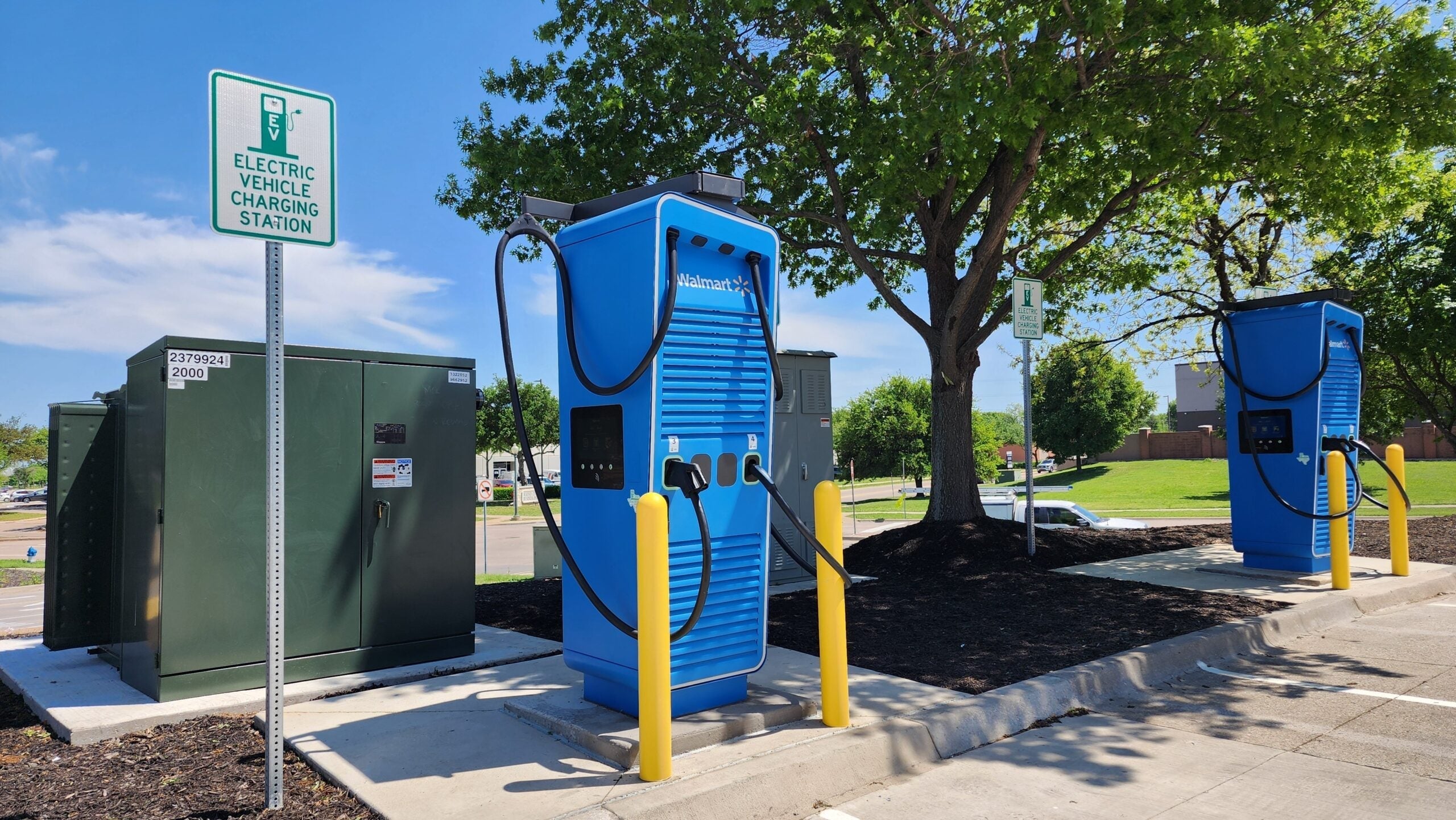
Walmart is moving beyond groceries and everyday essentials, stepping directly into the EV charging business with ambitious plans to operate its own network of chargers across the United States. For EV drivers, this could represent one of the most significant expansions of public charging infrastructure in the country.
Walmart’s Charging Ambitions
Back in 2023, Walmart announced its vision to install EV chargers at thousands of Walmart and Sam’s Club locations nationwide by 2030. Now, the retail giant has officially launched its first three pilot sites—two in Texas and one in Arkansas—and revealed more about what drivers can expect in the years ahead.
Walmart’s scale makes this move particularly impactful. The company operates more than 5,200 Walmart and Sam’s Club stores across the US, in rural, suburban, and urban areas. According to Walmart, 90% of Americans live within 10 miles of a Walmart, making its stores prime destinations for EV charging.

Expanding Beyond Third-Party Partnerships
Walmart has already been a popular charging destination, hosting hundreds of stations operated by third-party providers such as Electrify America and EVgo. In 2023, the company reported having over 1,300 chargers across more than 280 locations.
But this time, Walmart is taking full control. Its new network will be company-owned and operated, complementing the existing third-party chargers. While Walmart has not provided exact installation figures, industry analyst Tom Moloughney speculates rollout could reach tens of thousands of charging stalls nationwide by 2030.
High-Power Charging with CCS1 and NACS
One of the most anticipated details from Walmart’s announcement is the choice of hardware. Walmart plans to install 400 kW fast chargers, equipped with both CCS1 and NACS (SAE J3400 standard popularized by Tesla) connectors. For now, Walmart says it will split availability between CCS1 and NACS, but expects to lean more heavily toward NACS in the future. CHAdeMO chargers will not be included.
At the McKinney, Texas pilot site, Walmart deployed Alpitronic HYC400 chargers, each offering one CCS1 and one NACS port. Walmart also confirmed it will source chargers from ABB for future installations.
A Smooth Charging Experience
For drivers, Walmart promises a straightforward experience. Charging sessions can be started through the Walmart app by scanning a QR code, selecting the connector, and plugging in. Early reports show charging speeds above 300 kW, enough to add hundreds of miles of range in minutes. Walmart also plans to introduce credit card payment options, at least in states where regulators require it.
In terms of pricing, Walmart appears committed to affordability. At the pilot locations, charging cost $0.42 per kWh—slightly cheaper than nearby competitors. If that pricing philosophy holds true nationwide, Walmart could become one of the most cost-effective charging providers in the market.
Why Walmart Could Succeed
Walmart’s stores are uniquely suited for EV charging. Their large parking lots provide space for multiple stalls, and customers can shop, grab a meal, or pick up groceries while waiting.
Another encouraging sign is leadership. The initiative is led by Adam Happel, a veteran of the EV charging industry with prior roles at EVgo and Rivian. His background suggests Walmart is serious about building a reliable, user-friendly network rather than simply testing the waters.

Looking Ahead
With its enormous footprint, low-price reputation, and operational expertise, Walmart could quickly emerge as one of the most important players in the US charging landscape. If the company follows through on its 2030 timeline, millions of EV drivers could soon find Walmart stores doubling as convenient fast-charging hubs.
Walmart’s move highlights a larger trend: retailers and non-traditional players stepping into EV infrastructure. For shoppers, it could mean turning routine trips into an opportunity to recharge both their cars and their carts.
Recommend Reading: Costco’s EV Charging Pilot Could Transform Shopping Trips for Drivers

Share:
Hyundai Unlocks Key to Solid-State EV Batteries
Rivian Targets Hands-Free Point-to-Point Driving by 2026