
Costco is famous for being more than just a store — it’s a place where shoppers can grab groceries, household essentials, electronics, and even a slice of pizza under one roof. At many locations, the retailer also offers discounted gasoline, reinforcing its reputation as a one-stop shop for everyday needs. Now, Costco is preparing to take the next step: bringing fast electric vehicle (EV) charging directly to its parking lots.

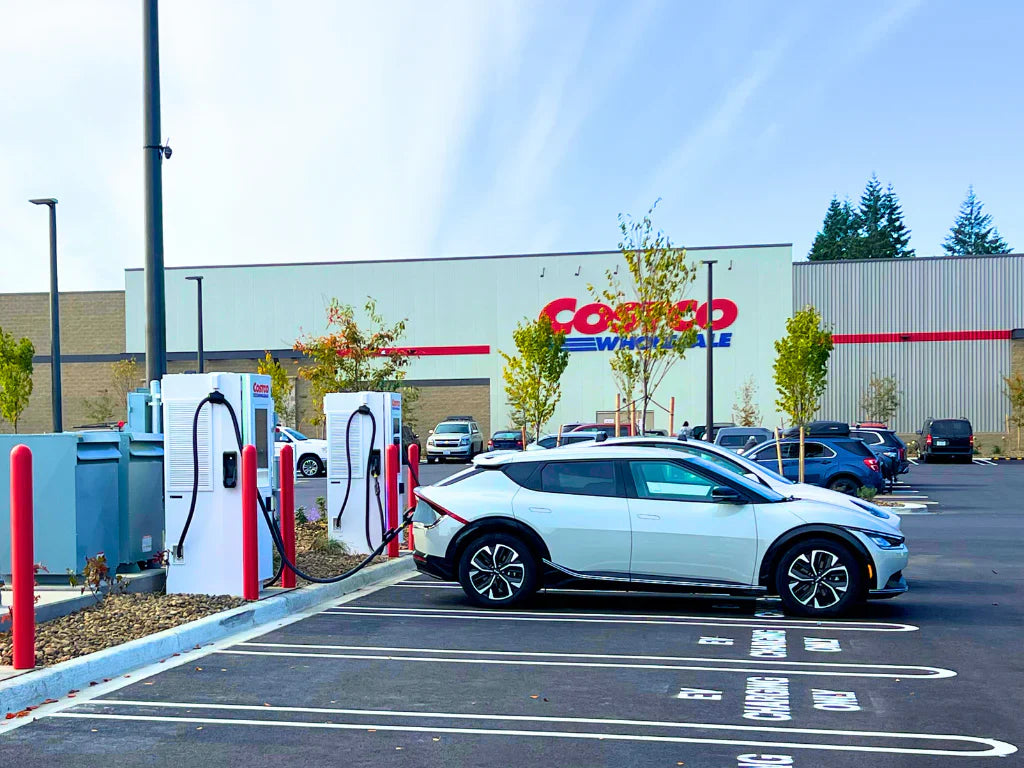
According to Electrek, Costco has partnered with Electric Era, an EV charging company founded by former SpaceX engineers, to install six fast-charging stalls at its North Port, Florida warehouse. The project was completed in just 54 days, and the chargers can deliver an 80% battery top-up in 20 to 60 minutes. This makes Costco one of the few major U.S. retailers experimenting with a charging solution that aligns with the pace of modern EV adoption.


Why this pilot is different

The U.S. EV market is expanding rapidly. Over 1 million new EVs were registered in 2024, according to Experian, and major automakers like General Motors and Hyundai are reporting record sales in 2025. Yet, charging infrastructure has not kept pace. Many drivers still complain about unreliable stations, slow charging speeds, or long waits during peak hours.

By working with Electric Era, Costco is testing a model that directly addresses these pain points:

  • Convenience – Shoppers can plug in, shop, and return to a charged vehicle.

  • Speed – Level 3 fast chargers can restore significant range in less than an hour, compared to the 6–8 hours often needed at slower Level 2 stations.

  • Scale potential – Costco operates more than 530 warehouses in the U.S. If even a fraction of these locations adopted similar setups, it could add thousands of fast-charging stalls nationwide without relying on government funding.

Chevrolet Equinox EV


The bigger EV charging challenge

For many EV owners, charging at home is ideal. But not everyone has a private driveway or reliable home charging setup. These drivers must rely on public infrastructure, which is often limited. Most stations only have four to six stalls, and availability shrinks during peak times. Weather conditions can also reduce charging speeds, creating an inconsistent experience.

Tesla’s Supercharger network has historically offered the most reliable fast-charging option, and thanks to recent partnerships, non-Tesla drivers from brands like Kia, Hyundai, Honda, and GM can now access it with adapters. However, as more automakers join, demand for Superchargers is surging, sometimes leading to congestion. That opens the door for alternative networks like Electric Era to fill the gap.

Tesla Superchargers with renewable energy


What it could mean for drivers

If Costco expands this program, the retailer’s parking lots could become a game-changing hub for EV charging. For busy families or commuters, a weekly Costco trip could double as a reliable charging session. Instead of carving out separate time to hunt for a charger, EV owners could integrate fueling seamlessly into their normal shopping routine.

For Costco, the benefits are clear as well. Offering fast charging could attract more EV-driving customers, extend shopping trips, and position the company as a leader in retail innovation. Just as its gas stations have been a long-term draw, EV charging could become the next loyalty driver.

The North Port pilot is still small-scale, but it signals Costco’s recognition that transportation is evolving and that retailers have a role to play in supporting infrastructure. If rolled out nationally, Costco’s experiment could ease one of the biggest pain points of EV ownership — where and how to charge quickly — and make driving electric more practical for millions of Americans.

Recommend Reading: Top EV Charging Networks in the U.S.: Speed, Coverage & Reliability Compared
FAQs - Level 3 DC Fast Charging

What is Level 3 DC fast charging for electric vehicles?

Level 3 charging, also known as DC fast charging (DCFC), provides direct current at high power levels (typically 50 kW to 350 kW) to quickly recharge an electric vehicle battery. Unlike Level 1 and Level 2 charging, DC fast charging bypasses the onboard charger, enabling much faster energy transfer.

How fast is Level 3 DC fast charging compared to Level 2 charging?

Level 2 chargers (240V AC) usually add 20–30 miles of range per hour, while Level 3 DC fast chargers can add 100–300 miles of range in 20–40 minutes, depending on EV battery capacity and charging power.

Does Level 3 fast charging damage EV batteries?

Frequent use of DC fast charging can accelerate battery degradation over time due to higher heat generation and faster charge cycles. However, modern EVs have battery thermal management systems that minimize impact. Occasional fast charging is safe and convenient for road trips.

What connector types are used for Level 3 DC fast charging?

The main EV fast charging connectors in North America are:

  • CCS (Combined Charging System) – widely adopted by most automakers
  • CHAdeMO – mainly used by older Nissan LEAF models
  • NACS (Tesla plug) – now being adopted across multiple brands (Ford, GM, Rivian, etc.)
What is the maximum power output of Level 3 DC fast charging stations?

Most public DC fast chargers range from 50 kW to 150 kW, while ultra-fast chargers can reach 250 kW to 350 kW. Tesla Superchargers V3 deliver up to 250 kW, and upcoming next-gen chargers may exceed 500 kW for heavy-duty EVs.

How much does Level 3 DC fast charging cost?

Pricing varies by network and location. Costs are usually based on per kWh, per minute, or a flat session fee. In the U.S., rates typically range from $0.25 to $0.60 per kWh, which is higher than home charging but competitive compared to gasoline costs.

Where can I find Level 3 DC fast charging stations in the U.S.?

DC fast chargers are commonly located along highways, rest stops, shopping centers, and EV charging networks like Tesla Supercharger, Electrify America, EVgo, and ChargePoint. Apps like PlugShare and ChargeHub help drivers locate fast charging stations.

Can all EVs use Level 3 DC fast charging?

Not all EVs are compatible. Some plug-in hybrid EVs (PHEVs) and older models lack DC fast charging capability. The maximum charging speed also depends on the vehicle’s onboard DC charging acceptance rate, which can range from 50 kW to 270 kW.

How does weather affect Level 3 DC charging speed?

Extreme cold or heat impacts battery temperature management, reducing fast charging speeds. EVs often precondition the battery before arriving at a fast charger to optimize charging efficiency in winter or summer conditions.

What is the future of Level 3 DC fast charging technology?

The future includes ultra-fast chargers (500 kW+), widespread adoption of NACS connectors, and vehicle-to-grid (V2G) integration. As EV infrastructure expands, Level 3 charging will become even more essential for long-distance travel and heavy-duty electric trucks.

EV News

View all

EVDANCE vs. Cheap EV Extension Cables: Don’t Compromise on Safety

EVDANCE vs. Cheap EV Extension Cables: Don’t Compromise on Safety

Cheap EV extension cables may seem convenient, but inferior materials and missing certifications pose safety risks. This article explains why EVDANCE cables deliver safer, more reliable charging—and why cutting corners backfire.

Read more

2026 Toyota RAV4 PHEV Review: Practical Plug-In Power for Everyday Driving

2026 Toyota RAV4 PHEV Review: Practical Plug-In Power for Everyday Driving

Toyota’s 2026 RAV4 PHEV combines all-wheel drive, up to 52 miles of electric range, and updated tech, delivering a practical and versatile plug-in option for daily driving and highly efficient hybrid performance.

Read more

Michigan Files Antitrust Lawsuit Accusing Oil Industry of Blocking EV Progress

Michigan Files Antitrust Lawsuit Accusing Oil Industry of Blocking EV Progress

Michigan has filed an antitrust lawsuit accusing major oil companies of colluding to slow EV adoption, restrict renewable energy, and keep energy prices high, arguing the conduct denied consumers cleaner and more competitive alternatives.

Read more