



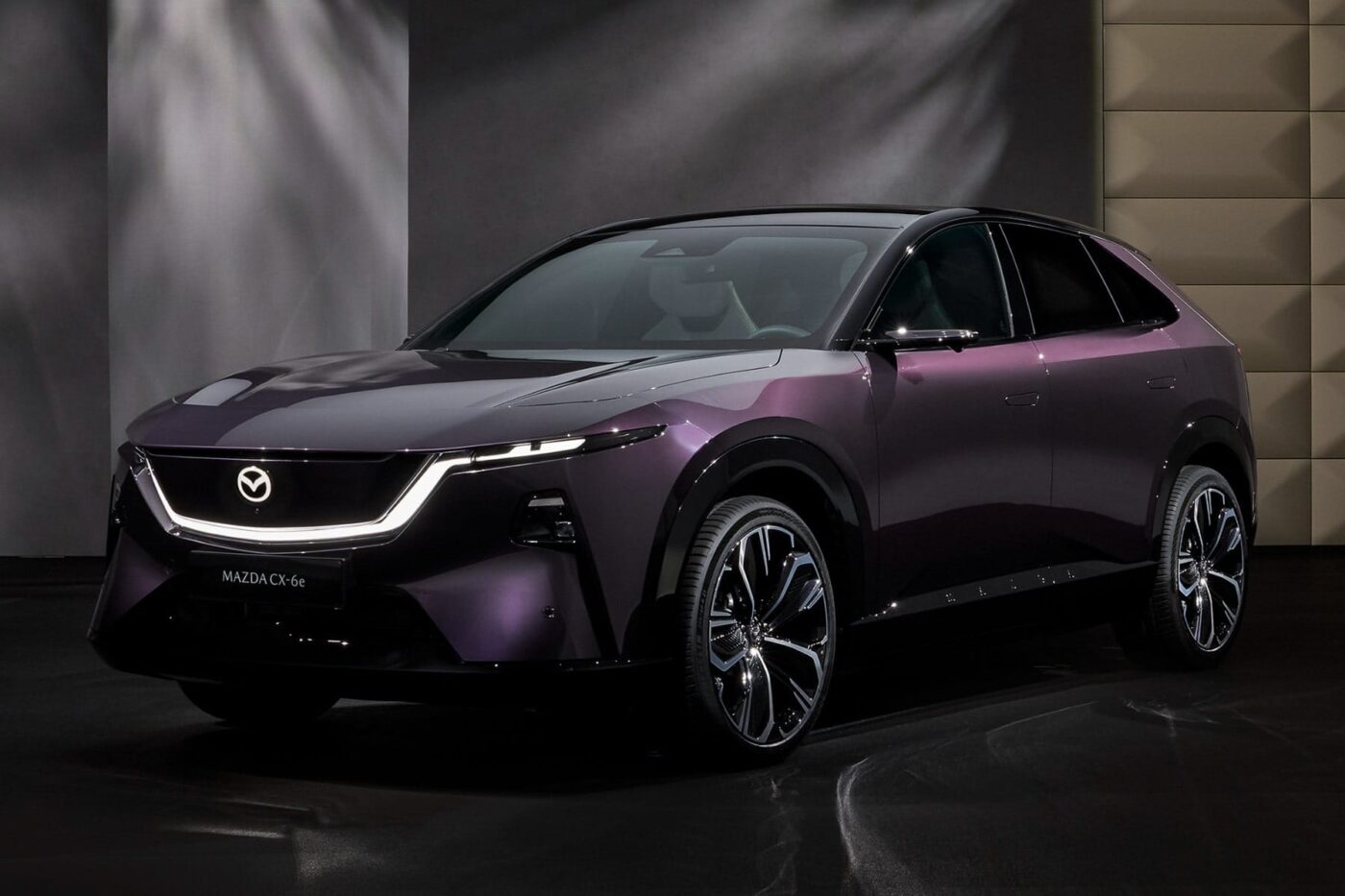
Mazda is no longer content to sit on the sidelines of the electric vehicle market. With the debut of the CX-6e electric crossover, the Japanese automaker is making a clear statement: it intends to compete directly in the fast-growing midsize electric SUV segment dominated by models like the Tesla Model Y. While Mazda may be late to the EV transition, the CX-6e suggests the company is now moving with greater confidence and purpose.
From Late Entry to Strategic Acceleration
Mazda’s electric strategy has historically been cautious, prioritizing efficiency improvements and plug-in hybrids over full battery-electric vehicles. That approach left the brand trailing competitors as EV adoption accelerated worldwide. The launch of the Mazda 6e electric sedan in Europe and China marked a turning point, and the CX-6e builds on that momentum by targeting one of the most competitive EV categories globally.
First introduced in China under the name EZ-60, the CX-6e made its European public debut at the Brussels Motor Show. Although it shares its underlying platform with vehicles developed alongside Changan Automobile, Mazda has invested heavily in differentiating the CX-6e to ensure it feels unmistakably like a Mazda product.
Design That Prioritizes Brand Identity
Despite its shared architecture, the CX-6e avoids looking like a rebadged joint-venture model. Mazda’s designers have applied the brand’s latest design language to create a crossover that is clean, restrained, and instantly recognizable.
The front end features slim daytime running lights connected by a full-width LED light bar that frames a closed-off grille. This gives the CX-6e a modern, tech-forward appearance without excessive visual complexity. Smooth body surfaces and rounded proportions contribute to a futuristic but understated aesthetic.
At the rear, a sharply angled back window and sculpted tail echo design cues seen on larger Mazda SUVs such as the CX-60 and CX-90. The result is an EV that fits naturally within Mazda’s lineup rather than standing apart as a stylistic experiment.
Battery Choice and Real-World Range Expectations
Powering the CX-6e is a 78 kWh lithium-iron-phosphate (LFP) battery, a chemistry increasingly favored for its durability, thermal stability, and lower cost. According to Mazda, the battery delivers a WLTP-rated range of 484 kilometers (approximately 300 miles).
While that figure falls short of long-range versions of the Tesla Model Y in Europe, it remains competitive with alternatives like the Audi Q4 e-tron and Volkswagen ID.4. Mazda appears to be prioritizing consistent, usable range rather than chasing headline-grabbing numbers.
The choice of an LFP battery also suggests a focus on longevity and predictable performance, particularly in urban and suburban driving scenarios where the CX-6e is most likely to be used.
Fast Charging as a Key Selling Point
Where the CX-6e aims to stand out is charging performance. Mazda claims the vehicle supports DC fast-charging speeds of up to 195 kW, allowing the battery to recharge from 10% to 80% in around 24 minutes under ideal conditions.
For daily charging, the CX-6e includes 11 kW AC charging, making it suitable for overnight home charging or workplace use. While not class-leading, this charging setup aligns well with expectations in the midsize EV segment and helps offset the vehicle’s more modest range figures.
Rear-Wheel Drive and Performance Tuning
Unlike many entry-level electric SUVs that rely on front-wheel drive, the CX-6e sends power exclusively to the rear wheels. A single rear-mounted electric motor produces 255 horsepower (190 kW) and 214 lb-ft of torque, delivering balanced handling characteristics that align with Mazda’s long-standing focus on driving feel.
Performance figures are respectable rather than aggressive. Mazda estimates a 0–62 mph time of roughly 7.9 seconds and a top speed of 115 mph. These numbers will not excite performance enthusiasts, but they are more than sufficient for everyday driving and align with the expectations of the CX-6e’s target audience.
A Minimalist, Screen-First Interior
The CX-6e’s exterior restraint continues inside the cabin. Physical buttons are kept to a minimum, with most functions controlled through a massive 26-inch display that spans the center of the dashboard. This screen serves both as the primary infotainment system and as a passenger entertainment display.
Mazda says the system includes a built-in voice assistant supporting nine languages, along with wireless Apple CarPlay and Android Auto. The layout reflects broader industry trends toward digital-first interiors, though it represents a significant departure from Mazda’s traditionally tactile control philosophy.
Material quality and seating comfort are expected to remain brand strengths, though final production specifications have yet to be fully detailed.
Market Focus and Global Availability
For now, the CX-6e is aimed squarely at European and Chinese markets, where demand for midsize electric SUVs continues to grow. The vehicle will be manufactured in China by Changan Automobile, leveraging existing EV production infrastructure.
This global focus highlights a notable gap in Mazda’s U.S. lineup. Currently, American buyers have no fully electric Mazda available. The MX-30 EV was discontinued in 2023 after limited availability, leaving plug-in hybrids like the CX-70 and CX-90 as the brand’s primary electrification offerings.
Mazda has been spotted testing an electric vehicle in California, suggesting a U.S.-specific EV is in development. However, no official timeline has been announced, and it remains unclear whether the CX-6e itself will ever reach North America.

A Cautious but Meaningful Step Forward
The CX-6e may not redefine the electric SUV segment, but it represents a critical evolution for Mazda. By focusing on design coherence, balanced performance, and practical charging capability, Mazda is signaling that it intends to compete seriously in the EV space—on its own terms.
Whether that approach will be enough to challenge dominant players like Tesla remains to be seen. What is clear, however, is that Mazda is no longer standing still.
Recommend Reading: Mazda Steps Up EV Plans as New U.S.-Focused Electric SUV Prototype Emerges

Aktie:
Ford Plans Eyes-Off Driving for Affordable EV Platform by 2028
Fast Charging and EV Battery Health: What the Data Really Shows