





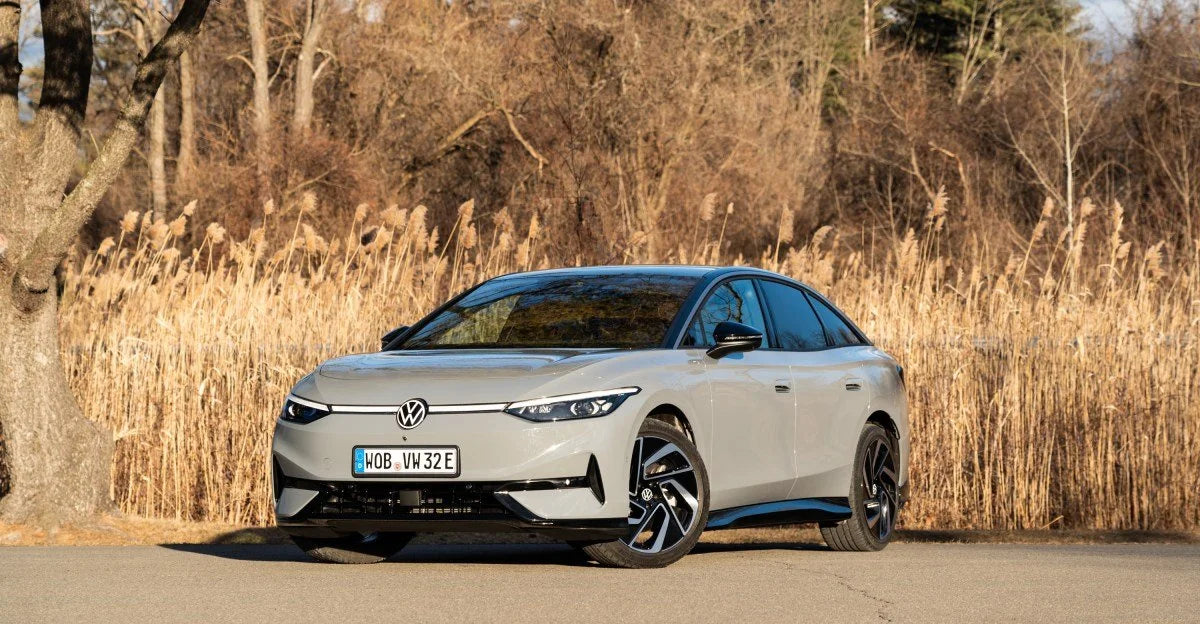
Volkswagen strengthened its position as Europe’s leading electric vehicle brand in 2025, particularly in its home market of Germany. While affordable compact EVs continued to perform well, the biggest surprise came from the top of Volkswagen’s lineup. The brand’s flagship electric sedan, the ID.7, emerged as Germany’s best-selling EV of the year, defying expectations about price sensitivity and body-style preferences.
At a time when EV incentives across Europe were being scaled back, the success of a premium electric sedan highlights how buyer priorities in the region are evolving.

Flagship Sedan Overtakes Cheaper Alternatives
In Germany, Volkswagen’s EV deliveries rose 60.7% year over year to 93,800 units. Rather than entry-level models leading the charge, the ID.7 accounted for approximately 35,000 deliveries, representing a 132% increase compared with the previous year.
This result put the ID.7 ahead of smaller and more affordable EVs within Volkswagen’s own lineup. According to market data, the five best-selling electric vehicles in Germany in 2025 all came from the Volkswagen Group, underscoring the company’s domestic dominance as well as its ability to capture buyers at multiple price points.
Strong European Demand Despite Incentive Rollbacks
The ID.7’s momentum was not limited to Germany. Across Europe, the model recorded 76,600 sales in 2025, up nearly 134% year over year, even as many countries reduced or eliminated EV purchase subsidies.
What makes this performance notable is that the ID.7 is neither a compact hatchback nor a low-cost option. Instead, it competes in the midsize sedan and wagon segment—a category that continues to resonate with European buyers, even as crossovers dominate headlines elsewhere.
Pricing, Powertrain, and Range Breakdown
In Germany, the ID.7 starts at €54,100 for the fastback and €54,900 for the wagon. The base version uses a single rear-mounted motor producing 286 horsepower, allowing it to reach 100 km/h (62 mph) in 6.5 seconds.
At the top of the range, the dual-motor ID.7 GTX delivers 340 horsepower, improves acceleration to 5.1 seconds, and features a larger usable battery capacity of 86 kWh, compared with 77 kWh in the base model.
The standout configuration is widely considered to be the Pro S variant, which combines a single motor with the larger battery. Its claimed WLTP range of 440 miles (708 km) places it among the longest-range electric vehicles currently sold in Europe.
Wagons, Competition, and Market Fit
The ID.7 is also Europe’s best-selling electric wagon, though competition is set to intensify. Later this year, the Zeekr 7GT is expected to arrive with more luxury features, faster charging, and aggressive pricing, potentially challenging Volkswagen’s lead in this niche.
Nevertheless, the ID.7 benefits from a market environment that remains far more welcoming to sedans and wagons than the United States. European buyers continue to value long-range efficiency, ride comfort, and traditional body styles.
Why the ID.7 Skipped the U.S.
Volkswagen originally planned to launch the ID.7 in the United States in 2024, but the company later reversed that decision, citing a “challenging EV climate.” The absence of the $7,500 federal tax credit, combined with strong American demand for crossovers and new tariffs on European-built vehicles, likely played a decisive role.
Without price incentives and facing shifting consumer preferences, Volkswagen appeared unconvinced that a premium electric sedan could succeed in the U.S. market.

What’s Next for Volkswagen’s EV Strategy
In total, Volkswagen sold 247,900 EVs in Europe in 2025, supported by the continued popularity of the ID.3, ID.4, and ID.5. Looking ahead, the company expects major volume growth from the upcoming ID. Polo, a €25,000 electric hatchback aimed at buyers seeking affordability without sacrificing quality.
Volkswagen also plans refreshed versions of the ID.3 and ID.4, with interiors redesigned to include more physical controls and fewer touch-sensitive interfaces. These updates signal a broader shift toward conventional design language across the ID lineup.
As a result, the ID.7 may soon stand as the last remaining example of Volkswagen’s original, more experimental ID design philosophy—at least until it receives its own mid-cycle refresh. If that update brings a more familiar look and feel, its appeal could expand even further.
Recommend Reading: Volkswagen ID.2: Redefining Affordable EVs with Style and Innovation









Share:
Electric Vehicles Are Becoming Less Politically Divisive
Mercedes-Benz Builds a Charger Network Designed for a No-Adapter Future