





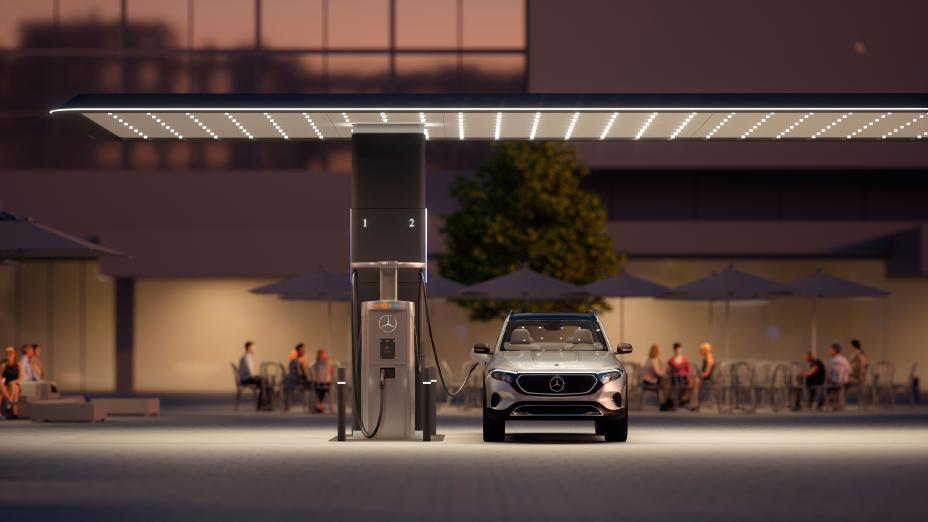
As the North American EV market transitions toward Tesla’s charging standard, Mercedes-Benz is taking a different approach to easing driver confusion. Instead of asking customers to carry adapters, the automaker’s charging network is rolling out hardware designed to work with both NACS and CCS vehicles at the same stall.
The goal is simple: make public fast charging feel straightforward again during a messy period of industry-wide change.

How Tesla’s Plug Changed the Charging Landscape
In late 2022, Tesla announced it would open-source its proprietary charging connector, later branded as the North American Charging Standard (NACS). The move triggered a rapid shift across the industry.
By mid-2023, Ford, General Motors, and nearly every major automaker selling EVs in North America had committed to adopting the Tesla-style plug on future vehicles. The promise was easier access to Tesla’s large and reliable Supercharger network—and faster EV adoption as a result.
But the transition left today’s drivers in limbo. Some EVs now ship with NACS ports, others rely on CCS, and millions of cars already on the road are stuck navigating adapters and compatibility charts.
Mercedes’ Answer: Multiport Fast Chargers
For Mercedes-Benz High-Power Charging (MBHPC), the solution is hardware that removes the decision-making from the driver altogether.
The network is deploying multiport DC fast chargers that feature four cables: two NACS and two CCS-1 connectors, split evenly on each side of the unit. Any EV can pull in and charge directly—no dongles required.
Each charger is based on the Alpitronic HYC 400 platform, capable of delivering up to 400 kilowatts of power, which is sufficient for the fastest-charging EVs currently sold in North America.
Why Mercedes Wants Adapters Out of the Equation
According to Mercedes executives, adapters introduce too much uncertainty into the charging experience. Drivers may buy low-quality hardware, mishandle connectors, or use adapters with incorrect current ratings that slow charging speeds.
From the network’s perspective, adapters are also unpredictable. Charging reliability becomes harder to guarantee when third-party hardware sits between the vehicle and the charger.
By offering native support for both standards at every stall, Mercedes aims to eliminate these variables—especially as CCS-equipped vehicles are expected to remain on the road for at least another decade.
Network Expansion and Retrofit Plans
Roughly half of Mercedes-Benz charging locations already feature multiport chargers, and that number is increasing quickly. All new MBHPC stations going forward will be built exclusively with the four-cable configuration.
The company is also retrofitting existing sites, meaning every Mercedes charging hub will eventually support CCS and NACS side by side. Several new locations in Canada recently opened with multiport chargers already in place.
Mercedes says this approach ensures every vehicle can charge without needing to plan ahead, regardless of model year or connector type.
Engineering Challenges Behind the Scenes
Making a four-cable fast charger work reliably required additional engineering. Cable length and cooling had to accommodate a wide range of vehicle port locations, from front fenders to rear bumpers.
Software updates were also necessary so vehicle navigation systems accurately report stall availability. Without these changes, cars could misread the number of usable charging spots at a station.
Mercedes says those issues have been resolved through a mix of hardware design and firmware tuning.
How This Compares to Other Charging Networks
Mercedes is not alone in adapting to the NACS transition, but its strategy stands out.
Other networks, including EVgo and Ionna, typically install separate chargers for CCS and NACS. Walmart is deploying chargers with one plug of each type. ChargePoint has introduced an internal adapter system that allows a single cable to serve both standards.
The Alpitronic four-cable charger is also being tested by Electrify America, but Mercedes is the first network to commit to deploying it across all locations.

A Cleaner Charging Experience During a Messy Transition
With more than 650 charging ports already installed and over 1,000 expected by year’s end, Mercedes-Benz High-Power Charging is betting that simplicity will matter more than brand loyalty as EV adoption grows.
As the industry works through what many drivers call the “adapter era,” Mercedes’ approach offers a glimpse of what the post-transition charging experience could look like: pull in, plug in, and leave the adapter at home.
Recommend Reading: New Mercedes GLB EV Targets Long-Range Efficiency in a Compact SUV










Share:
Germany’s Top-Selling EV in 2025 Was Volkswagen’s ID.7
GM Faces a Hard Reality About Plug-In Hybrids in the U.S.