



Lucid Expands Into the Mid-Size EV Segment
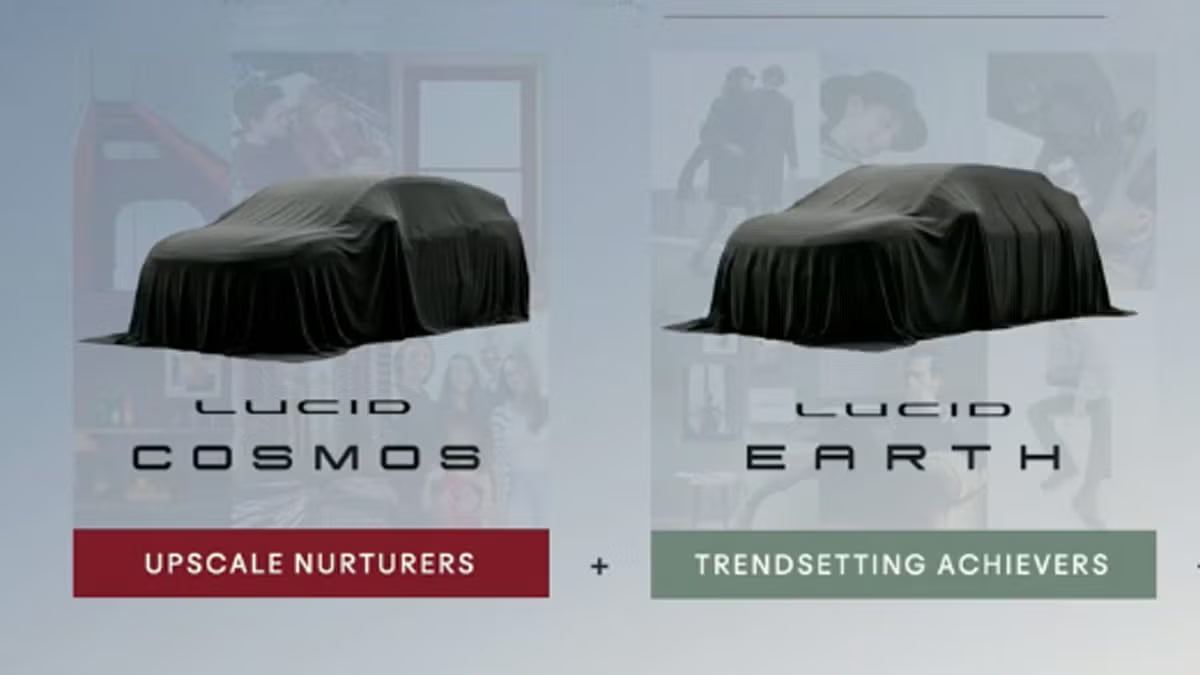
Lucid Motors has unveiled the names of its upcoming mid-size electric SUVs, confirming that the models will be called Cosmos and Earth. The announcement was made during the company’s Investor Day 2026 event in New York City, where executives outlined Lucid’s next phase of product expansion.
These vehicles mark a strategic shift for the California-based automaker. Until now, Lucid’s lineup has focused on premium models such as the Air sedan and the Gravity SUV, both positioned at the higher end of the market. The new crossovers aim to reach a broader customer base with a target starting price near $50,000, placing them directly in the competitive mid-size electric SUV category.
A third vehicle using the same architecture is also planned, though the company has not yet revealed its name.

Production Plans Across Saudi Arabia and the United States
Lucid’s global manufacturing strategy will play a major role in bringing the new models to market. According to company officials, production of the Cosmos is scheduled to begin before the end of 2026 at Lucid’s manufacturing facility in Saudi Arabia.
That plant is primarily intended to supply markets in the Middle East, Europe, and other international regions. However, the company indicated that early production units may also be shipped to North America during the initial launch phase.
Within roughly six to twelve months after production begins, Lucid expects to add manufacturing capacity for the mid-size SUV in the United States. The company plans to assemble the model at its Arizona factory, allowing it to serve the domestic market more efficiently.
The Earth crossover will arrive later, with Lucid estimating its launch roughly one year after the Cosmos enters production.
A New Platform Designed for Mass-Market EVs
Both vehicles will be built on a new mid-size electric platform that Lucid says will underpin several future models. This architecture represents a key step in the company’s effort to expand beyond niche luxury vehicles and compete in larger volume segments.
Engineers revealed that the upcoming SUVs will use an 800-volt electrical system, a technology commonly associated with high-performance EVs and faster charging capability.
Another highlight of the platform is its support for bidirectional charging, allowing electricity to flow both to and from the vehicle. In practical terms, this means the SUVs could potentially power external devices or send energy back to a building or grid under certain conditions.
The powertrain will also introduce a newly developed drive unit called Atlas. Lucid says this motor design reduces complexity and weight compared with its previous systems, featuring 23% less mass and about 30% fewer components.
Efficiency and Range Expectations
Although Lucid has not yet published final range estimates or battery capacities for the new vehicles, company engineers shared an example illustrating the platform’s efficiency.
According to Lucid, the Cosmos could travel approximately 300 miles using a 69-kWh battery pack. If achieved in production, that figure would represent impressive energy efficiency compared with many similarly sized electric SUVs.
Aerodynamic design is expected to contribute heavily to those numbers. The company claims a drag coefficient of roughly 0.22, a very low figure for a crossover-shaped vehicle.
Engineers noted that the example battery size does not necessarily reflect the final configuration. Depending on the version released, the vehicle could offer a different battery capacity and potentially a longer range.
Interior Design and Interface Changes
Lucid also confirmed several interior design changes that differentiate the new models from its existing vehicles.
Unlike the Air and Gravity, which feature a prominent central touchscreen, the upcoming crossovers will adopt a different dashboard layout. The design centers around one ultra-wide display spanning the top of the dashboard rather than a vertically oriented screen in the middle console.
The display will reportedly be divided into four functional sections. From left to right, these zones are expected to show:
-
Energy and vehicle status information
-
Navigation and mapping tools
-
Media and entertainment controls
-
Additional data such as weather updates
Lucid also plans to integrate an AI-driven voice assistant designed to allow natural spoken interaction with the vehicle’s systems.
Another notable design choice involves the door handles. Instead of electronically actuated handles—common on many modern EVs—Lucid confirmed that the new models will use traditional mechanical door handles.
Three Distinct Models for Different Drivers
Lucid is positioning the two announced SUVs with slightly different personalities.
The Cosmos is expected to focus on urban driving and on-road performance, appealing to customers who prioritize speed, efficiency, and everyday practicality.
The Earth, on the other hand, will be designed with broader versatility in mind, targeting drivers who want a vehicle capable of handling suburban environments and varied road conditions.
A third SUV, still unnamed, is also under development on the same platform. According to Lucid, this version will be oriented toward more adventurous driving, suggesting a stronger emphasis on off-road capability.
While the company has not yet shown final production designs, it displayed preview images during the event that hinted at the general proportions and body shapes of the upcoming vehicles.

Lucid’s Next Step in the EV Market
For Lucid, entering the mid-size electric SUV segment represents a critical moment in its growth strategy. The category includes some of the world’s best-selling EVs, and competition is intense.
By offering vehicles around the $50,000 price range, the company hopes to move beyond its current luxury niche and compete directly with high-volume electric crossovers.
Whether the Cosmos and Earth can achieve that goal will depend on factors such as final pricing, production scale, and how well Lucid’s technology translates into real-world performance once the vehicles reach customers.
Recommend Reading: Lucid Motors Sees 2026 Growth Hinged on Upcoming $50K Crossover
Aktie:
Honda EV Strategy Faces Questions After Major Project Cancellations