





Faster Charging Moves Closer to Reality
Limited charging speed has long been cited as a barrier to broader electric vehicle adoption. While modern EVs can travel substantial distances, replenishing the battery often requires 25 minutes or more at high-power stations. For some consumers, that gap compared with the few minutes needed to refuel a gasoline vehicle remains a sticking point.
In China, however, charging performance is advancing rapidly. BYD, one of the country’s largest automakers, introduced vehicles last year capable of accepting up to 1 megawatt (1,000 kW) of power. Under China’s CLTC testing standard, the company claimed those models could add roughly 250 miles of driving range in just five minutes.
Now, evidence suggests BYD may be preparing an even more powerful generation of public charging equipment.

New Hardware Spotted Online
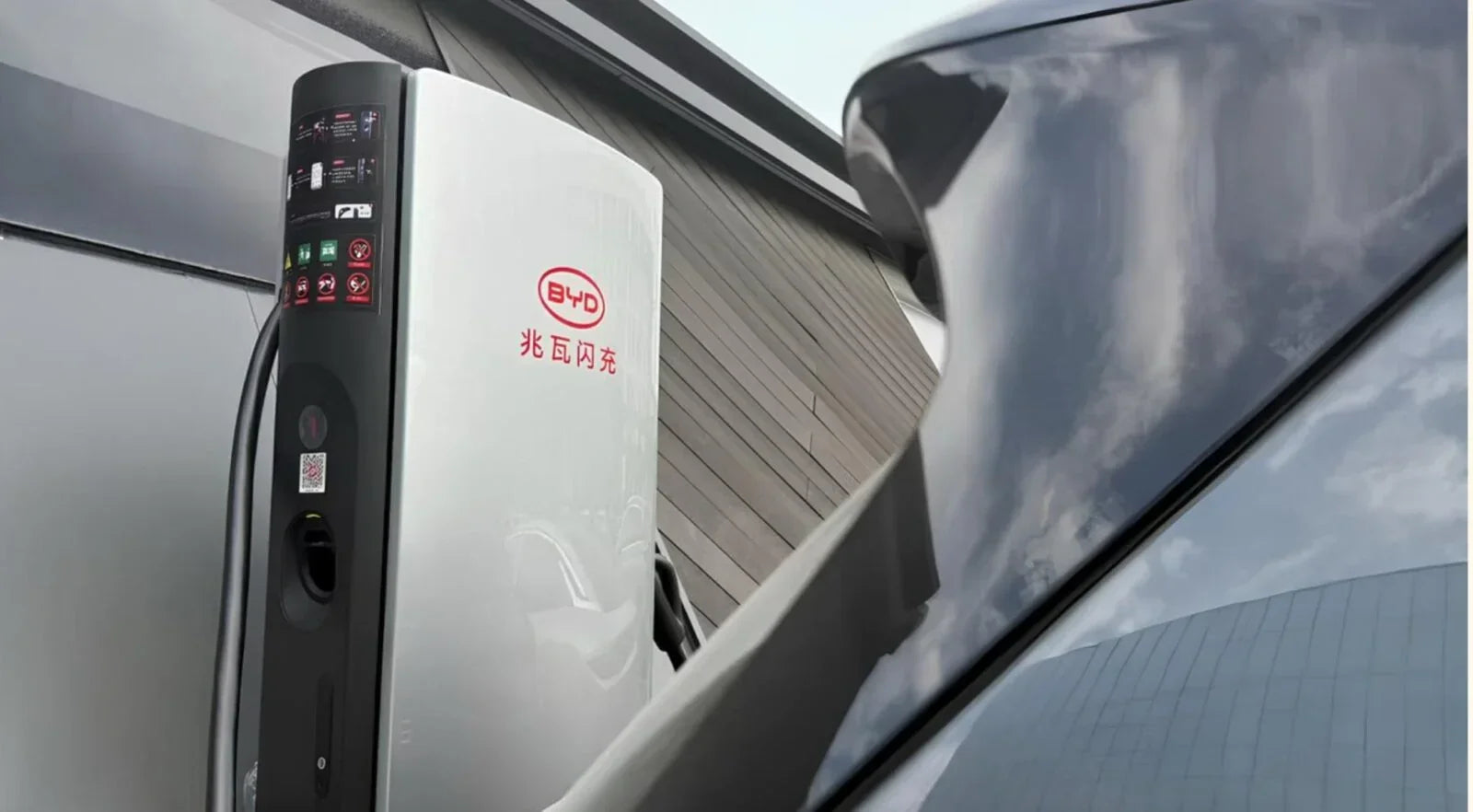
Images circulating on Chinese social media platforms show unfamiliar teal charging units with a distinct T-shaped structure. The design differs from the company’s earlier “Flash” charging dispensers, which resembled more conventional fast-charging cabinets despite their extremely high output.
Close-up photos of identification plates shared by automotive bloggers indicate that at least some of these new stations are rated at 1,500 kW, or 1.5 megawatts. That would represent a step up from the 1,360 kW capability BYD cited for its first-generation megawatt systems unveiled last year.
BYD has not formally announced upgraded hardware, and company representatives have not publicly confirmed details about the newly photographed units. Nevertheless, the appearance of these chargers in multiple locations suggests broader deployment may already be underway.
From Partnerships to Proprietary Network
Despite its dominance in EV sales, BYD historically relied on partnerships with independent charging operators rather than building an extensive proprietary network. That approach contrasted with strategies pursued by brands such as Tesla, whose dedicated Supercharger system has become a key competitive advantage.
Other Chinese manufacturers—including Xpeng, Nio, and Zeekr—have also invested heavily in their own high-speed charging infrastructure. Until recently, BYD’s direct involvement in public fast-charging expansion was comparatively limited.
That stance began to shift last year when the company outlined plans to construct 4,000 self-operated charging stations. By mid-2025, it expanded that ambition, stating that cooperation agreements with third-party providers could raise the total number of BYD-branded sites by an additional 15,000 units.
Currently, China hosts at least 500 first-generation 1 MW charging stations linked to BYD’s earlier rollout. The newly spotted T-shaped units may represent the next phase of this expansion.
Why Megawatt Charging Matters
Charging rates above 1 MW significantly reduce downtime, particularly for vehicles designed to handle extremely high currents. In practical terms, adding hundreds of miles of range in minutes brings the EV ownership experience closer to that of internal combustion vehicles.
However, such performance depends on more than just the charger. Vehicles must be engineered to accept high power safely without degrading battery longevity. BYD’s recent models were among the first to publicly demonstrate consistent megawatt-level intake during live testing.
Independent visits to Chinese charging sites last year confirmed that these high-output sessions were not merely theoretical claims. Observers documented sustained power levels approaching advertised figures, though real-world range gains vary depending on driving conditions and battery state.
If the new 1.5 MW units are fully operational, they could push charging times even lower, assuming compatible vehicles can utilize the extra capacity.
A Competitive Race Toward Higher Output
The pursuit of faster charging is not limited to BYD. Global manufacturers are steadily raising peak rates, aiming to minimize refueling interruptions. Premium brands such as Mercedes-Benz have introduced next-generation platforms capable of accepting very high power levels, while Chinese automakers like Zeekr continue refining rapid-charge architectures.
Still, BYD’s apparent move toward 1.5 MW infrastructure would place it at the forefront of publicly available charging power. For comparison, most high-speed stations in the United States top out at 350 kW, far below the megawatt threshold.
Although these advancements remain confined to China for now, they illustrate how quickly the technological ceiling is rising. The ability to recover substantial range in just a few minutes challenges the long-standing perception that EV charging must be slow and inconvenient.

Outlook
Without an official announcement, technical details about BYD’s new chargers remain limited. Questions persist regarding deployment scale, compatibility with existing vehicles and integration with third-party networks.
Even so, the emergence of 1.5 MW-rated stations signals continued momentum in ultra-fast charging development. As automakers and infrastructure providers compete to shorten wait times, the distinction between electric and gasoline refueling experiences may narrow further—at least in markets where such high-capacity networks are being built.
Recommend Reading: BYD Prepares Global Rollout of Ultra-Fast 5-Minute EV Charging









Share:
2026 Subaru Trailseeker Review: Specs, Range and Driving Impressions
Voice Command Error Linked to Headlight Shutdown Crash in China