





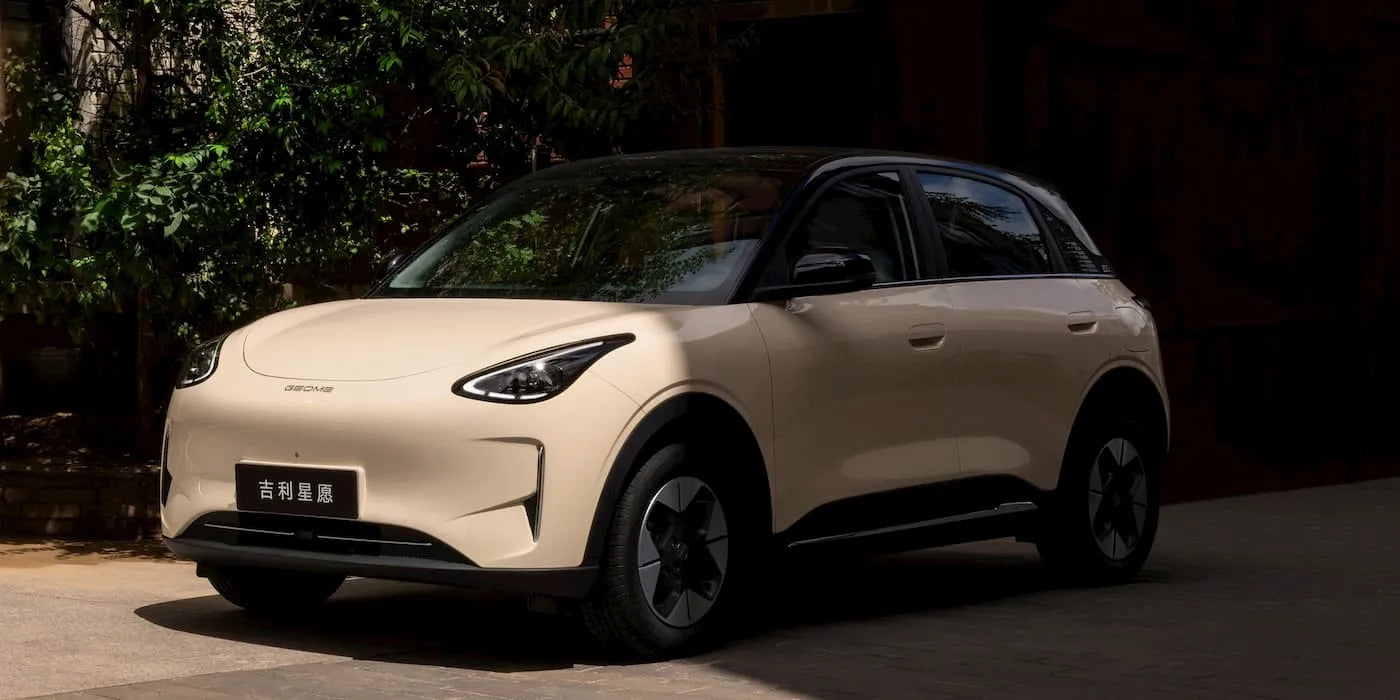
Geely has quietly produced one of the most disruptive electric vehicles in the global market. Its compact electric hatchback, the Geely Xingyuan, is not only selling in massive numbers, but is also outperforming longtime leaders like BYD and Tesla in China—something few thought possible in the affordable EV segment.

A Surprise Sales Leader in China’s EV Market
Since launching in October last year, the Geely Xingyuan has rapidly climbed the sales charts. In the first half of this year, it surpassed both the BYD Seagull and the Tesla Model Y to become China’s best-selling electric vehicle. From January through November alone, Geely delivered nearly 430,000 units, making the Xingyuan the country’s top-selling EV over that period.
This success is especially notable given China’s intensely competitive EV market, where dozens of brands compete on price, technology, and features. The Xingyuan’s rise signals a shift in what buyers now prioritize: value, usability, and smart engineering over brand prestige.
Pricing That Resets Expectations
A major reason for the Xingyuan’s popularity is its aggressive pricing. The 2026 model year starts at approximately $9,700 (68,800 yuan) and tops out around $12,340, placing it squarely in the same bracket as the BYD Seagull.
At this price point, expectations are usually low. Yet the Xingyuan delivers more interior space, higher-quality materials, and more advanced software than many direct competitors. Chinese reviewers frequently note that the cabin feels closer to vehicles costing significantly more.
For buyers who want an EV without financial strain, the Xingyuan hits a sweet spot that few rivals currently match.
Platform and Battery Choices Built for Affordability
The Xingyuan is built on Geely’s Sustainable Experience Architecture-Entry (SEA-E) platform, designed specifically for low-cost electric vehicles. This dedicated EV foundation allows Geely to optimize space, reduce manufacturing complexity, and keep costs down.
Buyers can choose between two CATL lithium iron phosphate (LFP) battery packs:
-
30 kWh, rated at 310 kilometers (192 miles)
-
40 kWh, rated at 410 kilometers (254 miles) on the CLTC cycle
While real-world range is likely lower than official figures, China’s dense charging infrastructure makes shorter-range EVs far more practical. With millions of charging points nationwide, daily usability matters more than headline range numbers.
Charging Infrastructure Changes the Equation
China’s charging ecosystem gives vehicles like the Xingyuan a major advantage. Estimates suggest there are now roughly two chargers for every five cars, with over 16 million connectors installed nationwide.
As charging availability grows, range anxiety has become less of an EV problem and more of an internal combustion issue. Gas stations are slowly disappearing, while EV infrastructure continues expanding—making affordable electric cars increasingly attractive.
Ride, Handling, and Interior Tech
Where the Xingyuan truly differentiates itself is in its mechanical and technological setup. Unlike many budget hatchbacks, it uses rear-wheel drive and independent rear suspension, delivering a more refined ride. Most rivals, including the Seagull, rely on front-wheel drive and simpler torsion-beam rear setups.
Inside, Geely equips the Xingyuan with the Flyme Auto smart cockpit, typically found in higher-end Geely models. Highlights include a 14.1-inch central touchscreen, an 8.8-inch digital instrument cluster, and generous cargo space. With a 375-liter trunk and a 70-liter frunk, total storage rivals that of much larger vehicles.
Where Costs Were Cut
To hit its price target, Geely did make compromises. The Xingyuan lacks rear windshield wipers, automatic front wipers, and automatic climate control. These omissions are noticeable but largely forgiven by buyers given the overall value proposition.
Sales figures suggest that customers see these trade-offs as minor inconveniences rather than dealbreakers.

A New Benchmark for Affordable EVs
In just over a year, Geely has sold more than half a million Xingyuan hatchbacks. It ranked as the world’s third best-selling EV in the first three quarters of the year, trailing only Tesla’s Model Y and Model 3.
If current trends continue, the Xingyuan could soon challenge Tesla’s global sales rankings, especially as demand softens in some overseas markets. More importantly, it proves that affordable EVs can lead the market—not follow it.
Recommend Reading: BYD Dolphin Hits 1 Million Sales, Cementing Its Global EV Success









Share:
Lexus Revives the LFA Nameplate as a Potential Electric Supercar
Tesla Robotaxi Introduces Cleaning Fees for Rider Messes