





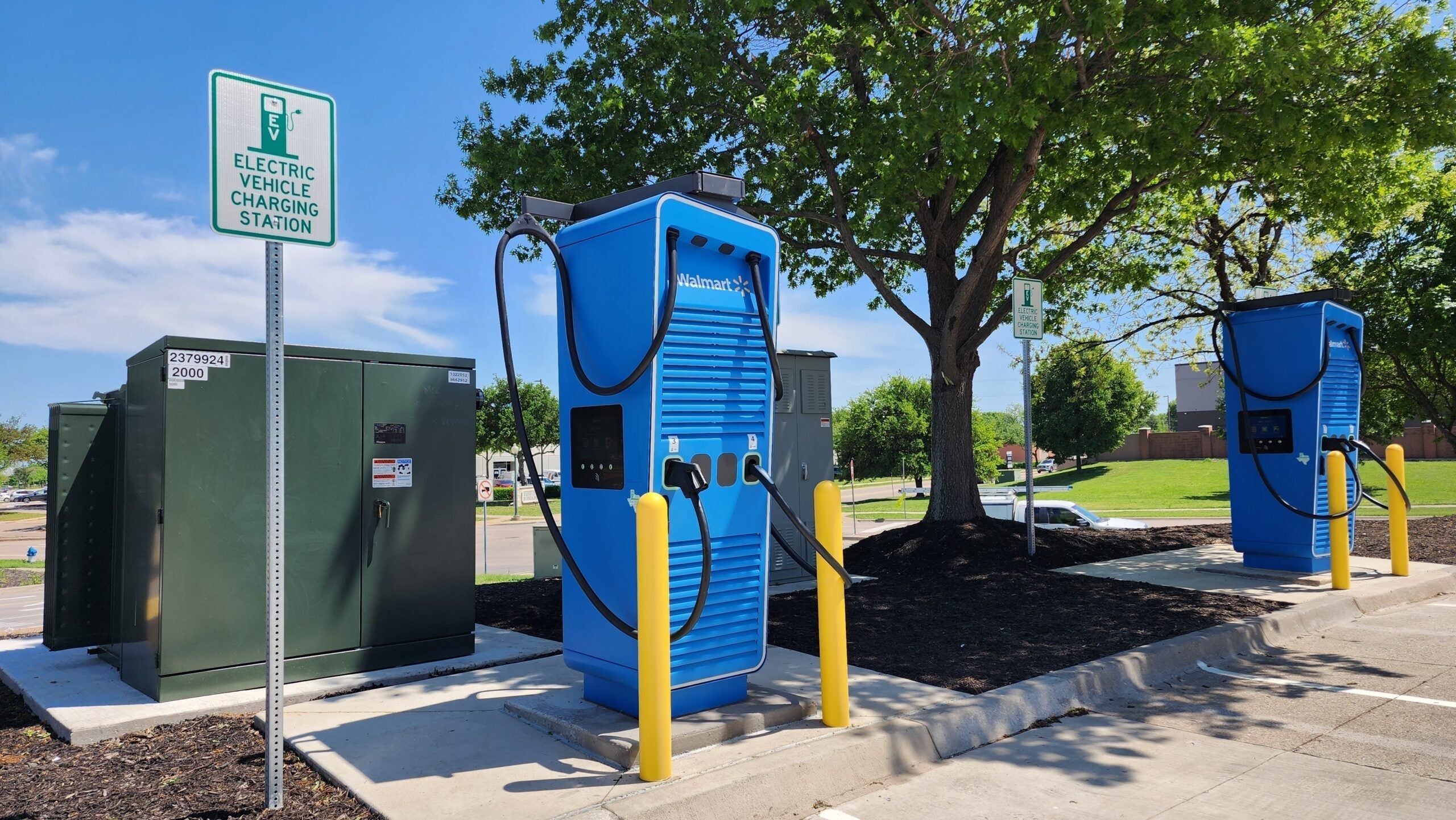
Charging Network Growth Accelerates
Walmart has significantly scaled up its electric vehicle charging footprint in the United States, rapidly increasing the number of high-speed charging points available at its locations. In a relatively short period, the retailer expanded its network by roughly 50%, bringing the total to more than 200 DC fast-charging connectors nationwide.
Data from federal energy tracking sources indicates that Walmart now operates 31 fast-charging sites, marking a notable acceleration compared to its earlier rollout pace. This growth highlights the company’s increasing commitment to supporting EV adoption through accessible charging infrastructure.

High-Power Charging Technology Standardized
One of the defining features of Walmart’s network is its focus on high-performance hardware. All newly installed stations utilize 400 kW DC fast chargers, supplied by manufacturers such as Alpitronic and ABB. This ensures compatibility with next-generation EVs capable of ultra-fast charging.
Each charging unit is equipped with both NACS and CCS1 connectors, allowing a broad range of electric vehicles to plug in without needing adapters. In total, Walmart operates approximately 112 individual charging dispensers, each serving multiple ports to maximize throughput.
This standardized approach simplifies deployment and ensures a consistent charging experience across different regions.
From Slow Start to Rapid Expansion
Walmart’s entry into the EV charging space began in 2023, when the company announced plans to develop its own branded network rather than relying solely on third-party providers. The first locations became operational in early 2025.
Initial progress was modest. By late 2025, the company had only deployed around 10 charging stations. However, momentum picked up quickly. Within just a few months, the network doubled in size, reaching 20 locations, before expanding further to 31 sites today.
This shift suggests that Walmart has moved beyond the pilot phase and is now scaling deployment more aggressively.
Strategic Location Distribution
The company’s charging infrastructure is currently concentrated in several key states. Texas leads with 15 locations, reflecting both high EV adoption potential and Walmart’s strong retail presence in the region.
Other states with multiple installations include Arizona (6 sites) and Florida (3 sites). Additional stations are spread across states such as Oklahoma, Alabama, Arkansas, Georgia, New Jersey, and South Carolina, though in smaller numbers.
By prioritizing areas with strong traffic and growing EV demand, Walmart appears to be targeting locations where fast charging can deliver the most immediate value.
Integration With Existing Charging Ecosystem
It is important to note that Walmart stores have long hosted charging infrastructure operated by third-party providers like Electrify America. However, the company’s decision to build its own network reflects a shift toward greater control over the customer experience.
By operating its own chargers, Walmart can integrate charging services more closely with its retail ecosystem, potentially encouraging longer store visits and increased in-store spending while customers wait for their vehicles to charge.
Pricing and Access Model
Access to Walmart’s charging stations is managed entirely through its mobile application. Unlike many public chargers, these stations do not support direct card payments, meaning drivers must use the app to initiate and pay for charging sessions.
Pricing varies by location, but the average cost is approximately $0.48 per kilowatt-hour. While this is in line with many fast-charging networks, the app-only model may present a barrier for users who prefer more flexible payment options.
Long-Term Expansion Plans
Looking ahead, Walmart has outlined ambitious goals for its charging network. The company previously stated its intention to deploy fast chargers at thousands of locations by 2030, with continued expansion planned beyond that timeframe.
If executed successfully, this strategy could position Walmart as one of the largest retail-based EV charging providers in the country, leveraging its extensive store network to offer convenient charging access at scale.

Market Implications
Walmart’s rapid expansion comes at a time when reliable charging infrastructure remains a critical factor in EV adoption. By investing in high-power chargers and placing them at familiar retail locations, the company is addressing two key concerns for drivers: charging speed and convenience.
However, challenges remain. The lack of alternative payment methods and the need to scale deployment consistently across regions could influence how quickly the network gains widespread adoption.
Still, the pace of recent growth suggests that Walmart is becoming an increasingly important player in the evolving U.S. charging landscape.
Recommend Reading: Walmart to Launch Thousands of EV Charging Stations by 2030











Share:
Tesla Regains Global EV Lead as BYD Sales Decline in Q1
Volkswagen ID. Buzz Self-Driving Vans Begin Testing in Los Angeles